

28
K. Adrjanowicz
where and are kinetic and thermodynamic barriers to crystal growth, respectively. Same like D , is also related to the diffusion coefficient or the viscosity.
The value of the thermodynamic driving force for the growth of crystals can
be replaced by μ, i.e., the difference between chemical potentials of liquid and
crystalline phases [52]. C 1 , C 2 and C 3 are constants.
The nucleation time lag is defined as:
τ # (T, p) =
C 3
σ (T, p)
μ 2 (T, p)
exp
−
D (T, p)
k B T
(3)
where σ is the liquid/crystal interface energy.
Without going much into the details, we draw the reader’s attention to the fact that
abovementioned equations are both composed of the two parts. In each of them, the
first term refers to the thermodynamic factor of crystallization, whereas the second
one to the kinetic factor. Broadly speaking one distinguishes between two effects
governing crystallization: (1) the thermodynamic driving force, “how much the materials want to crystallize”; this depends among other things, on how far the system
below the melting point is, and (2) the kinetic factor: “how quickly can molecules
move/rearrange into the right position to form a critical nucleus and make it grow”.
Both factors have, in fact, the opposite effect on the crystallization kinetics. At p
= const., the exponential terms related to the thermodynamic factor act in such a
way that on decreasing temperature of the melt they are responsible for increasing
nucleation and growth rates (Eqs. 1 and 2). At the same time, the exponential terms
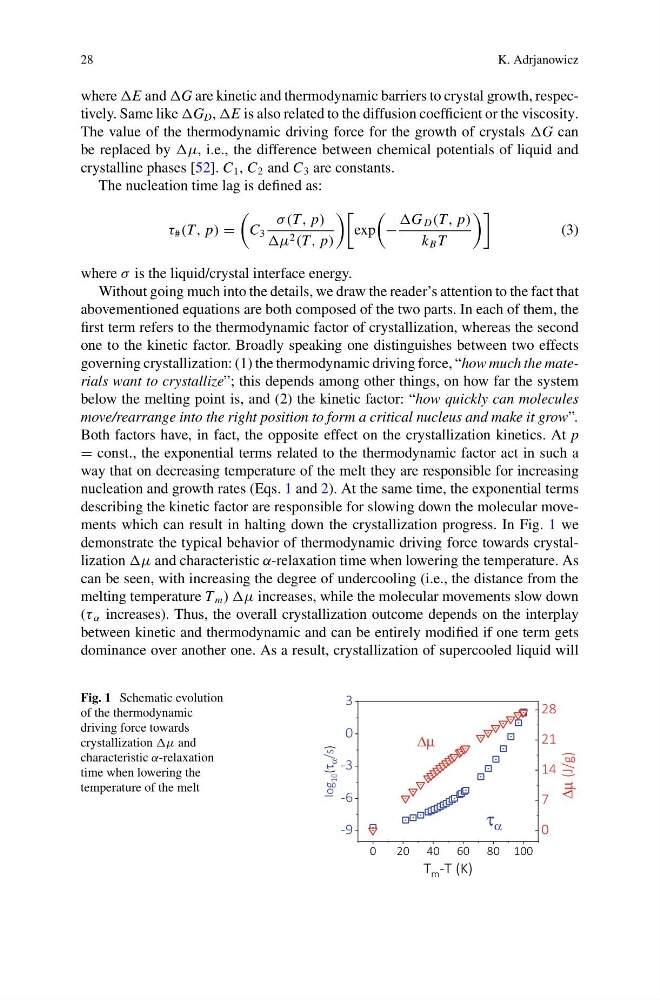
describing the kinetic factor are responsible for slowing down the molecular movements which can result in halting down the crystallization progress. In Fig. 1 we
demonstrate the typical behavior of thermodynamic driving force towards crystallization μ and characteristic α-relaxation time when lowering the temperature. As
can be seen, with increasing the degree of undercooling (i.e., the distance from the
melting temperature T m ) μ increases, while the molecular movements slow down
(τ α increases). Thus, the overall crystallization outcome depends on the interplay
between kinetic and thermodynamic and can be entirely modified if one term gets
dominance over another one. As a result, crystallization of supercooled liquid will
Fig. 1 Schematic evolution
of the thermodynamic
driving force towards
crystallization μ and
characteristic α-relaxation
time when lowering the
temperature of the melt
0
20 40 60 80 100
-9
-6
-3
0
3
log
10 (τ
α /s)
T m -T (K)
0
7
14
21
28
τ α
Δμ (J/g)
Δμ
K. Adrjanowicz
where and are kinetic and thermodynamic barriers to crystal growth, respectively. Same like D , is also related to the diffusion coefficient or the viscosity.
The value of the thermodynamic driving force for the growth of crystals can
be replaced by μ, i.e., the difference between chemical potentials of liquid and
crystalline phases [52]. C 1 , C 2 and C 3 are constants.
The nucleation time lag is defined as:
τ # (T, p) =
C 3
σ (T, p)
μ 2 (T, p)
exp
−
D (T, p)
k B T
(3)
where σ is the liquid/crystal interface energy.
Without going much into the details, we draw the reader’s attention to the fact that
abovementioned equations are both composed of the two parts. In each of them, the
first term refers to the thermodynamic factor of crystallization, whereas the second
one to the kinetic factor. Broadly speaking one distinguishes between two effects
governing crystallization: (1) the thermodynamic driving force, “how much the materials want to crystallize”; this depends among other things, on how far the system
below the melting point is, and (2) the kinetic factor: “how quickly can molecules
move/rearrange into the right position to form a critical nucleus and make it grow”.
Both factors have, in fact, the opposite effect on the crystallization kinetics. At p
= const., the exponential terms related to the thermodynamic factor act in such a
way that on decreasing temperature of the melt they are responsible for increasing
nucleation and growth rates (Eqs. 1 and 2). At the same time, the exponential terms
describing the kinetic factor are responsible for slowing down the molecular movements which can result in halting down the crystallization progress. In Fig. 1 we
demonstrate the typical behavior of thermodynamic driving force towards crystallization μ and characteristic α-relaxation time when lowering the temperature. As
can be seen, with increasing the degree of undercooling (i.e., the distance from the
melting temperature T m ) μ increases, while the molecular movements slow down
(τ α increases). Thus, the overall crystallization outcome depends on the interplay
between kinetic and thermodynamic and can be entirely modified if one term gets
dominance over another one. As a result, crystallization of supercooled liquid will
Fig. 1 Schematic evolution
of the thermodynamic
driving force towards
crystallization μ and
characteristic α-relaxation
time when lowering the
temperature of the melt
0
20 40 60 80 100
-9
-6
-3
0
3
log
10 (τ
α /s)
T m -T (K)
0
7
14
21
28
τ α
Δμ (J/g)
Δμ