

High-Pressure Crystallization of Glass-Forming Liquids …
27
selected combinations of temperature and pressure without taking into account the
relative impact of the fundamental factors governing its progress (molecular mobility
and thermodynamic) at any given (T, p) conditions. On the other hand, one should
also remember that in experimental reality it is not so easy to explore the T-p (T-ρ)
phase diagram. This, in turn, is a major impediment in the case of many commercially
available high-pressure setups.
1.1 General Information About the Crystallization
The crystallization process itself involves two steps: nucleation, i.e., the formation
of a crystal nucleus big enough to grow, and the subsequent growth of the nucleus
into a proper crystal phase. According to the classical theory [43–45] to provide
complete information about the overall crystallization progress of a glass-forming
liquid at any given (T, p) condition it is necessary to describe three basic parameters:
nucleation rate I, crystal growth rate U and the nucleation time lag, τ # . The first
attempt to describe changes in the rates of nucleation and crystal growth caused
by pressure variations were carried out by Turnbull and coworkers [30, 32, 46].
However, that time as due to a limited number of the experimental results a more
elaborate characteristics of the crystallization processes in dependence on pressure
was not possible. Later, as more experimental data showed up, an attempt to provide
a generalized theoretical description of the crystallization process carried out in the
presence of increased pressure was developed by Gutzow et al. [36] and Schmelzer
et al. [33, 34, 47, 48].
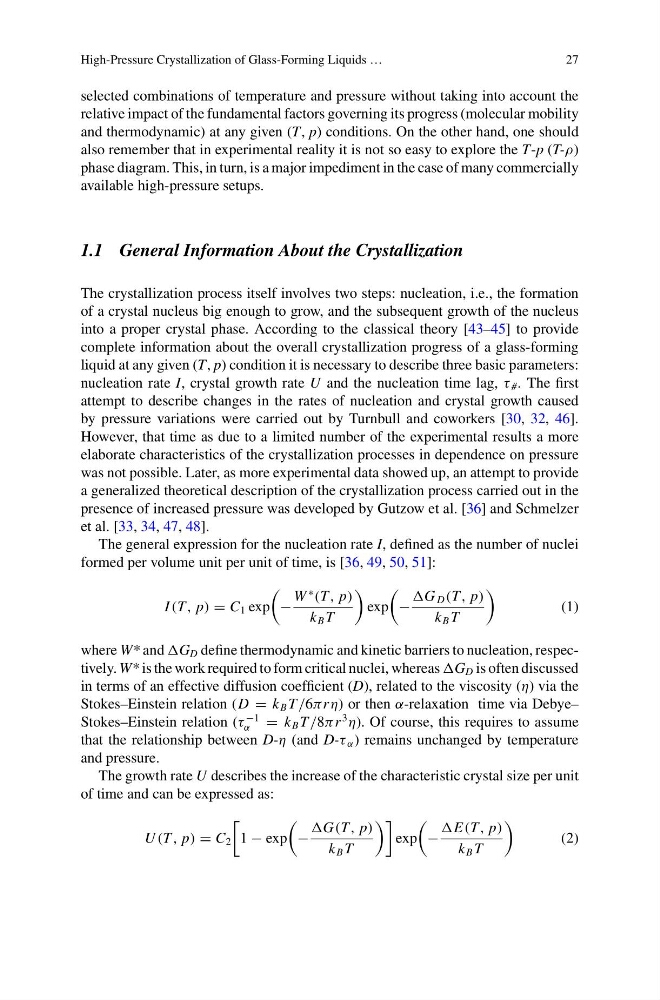
The general expression for the nucleation rate I, defined as the number of nuclei
formed per volume unit per unit of time, is [36, 49, 50, 51]:
I (T, p) = C 1 exp
−
W
∗
(T, p)
k B T
exp
−
G D (T, p)
k B T
(1)
where W* and G D define thermodynamic and kinetic barriers to nucleation, respectively. W* is the work required to form critical nuclei, whereas G D is often discussed
in terms of an effective diffusion coefficient (D), related to the viscosity (η) via the
Stokes–Einstein relation (D = k B T /6πr η) or then α-relaxation time via Debye–
Stokes–Einstein relation (τ
−1
α
= k B T /8πr
3
η). Of course, this requires to assume
that the relationship between D-η (and D-τ α ) remains unchanged by temperature
and pressure.
The growth rate U describes the increase of the characteristic crystal size per unit
of time and can be expressed as:
U (T, p) = C 2
1 − exp
−
G(T, p)
k B T
exp
−
E(T, p)
k B T
(2)
27
selected combinations of temperature and pressure without taking into account the
relative impact of the fundamental factors governing its progress (molecular mobility
and thermodynamic) at any given (T, p) conditions. On the other hand, one should
also remember that in experimental reality it is not so easy to explore the T-p (T-ρ)
phase diagram. This, in turn, is a major impediment in the case of many commercially
available high-pressure setups.
1.1 General Information About the Crystallization
The crystallization process itself involves two steps: nucleation, i.e., the formation
of a crystal nucleus big enough to grow, and the subsequent growth of the nucleus
into a proper crystal phase. According to the classical theory [43–45] to provide
complete information about the overall crystallization progress of a glass-forming
liquid at any given (T, p) condition it is necessary to describe three basic parameters:
nucleation rate I, crystal growth rate U and the nucleation time lag, τ # . The first
attempt to describe changes in the rates of nucleation and crystal growth caused
by pressure variations were carried out by Turnbull and coworkers [30, 32, 46].
However, that time as due to a limited number of the experimental results a more
elaborate characteristics of the crystallization processes in dependence on pressure
was not possible. Later, as more experimental data showed up, an attempt to provide
a generalized theoretical description of the crystallization process carried out in the
presence of increased pressure was developed by Gutzow et al. [36] and Schmelzer
et al. [33, 34, 47, 48].
The general expression for the nucleation rate I, defined as the number of nuclei
formed per volume unit per unit of time, is [36, 49, 50, 51]:
I (T, p) = C 1 exp
−
W
∗
(T, p)
k B T
exp
−
G D (T, p)
k B T
(1)
where W* and G D define thermodynamic and kinetic barriers to nucleation, respectively. W* is the work required to form critical nuclei, whereas G D is often discussed
in terms of an effective diffusion coefficient (D), related to the viscosity (η) via the
Stokes–Einstein relation (D = k B T /6πr η) or then α-relaxation time via Debye–
Stokes–Einstein relation (τ
−1
α
= k B T /8πr
3
η). Of course, this requires to assume
that the relationship between D-η (and D-τ α ) remains unchanged by temperature
and pressure.
The growth rate U describes the increase of the characteristic crystal size per unit
of time and can be expressed as:
U (T, p) = C 2
1 − exp
−
G(T, p)
k B T
exp
−
E(T, p)
k B T
(2)