

Crystallization of Polymers Under 1D Confinement
231
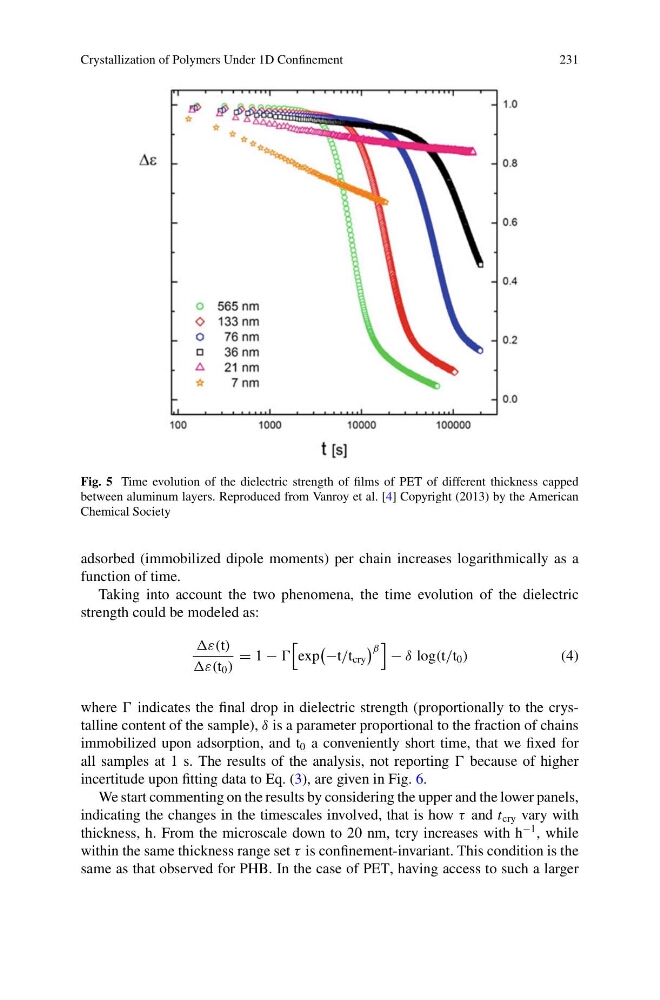
Fig. 5 Time evolution of the dielectric strength of films of PET of different thickness capped
between aluminum layers. Reproduced from Vanroy et al. [4] Copyright (2013) by the American
Chemical Society
adsorbed (immobilized dipole moments) per chain increases logarithmically as a
function of time.
Taking into account the two phenomena, the time evolution of the dielectric
strength could be modeled as:
ε(t)
ε(t 0 )
= 1 −
exp
−t/t cry
β
− δ log(t/t 0 )
(4)
where indicates the final drop in dielectric strength (proportionally to the crystalline content of the sample), δ is a parameter proportional to the fraction of chains
immobilized upon adsorption, and t 0 a conveniently short time, that we fixed for
all samples at 1 s. The results of the analysis, not reporting because of higher
incertitude upon fitting data to Eq. (3), are given in Fig. 6.
We start commenting on the results by considering the upper and the lower panels,
indicating the changes in the timescales involved, that is how τ and t cry vary with
thickness, h. From the microscale down to 20 nm, tcry increases with h
−1 , while
within the same thickness range set τ is confinement-invariant. This condition is the
same as that observed for PHB. In the case of PET, having access to such a larger
231
Fig. 5 Time evolution of the dielectric strength of films of PET of different thickness capped
between aluminum layers. Reproduced from Vanroy et al. [4] Copyright (2013) by the American
Chemical Society
adsorbed (immobilized dipole moments) per chain increases logarithmically as a
function of time.
Taking into account the two phenomena, the time evolution of the dielectric
strength could be modeled as:
ε(t)
ε(t 0 )
= 1 −
exp
−t/t cry
β
− δ log(t/t 0 )
(4)
where indicates the final drop in dielectric strength (proportionally to the crystalline content of the sample), δ is a parameter proportional to the fraction of chains
immobilized upon adsorption, and t 0 a conveniently short time, that we fixed for
all samples at 1 s. The results of the analysis, not reporting because of higher
incertitude upon fitting data to Eq. (3), are given in Fig. 6.
We start commenting on the results by considering the upper and the lower panels,
indicating the changes in the timescales involved, that is how τ and t cry vary with
thickness, h. From the microscale down to 20 nm, tcry increases with h
−1 , while
within the same thickness range set τ is confinement-invariant. This condition is the
same as that observed for PHB. In the case of PET, having access to such a larger