

206
A. Nogales et al.
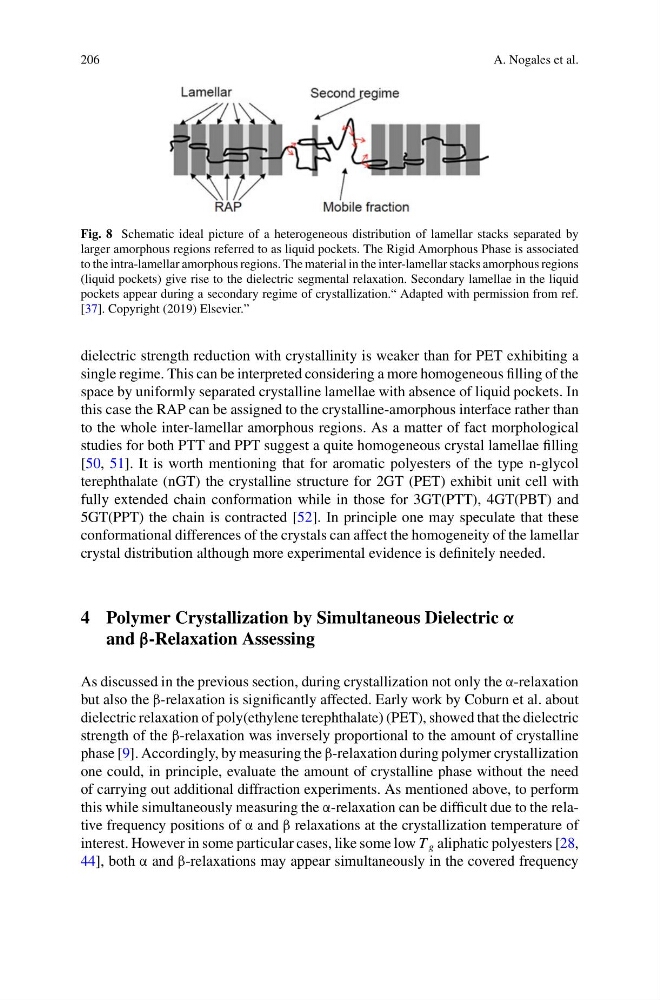
Fig. 8 Schematic ideal picture of a heterogeneous distribution of lamellar stacks separated by
larger amorphous regions referred to as liquid pockets. The Rigid Amorphous Phase is associated
to the intra-lamellar amorphous regions. The material in the inter-lamellar stacks amorphous regions
(liquid pockets) give rise to the dielectric segmental relaxation. Secondary lamellae in the liquid
pockets appear during a secondary regime of crystallization.“ Adapted with permission from ref.
[37]. Copyright (2019) Elsevier.”
dielectric strength reduction with crystallinity is weaker than for PET exhibiting a
single regime. This can be interpreted considering a more homogeneous filling of the
space by uniformly separated crystalline lamellae with absence of liquid pockets. In
this case the RAP can be assigned to the crystalline-amorphous interface rather than
to the whole inter-lamellar amorphous regions. As a matter of fact morphological
studies for both PTT and PPT suggest a quite homogeneous crystal lamellae filling
[50, 51]. It is worth mentioning that for aromatic polyesters of the type n-glycol
terephthalate (nGT) the crystalline structure for 2GT (PET) exhibit unit cell with
fully extended chain conformation while in those for 3GT(PTT), 4GT(PBT) and
5GT(PPT) the chain is contracted [52]. In principle one may speculate that these
conformational differences of the crystals can affect the homogeneity of the lamellar
crystal distribution although more experimental evidence is definitely needed.
4 Polymer Crystallization by Simultaneous Dielectric α
and β-Relaxation Assessing
As discussed in the previous section, during crystallization not only the α-relaxation
but also the β-relaxation is significantly affected. Early work by Coburn et al. about
dielectric relaxation of poly(ethylene terephthalate) (PET), showed that the dielectric
strength of the β-relaxation was inversely proportional to the amount of crystalline
phase [9]. Accordingly, by measuring the β-relaxation during polymer crystallization
one could, in principle, evaluate the amount of crystalline phase without the need
of carrying out additional diffraction experiments. As mentioned above, to perform
this while simultaneously measuring the α-relaxation can be difficult due to the relative frequency positions of α and β relaxations at the crystallization temperature of
interest. However in some particular cases, like some low T g aliphatic polyesters [28,
44], both α and β-relaxations may appear simultaneously in the covered frequency
A. Nogales et al.
Fig. 8 Schematic ideal picture of a heterogeneous distribution of lamellar stacks separated by
larger amorphous regions referred to as liquid pockets. The Rigid Amorphous Phase is associated
to the intra-lamellar amorphous regions. The material in the inter-lamellar stacks amorphous regions
(liquid pockets) give rise to the dielectric segmental relaxation. Secondary lamellae in the liquid
pockets appear during a secondary regime of crystallization.“ Adapted with permission from ref.
[37]. Copyright (2019) Elsevier.”
dielectric strength reduction with crystallinity is weaker than for PET exhibiting a
single regime. This can be interpreted considering a more homogeneous filling of the
space by uniformly separated crystalline lamellae with absence of liquid pockets. In
this case the RAP can be assigned to the crystalline-amorphous interface rather than
to the whole inter-lamellar amorphous regions. As a matter of fact morphological
studies for both PTT and PPT suggest a quite homogeneous crystal lamellae filling
[50, 51]. It is worth mentioning that for aromatic polyesters of the type n-glycol
terephthalate (nGT) the crystalline structure for 2GT (PET) exhibit unit cell with
fully extended chain conformation while in those for 3GT(PTT), 4GT(PBT) and
5GT(PPT) the chain is contracted [52]. In principle one may speculate that these
conformational differences of the crystals can affect the homogeneity of the lamellar
crystal distribution although more experimental evidence is definitely needed.
4 Polymer Crystallization by Simultaneous Dielectric α
and β-Relaxation Assessing
As discussed in the previous section, during crystallization not only the α-relaxation
but also the β-relaxation is significantly affected. Early work by Coburn et al. about
dielectric relaxation of poly(ethylene terephthalate) (PET), showed that the dielectric
strength of the β-relaxation was inversely proportional to the amount of crystalline
phase [9]. Accordingly, by measuring the β-relaxation during polymer crystallization
one could, in principle, evaluate the amount of crystalline phase without the need
of carrying out additional diffraction experiments. As mentioned above, to perform
this while simultaneously measuring the α-relaxation can be difficult due to the relative frequency positions of α and β relaxations at the crystallization temperature of
interest. However in some particular cases, like some low T g aliphatic polyesters [28,
44], both α and β-relaxations may appear simultaneously in the covered frequency