

Order and Dielectric Relaxation During Polymer Crystallization
199
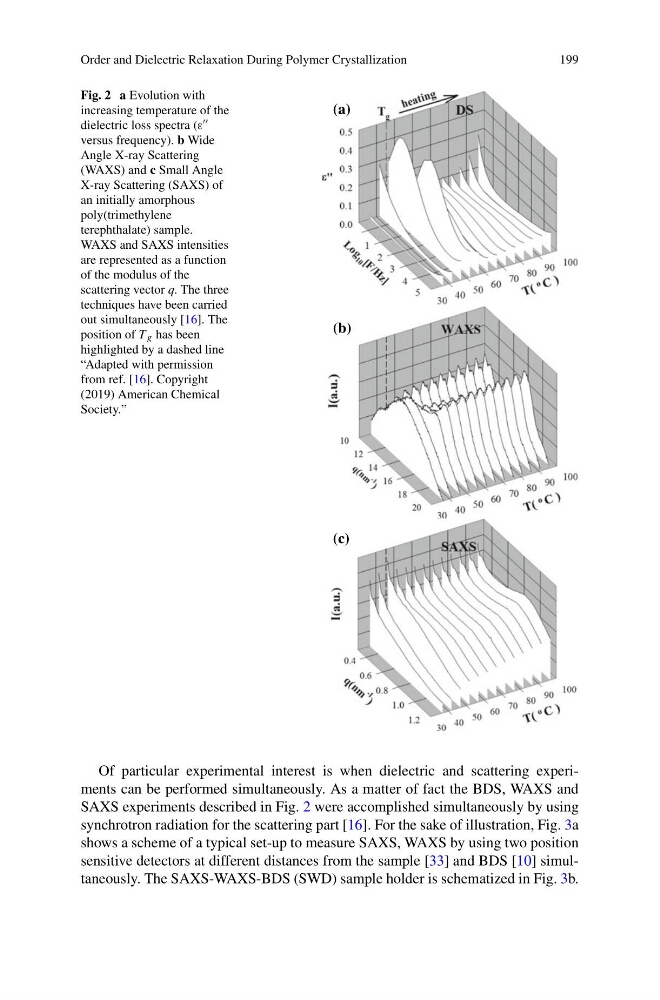
Fig. 2 a Evolution with
increasing temperature of the
dielectric loss spectra (ε
versus frequency). b Wide
Angle X-ray Scattering
(WAXS) and c Small Angle
X-ray Scattering (SAXS) of
an initially amorphous
poly(trimethylene
terephthalate) sample.
WAXS and SAXS intensities
are represented as a function
of the modulus of the
scattering vector q. The three
techniques have been carried
out simultaneously [16]. The
position of T g has been
highlighted by a dashed line
“Adapted with permission
from ref. [16]. Copyright
(2019) American Chemical
Society.”
(a)
(b)
(c)
Of particular experimental interest is when dielectric and scattering experiments can be performed simultaneously. As a matter of fact the BDS, WAXS and
SAXS experiments described in Fig. 2 were accomplished simultaneously by using
synchrotron radiation for the scattering part [16]. For the sake of illustration, Fig. 3a
shows a scheme of a typical set-up to measure SAXS, WAXS by using two position
sensitive detectors at different distances from the sample [33] and BDS [10] simultaneously. The SAXS-WAXS-BDS (SWD) sample holder is schematized in Fig. 3b.
199
Fig. 2 a Evolution with
increasing temperature of the
dielectric loss spectra (ε
versus frequency). b Wide
Angle X-ray Scattering
(WAXS) and c Small Angle
X-ray Scattering (SAXS) of
an initially amorphous
poly(trimethylene
terephthalate) sample.
WAXS and SAXS intensities
are represented as a function
of the modulus of the
scattering vector q. The three
techniques have been carried
out simultaneously [16]. The
position of T g has been
highlighted by a dashed line
“Adapted with permission
from ref. [16]. Copyright
(2019) American Chemical
Society.”
(a)
(b)
(c)
Of particular experimental interest is when dielectric and scattering experiments can be performed simultaneously. As a matter of fact the BDS, WAXS and
SAXS experiments described in Fig. 2 were accomplished simultaneously by using
synchrotron radiation for the scattering part [16]. For the sake of illustration, Fig. 3a
shows a scheme of a typical set-up to measure SAXS, WAXS by using two position
sensitive detectors at different distances from the sample [33] and BDS [10] simultaneously. The SAXS-WAXS-BDS (SWD) sample holder is schematized in Fig. 3b.