

Dynamics of Water in Partially Crystallized Solutions of Glass …
173
heating or cooling. Samples weighing about 10–15 mg were prepared in hermetic
pans. Standard DSC experiments were performed at heating and cooling rates of 5–
10 K/min as indicated in each experiment. Modulated experiments were performed
with a 0.4 K temperature amplitude, 60 s modulation period, and 5 K/min underlying
heating rate. A helium flow rate of 25 mL/min was used all throughout.
2.2 Dielectric Experiments
Broadband dielectric spectroscopy (BDS) is a powerful technique to evaluate the
dielectric properties of aqueous solutions and to assess the molecular dynamics on
various time and length scales. In particular, using the changes in the dielectric
permittivity, BDS can probe phase transformations. During crystallization of water,
the dielectric permittivity decreases from that of liquid water (~80) to that of ice
(~3.2).
To measure the complex dielectric permittivity, ε*(ω) = ε
(ω) – i ε
(ω), we
combined different dielectric techniques to obtain a wide spectral range (0.1 Hz–
20 GHz). For the frequency range from 10
−1 to 10
6 Hz, we used a Novocontrol
Alpha Analyzer. The sample thickness for all measurements was 0.1 mm and the
sample diameter was 30 mm.
To analyze the complex permittivity (ε*), fitting of the imaginary (ε
) component
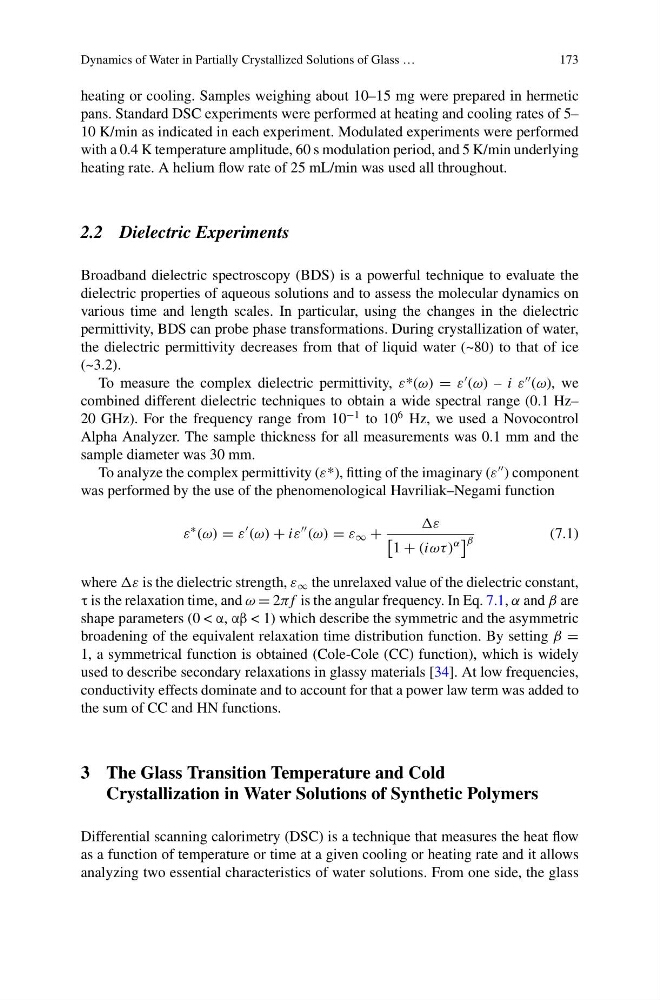
was performed by the use of the phenomenological Havriliak–Negami function
ε
∗
(ω) = ε
(ω) + iε
(ω) = ε ∞ +
ε
1 + (iωτ )
α
β
(7.1)
where ε is the dielectric strength, ε ∞ the unrelaxed value of the dielectric constant,
τ is the relaxation time, and ω = 2π f is the angular frequency. In Eq. 7.1, α and β are
shape parameters (0 < α, αβ < 1) which describe the symmetric and the asymmetric
broadening of the equivalent relaxation time distribution function. By setting β =
1, a symmetrical function is obtained (Cole-Cole (CC) function), which is widely
used to describe secondary relaxations in glassy materials [34]. At low frequencies,
conductivity effects dominate and to account for that a power law term was added to
the sum of CC and HN functions.
3 The Glass Transition Temperature and Cold
Crystallization in Water Solutions of Synthetic Polymers
Differential scanning calorimetry (DSC) is a technique that measures the heat flow
as a function of temperature or time at a given cooling or heating rate and it allows
analyzing two essential characteristics of water solutions. From one side, the glass
173
heating or cooling. Samples weighing about 10–15 mg were prepared in hermetic
pans. Standard DSC experiments were performed at heating and cooling rates of 5–
10 K/min as indicated in each experiment. Modulated experiments were performed
with a 0.4 K temperature amplitude, 60 s modulation period, and 5 K/min underlying
heating rate. A helium flow rate of 25 mL/min was used all throughout.
2.2 Dielectric Experiments
Broadband dielectric spectroscopy (BDS) is a powerful technique to evaluate the
dielectric properties of aqueous solutions and to assess the molecular dynamics on
various time and length scales. In particular, using the changes in the dielectric
permittivity, BDS can probe phase transformations. During crystallization of water,
the dielectric permittivity decreases from that of liquid water (~80) to that of ice
(~3.2).
To measure the complex dielectric permittivity, ε*(ω) = ε
(ω) – i ε
(ω), we
combined different dielectric techniques to obtain a wide spectral range (0.1 Hz–
20 GHz). For the frequency range from 10
−1 to 10
6 Hz, we used a Novocontrol
Alpha Analyzer. The sample thickness for all measurements was 0.1 mm and the
sample diameter was 30 mm.
To analyze the complex permittivity (ε*), fitting of the imaginary (ε
) component
was performed by the use of the phenomenological Havriliak–Negami function
ε
∗
(ω) = ε
(ω) + iε
(ω) = ε ∞ +
ε
1 + (iωτ )
α
β
(7.1)
where ε is the dielectric strength, ε ∞ the unrelaxed value of the dielectric constant,
τ is the relaxation time, and ω = 2π f is the angular frequency. In Eq. 7.1, α and β are
shape parameters (0 < α, αβ < 1) which describe the symmetric and the asymmetric
broadening of the equivalent relaxation time distribution function. By setting β =
1, a symmetrical function is obtained (Cole-Cole (CC) function), which is widely
used to describe secondary relaxations in glassy materials [34]. At low frequencies,
conductivity effects dominate and to account for that a power law term was added to
the sum of CC and HN functions.
3 The Glass Transition Temperature and Cold
Crystallization in Water Solutions of Synthetic Polymers
Differential scanning calorimetry (DSC) is a technique that measures the heat flow
as a function of temperature or time at a given cooling or heating rate and it allows
analyzing two essential characteristics of water solutions. From one side, the glass