

164
K. Adrjanowicz and R. Richert
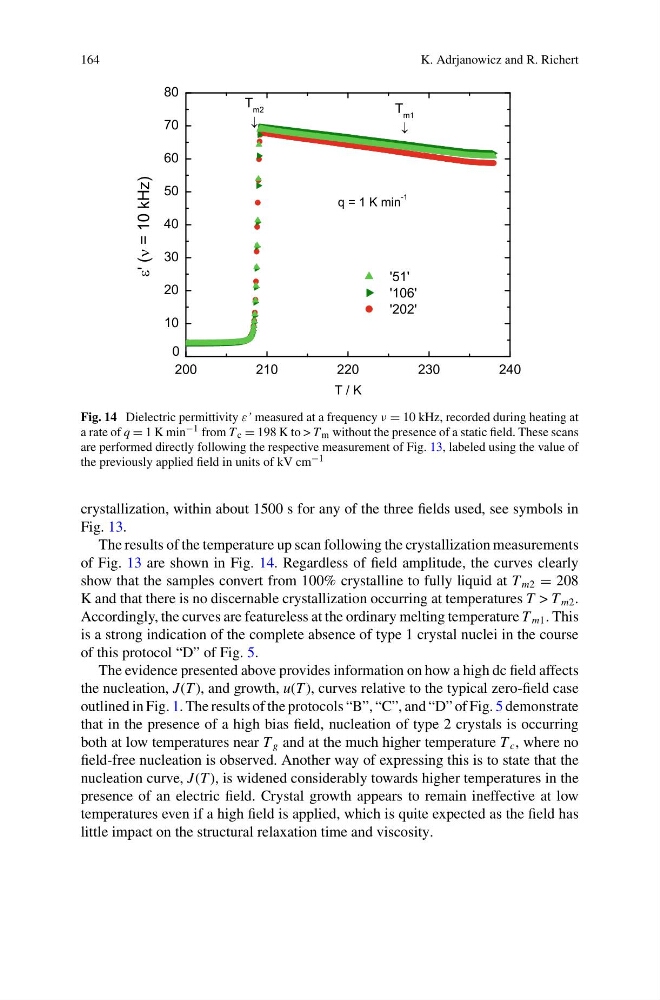
Fig. 14 Dielectric permittivity ε’ measured at a frequency ν = 10 kHz, recorded during heating at
a rate of q = 1 K min −1 from T c = 198 K to > T m without the presence of a static field. These scans
are performed directly following the respective measurement of Fig. 13, labeled using the value of
the previously applied field in units of kV cm −1
crystallization, within about 1500 s for any of the three fields used, see symbols in
Fig. 13.
The results of the temperature up scan following the crystallization measurements
of Fig. 13 are shown in Fig. 14. Regardless of field amplitude, the curves clearly
show that the samples convert from 100% crystalline to fully liquid at T m2 = 208
K and that there is no discernable crystallization occurring at temperatures T > T m2 .
Accordingly, the curves are featureless at the ordinary melting temperature T m1 . This
is a strong indication of the complete absence of type 1 crystal nuclei in the course
of this protocol “D” of Fig. 5.
The evidence presented above provides information on how a high dc field affects
the nucleation, J(T ), and growth, u(T ), curves relative to the typical zero-field case
outlined in Fig. 1. The results of the protocols “B”, “C”, and “D” of Fig. 5 demonstrate
that in the presence of a high bias field, nucleation of type 2 crystals is occurring
both at low temperatures near T g and at the much higher temperature T c , where no
field-free nucleation is observed. Another way of expressing this is to state that the
nucleation curve, J(T ), is widened considerably towards higher temperatures in the
presence of an electric field. Crystal growth appears to remain ineffective at low
temperatures even if a high field is applied, which is quite expected as the field has
little impact on the structural relaxation time and viscosity.
K. Adrjanowicz and R. Richert
Fig. 14 Dielectric permittivity ε’ measured at a frequency ν = 10 kHz, recorded during heating at
a rate of q = 1 K min −1 from T c = 198 K to > T m without the presence of a static field. These scans
are performed directly following the respective measurement of Fig. 13, labeled using the value of
the previously applied field in units of kV cm −1
crystallization, within about 1500 s for any of the three fields used, see symbols in
Fig. 13.
The results of the temperature up scan following the crystallization measurements
of Fig. 13 are shown in Fig. 14. Regardless of field amplitude, the curves clearly
show that the samples convert from 100% crystalline to fully liquid at T m2 = 208
K and that there is no discernable crystallization occurring at temperatures T > T m2 .
Accordingly, the curves are featureless at the ordinary melting temperature T m1 . This
is a strong indication of the complete absence of type 1 crystal nuclei in the course
of this protocol “D” of Fig. 5.
The evidence presented above provides information on how a high dc field affects
the nucleation, J(T ), and growth, u(T ), curves relative to the typical zero-field case
outlined in Fig. 1. The results of the protocols “B”, “C”, and “D” of Fig. 5 demonstrate
that in the presence of a high bias field, nucleation of type 2 crystals is occurring
both at low temperatures near T g and at the much higher temperature T c , where no
field-free nucleation is observed. Another way of expressing this is to state that the
nucleation curve, J(T ), is widened considerably towards higher temperatures in the
presence of an electric field. Crystal growth appears to remain ineffective at low
temperatures even if a high field is applied, which is quite expected as the field has
little impact on the structural relaxation time and viscosity.