

Control of Crystallization Pathways by Electric Fields
153
the present example of Fig. 3, the high-field is assumed to lead to faster crystallization, thus requiring a higher cooling rate to avoid exceeding a certain extent of
crystallization.
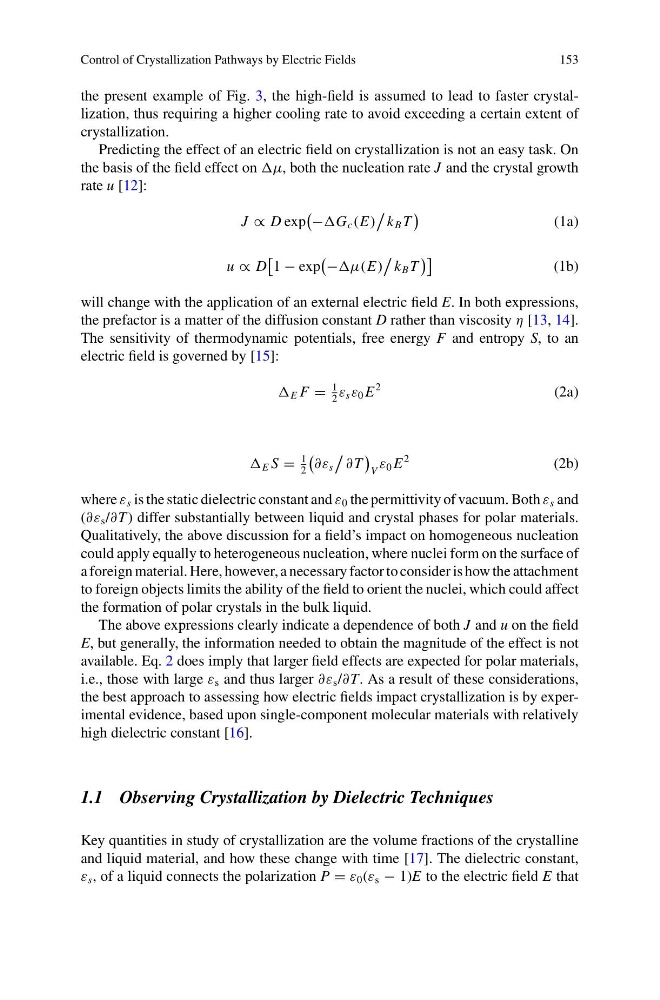
Predicting the effect of an electric field on crystallization is not an easy task. On
the basis of the field effect on μ, both the nucleation rate J and the crystal growth
rate u [12]:
J ∝ D exp
−G c (E)
k B T
(1a)
u ∝ D
1 − exp
−μ(E)
k B T
(1b)
will change with the application of an external electric field E. In both expressions,
the prefactor is a matter of the diffusion constant D rather than viscosity η [13, 14].
The sensitivity of thermodynamic potentials, free energy F and entropy S, to an
electric field is governed by [15]:
E F =
1
2
ε s ε 0 E
2
(2a)
E S =
1
2
∂ε s
∂ T
V
ε 0 E
2
(2b)
where ε s is the static dielectric constant and ε 0 the permittivity of vacuum. Both ε s and
(∂ε s /∂T ) differ substantially between liquid and crystal phases for polar materials.
Qualitatively, the above discussion for a field’s impact on homogeneous nucleation
could apply equally to heterogeneous nucleation, where nuclei form on the surface of
a foreign material. Here, however, a necessary factor to consider is how the attachment
to foreign objects limits the ability of the field to orient the nuclei, which could affect
the formation of polar crystals in the bulk liquid.
The above expressions clearly indicate a dependence of both J and u on the field
E, but generally, the information needed to obtain the magnitude of the effect is not
available. Eq. 2 does imply that larger field effects are expected for polar materials,
i.e., those with large ε s and thus larger ∂ε s /∂T. As a result of these considerations,
the best approach to assessing how electric fields impact crystallization is by experimental evidence, based upon single-component molecular materials with relatively
high dielectric constant [16].
1.1 Observing Crystallization by Dielectric Techniques
Key quantities in study of crystallization are the volume fractions of the crystalline
and liquid material, and how these change with time [17]. The dielectric constant,
ε s , of a liquid connects the polarization P = ε 0 (ε s − 1)E to the electric field E that
153
the present example of Fig. 3, the high-field is assumed to lead to faster crystallization, thus requiring a higher cooling rate to avoid exceeding a certain extent of
crystallization.
Predicting the effect of an electric field on crystallization is not an easy task. On
the basis of the field effect on μ, both the nucleation rate J and the crystal growth
rate u [12]:
J ∝ D exp
−G c (E)
k B T
(1a)
u ∝ D
1 − exp
−μ(E)
k B T
(1b)
will change with the application of an external electric field E. In both expressions,
the prefactor is a matter of the diffusion constant D rather than viscosity η [13, 14].
The sensitivity of thermodynamic potentials, free energy F and entropy S, to an
electric field is governed by [15]:
E F =
1
2
ε s ε 0 E
2
(2a)
E S =
1
2
∂ε s
∂ T
V
ε 0 E
2
(2b)
where ε s is the static dielectric constant and ε 0 the permittivity of vacuum. Both ε s and
(∂ε s /∂T ) differ substantially between liquid and crystal phases for polar materials.
Qualitatively, the above discussion for a field’s impact on homogeneous nucleation
could apply equally to heterogeneous nucleation, where nuclei form on the surface of
a foreign material. Here, however, a necessary factor to consider is how the attachment
to foreign objects limits the ability of the field to orient the nuclei, which could affect
the formation of polar crystals in the bulk liquid.
The above expressions clearly indicate a dependence of both J and u on the field
E, but generally, the information needed to obtain the magnitude of the effect is not
available. Eq. 2 does imply that larger field effects are expected for polar materials,
i.e., those with large ε s and thus larger ∂ε s /∂T. As a result of these considerations,
the best approach to assessing how electric fields impact crystallization is by experimental evidence, based upon single-component molecular materials with relatively
high dielectric constant [16].
1.1 Observing Crystallization by Dielectric Techniques
Key quantities in study of crystallization are the volume fractions of the crystalline
and liquid material, and how these change with time [17]. The dielectric constant,
ε s , of a liquid connects the polarization P = ε 0 (ε s − 1)E to the electric field E that