

Control of Crystallization Pathways by Electric Fields
151
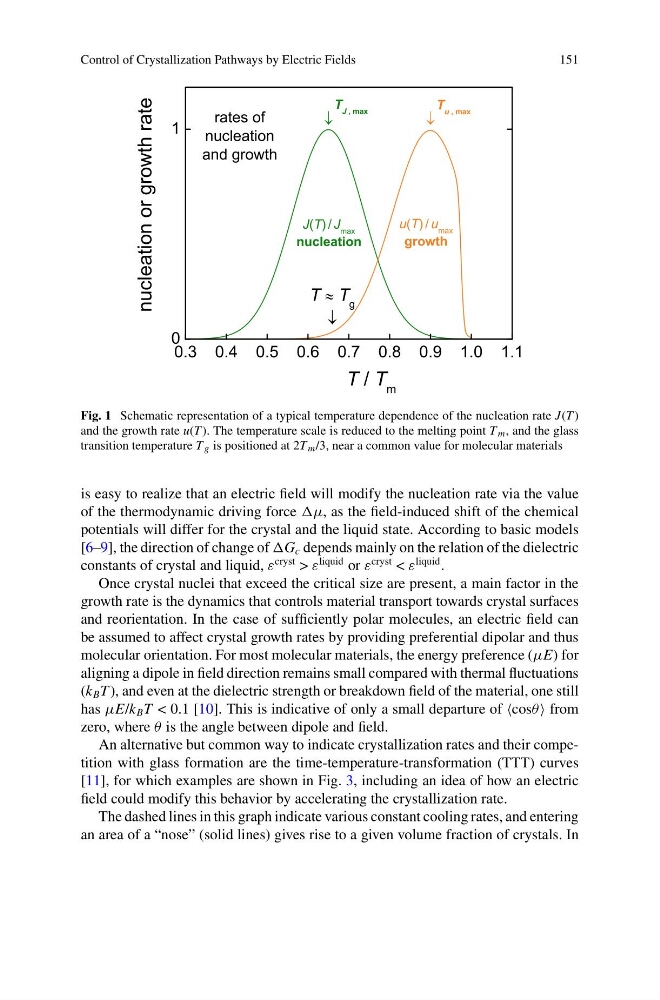
Fig. 1 Schematic representation of a typical temperature dependence of the nucleation rate J(T )
and the growth rate u(T ). The temperature scale is reduced to the melting point T m , and the glass
transition temperature T g is positioned at 2T m /3, near a common value for molecular materials
is easy to realize that an electric field will modify the nucleation rate via the value
of the thermodynamic driving force μ, as the field-induced shift of the chemical
potentials will differ for the crystal and the liquid state. According to basic models
[6–9], the direction of change of c depends mainly on the relation of the dielectric
constants of crystal and liquid, ε
cryst > ε
liquid or ε
cryst < ε
liquid .
Once crystal nuclei that exceed the critical size are present, a main factor in the
growth rate is the dynamics that controls material transport towards crystal surfaces
and reorientation. In the case of sufficiently polar molecules, an electric field can
be assumed to affect crystal growth rates by providing preferential dipolar and thus
molecular orientation. For most molecular materials, the energy preference (μE) for
aligning a dipole in field direction remains small compared with thermal fluctuations
(k B T ), and even at the dielectric strength or breakdown field of the material, one still
has μE/k B T < 0.1 [10]. This is indicative of only a small departure of cosθ from
zero, where θ is the angle between dipole and field.
An alternative but common way to indicate crystallization rates and their competition with glass formation are the time-temperature-transformation (TTT) curves
[11], for which examples are shown in Fig. 3, including an idea of how an electric
field could modify this behavior by accelerating the crystallization rate.
The dashed lines in this graph indicate various constant cooling rates, and entering
an area of a “nose” (solid lines) gives rise to a given volume fraction of crystals. In
151
Fig. 1 Schematic representation of a typical temperature dependence of the nucleation rate J(T )
and the growth rate u(T ). The temperature scale is reduced to the melting point T m , and the glass
transition temperature T g is positioned at 2T m /3, near a common value for molecular materials
is easy to realize that an electric field will modify the nucleation rate via the value
of the thermodynamic driving force μ, as the field-induced shift of the chemical
potentials will differ for the crystal and the liquid state. According to basic models
[6–9], the direction of change of c depends mainly on the relation of the dielectric
constants of crystal and liquid, ε
cryst > ε
liquid or ε
cryst < ε
liquid .
Once crystal nuclei that exceed the critical size are present, a main factor in the
growth rate is the dynamics that controls material transport towards crystal surfaces
and reorientation. In the case of sufficiently polar molecules, an electric field can
be assumed to affect crystal growth rates by providing preferential dipolar and thus
molecular orientation. For most molecular materials, the energy preference (μE) for
aligning a dipole in field direction remains small compared with thermal fluctuations
(k B T ), and even at the dielectric strength or breakdown field of the material, one still
has μE/k B T < 0.1 [10]. This is indicative of only a small departure of cosθ from
zero, where θ is the angle between dipole and field.
An alternative but common way to indicate crystallization rates and their competition with glass formation are the time-temperature-transformation (TTT) curves
[11], for which examples are shown in Fig. 3, including an idea of how an electric
field could modify this behavior by accelerating the crystallization rate.
The dashed lines in this graph indicate various constant cooling rates, and entering
an area of a “nose” (solid lines) gives rise to a given volume fraction of crystals. In