

Isothermal and Non-isothermal Crystallization in Liquid Crystals …
121
liquid crystals for chiral isooctyloxycyanobiphenyl [14]. Further studies on crystallization phenomena in LCs suggest that they may be dependent on the thermal history
of the sample and the structure of the initial phase [15–19].
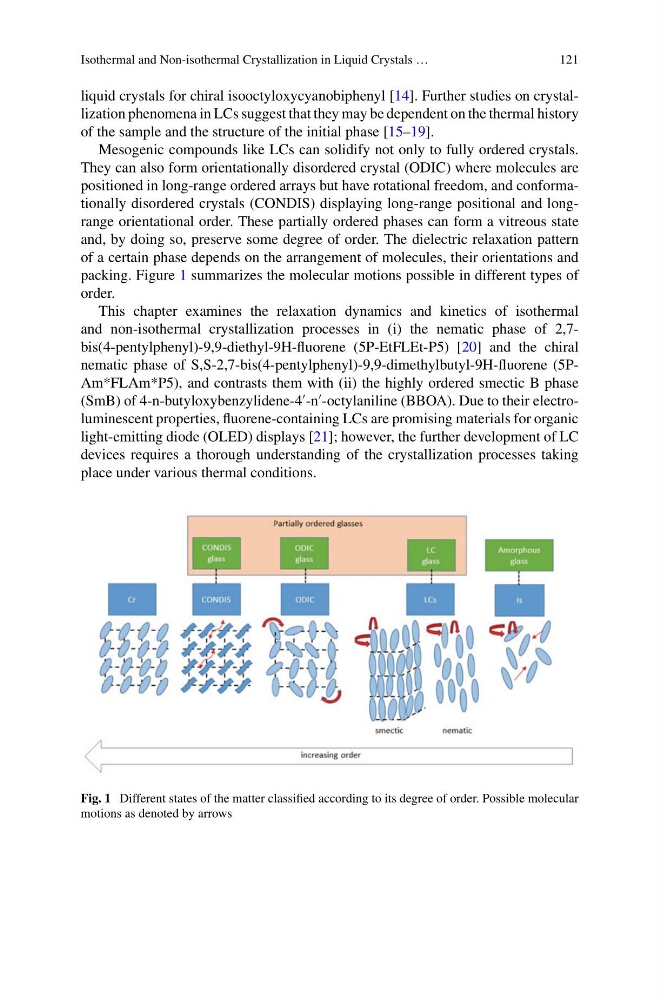
Mesogenic compounds like LCs can solidify not only to fully ordered crystals.
They can also form orientationally disordered crystal (ODIC) where molecules are
positioned in long-range ordered arrays but have rotational freedom, and conformationally disordered crystals (CONDIS) displaying long-range positional and longrange orientational order. These partially ordered phases can form a vitreous state
and, by doing so, preserve some degree of order. The dielectric relaxation pattern
of a certain phase depends on the arrangement of molecules, their orientations and
packing. Figure 1 summarizes the molecular motions possible in different types of
order.
This chapter examines the relaxation dynamics and kinetics of isothermal
and non-isothermal crystallization processes in (i) the nematic phase of 2,7bis(4-pentylphenyl)-9,9-diethyl-9H-fluorene (5P-EtFLEt-P5) [20] and the chiral
nematic phase of S,S-2,7-bis(4-pentylphenyl)-9,9-dimethylbutyl-9H-fluorene (5PAm*FLAm*P5), and contrasts them with (ii) the highly ordered smectic B phase
(SmB) of 4-n-butyloxybenzylidene-4
-n
-octylaniline (BBOA). Due to their electroluminescent properties, fluorene-containing LCs are promising materials for organic
light-emitting diode (OLED) displays [21]; however, the further development of LC
devices requires a thorough understanding of the crystallization processes taking
place under various thermal conditions.
Fig. 1 Different states of the matter classified according to its degree of order. Possible molecular
motions as denoted by arrows
121
liquid crystals for chiral isooctyloxycyanobiphenyl [14]. Further studies on crystallization phenomena in LCs suggest that they may be dependent on the thermal history
of the sample and the structure of the initial phase [15–19].
Mesogenic compounds like LCs can solidify not only to fully ordered crystals.
They can also form orientationally disordered crystal (ODIC) where molecules are
positioned in long-range ordered arrays but have rotational freedom, and conformationally disordered crystals (CONDIS) displaying long-range positional and longrange orientational order. These partially ordered phases can form a vitreous state
and, by doing so, preserve some degree of order. The dielectric relaxation pattern
of a certain phase depends on the arrangement of molecules, their orientations and
packing. Figure 1 summarizes the molecular motions possible in different types of
order.
This chapter examines the relaxation dynamics and kinetics of isothermal
and non-isothermal crystallization processes in (i) the nematic phase of 2,7bis(4-pentylphenyl)-9,9-diethyl-9H-fluorene (5P-EtFLEt-P5) [20] and the chiral
nematic phase of S,S-2,7-bis(4-pentylphenyl)-9,9-dimethylbutyl-9H-fluorene (5PAm*FLAm*P5), and contrasts them with (ii) the highly ordered smectic B phase
(SmB) of 4-n-butyloxybenzylidene-4
-n
-octylaniline (BBOA). Due to their electroluminescent properties, fluorene-containing LCs are promising materials for organic
light-emitting diode (OLED) displays [21]; however, the further development of LC
devices requires a thorough understanding of the crystallization processes taking
place under various thermal conditions.
Fig. 1 Different states of the matter classified according to its degree of order. Possible molecular
motions as denoted by arrows