

80
K. K. Leelamma
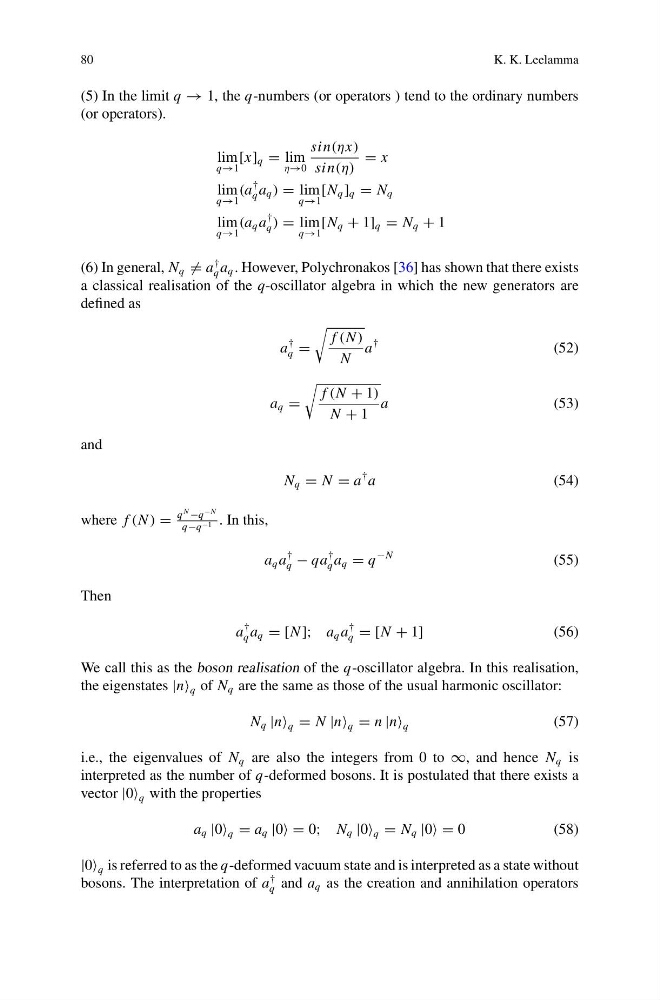
(5) In the limit q → 1, the q-numbers (or operators ) tend to the ordinary numbers
(or operators).
lim
q→1
[x] q = lim
η→0
sin(ηx)
sin(η)
= x
lim
q→1
(a
†
q a q ) = lim
q→1
[N q ] q = N q
lim
q→1
(a q a
†
q ) = lim
q→1
[N q + 1] q = N q + 1
(6) In general, N q = a
†
q a q . However, Polychronakos [36] has shown that there exists
a classical realisation of the q-oscillator algebra in which the new generators are
defined as
a
†
q =
f (N )
N
a
†
(52)
a q =
f (N + 1)
N + 1
a
(53)
and
N q = N = a
† a
(54)
where f (N ) =
q
N −q
−N
q−q −1 . In this,
a q a
†
q − qa
†
q a q = q
−N
(55)
Then
a
†
q a q = [N ]; a q a
†
q = [N + 1]
(56)
We call this as the boson realisation of the q-oscillator algebra. In this realisation,
the eigenstates |n q of N q are the same as those of the usual harmonic oscillator:
N q |n q = N |n q = n |n q
(57)
i.e., the eigenvalues of N q are also the integers from 0 to ∞, and hence N q is
interpreted as the number of q-deformed bosons. It is postulated that there exists a
vector |0 q with the properties
a q |0 q = a q |0 = 0; N q |0 q = N q |0 = 0
(58)
|0 q is referred to as the q-deformed vacuum state and is interpreted as a state without
bosons. The interpretation of a
†
q and a q as the creation and annihilation operators
K. K. Leelamma
(5) In the limit q → 1, the q-numbers (or operators ) tend to the ordinary numbers
(or operators).
lim
q→1
[x] q = lim
η→0
sin(ηx)
sin(η)
= x
lim
q→1
(a
†
q a q ) = lim
q→1
[N q ] q = N q
lim
q→1
(a q a
†
q ) = lim
q→1
[N q + 1] q = N q + 1
(6) In general, N q = a
†
q a q . However, Polychronakos [36] has shown that there exists
a classical realisation of the q-oscillator algebra in which the new generators are
defined as
a
†
q =
f (N )
N
a
†
(52)
a q =
f (N + 1)
N + 1
a
(53)
and
N q = N = a
† a
(54)
where f (N ) =
q
N −q
−N
q−q −1 . In this,
a q a
†
q − qa
†
q a q = q
−N
(55)
Then
a
†
q a q = [N ]; a q a
†
q = [N + 1]
(56)
We call this as the boson realisation of the q-oscillator algebra. In this realisation,
the eigenstates |n q of N q are the same as those of the usual harmonic oscillator:
N q |n q = N |n q = n |n q
(57)
i.e., the eigenvalues of N q are also the integers from 0 to ∞, and hence N q is
interpreted as the number of q-deformed bosons. It is postulated that there exists a
vector |0 q with the properties
a q |0 q = a q |0 = 0; N q |0 q = N q |0 = 0
(58)
|0 q is referred to as the q-deformed vacuum state and is interpreted as a state without
bosons. The interpretation of a
†
q and a q as the creation and annihilation operators