

q-Oscillators and a q-deformed Debye Model for Lattice Heat Capacity
79
These generators satisfy the su q (2) algebra (33).
1.4.1 Properties of q-Boson Operators
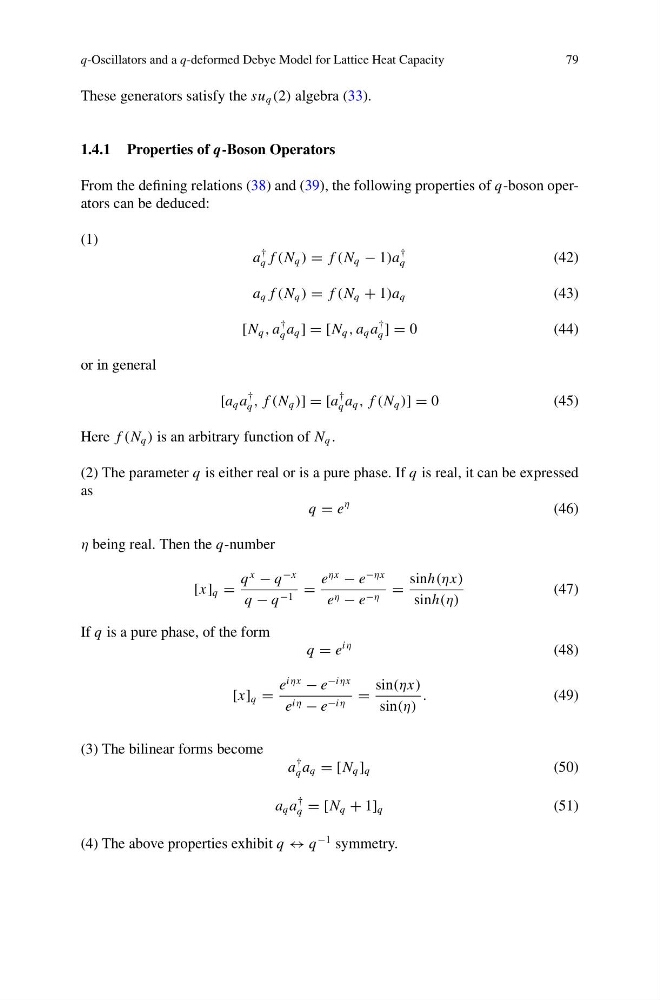
From the defining relations (38) and (39), the following properties of q-boson operators can be deduced:
(1)
a
†
q f (N q ) = f (N q − 1)a
†
q
(42)
a q f (N q ) = f (N q + 1)a q
(43)
[N q , a
†
q a q ] = [N q , a q a
†
q ] = 0
( 4 4 )
or in general
[a q a
†
q , f (N q )] = [a
†
q a q , f (N q )] = 0
(45)
Here f (N q ) is an arbitrary function of N q .
(2) The parameter q is either real or is a pure phase. If q is real, it can be expressed
as
q = e
η
(46)
η being real. Then the q-number
[x] q =
q
x
− q
−x
q − q −1 =
e
ηx
− e
−ηx
e η − e −η =
sinh(ηx)
sinh(η)
(47)
If q is a pure phase, of the form
q = e
iη
(48)
[x] q =
e
iηx
− e
−iηx
e iη − e −iη =
sin(ηx)
sin(η)
.
(49)
(3) The bilinear forms become
a
†
q a q = [N q ] q
(50)
a q a
†
q = [N q + 1] q
(51)
(4) The above properties exhibit q ↔ q
−1 symmetry.
79
These generators satisfy the su q (2) algebra (33).
1.4.1 Properties of q-Boson Operators
From the defining relations (38) and (39), the following properties of q-boson operators can be deduced:
(1)
a
†
q f (N q ) = f (N q − 1)a
†
q
(42)
a q f (N q ) = f (N q + 1)a q
(43)
[N q , a
†
q a q ] = [N q , a q a
†
q ] = 0
( 4 4 )
or in general
[a q a
†
q , f (N q )] = [a
†
q a q , f (N q )] = 0
(45)
Here f (N q ) is an arbitrary function of N q .
(2) The parameter q is either real or is a pure phase. If q is real, it can be expressed
as
q = e
η
(46)
η being real. Then the q-number
[x] q =
q
x
− q
−x
q − q −1 =
e
ηx
− e
−ηx
e η − e −η =
sinh(ηx)
sinh(η)
(47)
If q is a pure phase, of the form
q = e
iη
(48)
[x] q =
e
iηx
− e
−iηx
e iη − e −iη =
sin(ηx)
sin(η)
.
(49)
(3) The bilinear forms become
a
†
q a q = [N q ] q
(50)
a q a
†
q = [N q + 1] q
(51)
(4) The above properties exhibit q ↔ q
−1 symmetry.