

46
K. P. Satheesh
As usual Hamiltonian is constructed by the Legendre transform of the Lagrangian
H (π, φ) =
d
d x[π ˙
φ − L] =
1
2
d
d x[π
2
− ∇
2
φ + m
2
φ
2
].
Conventionally, the system can be quantized by treating fields as operators and prescribing an appropriate algebra. This is done by choosing foliation of the space-time
into space-like hypersurfaces keeping time fixed and using equal time commutation relations. It is interesting to note that, in general, in non-Minkowskian spacetime this foliation possesses some difficulties which has also been circumvented in
Schrödinger picture formalism.
3 Basic Formalism
In the Schrödinger picture approach, we take the basis vectors of the state vector
space to be the eigenstates of the field operator φ(x) on a fixed time hypersurface with
eigenvalue ψ( ¯
x). The quantum mechanical state |ψ(t) is replaced by a functional
of the c-number field
|ψ(t) −→ [φ, t].
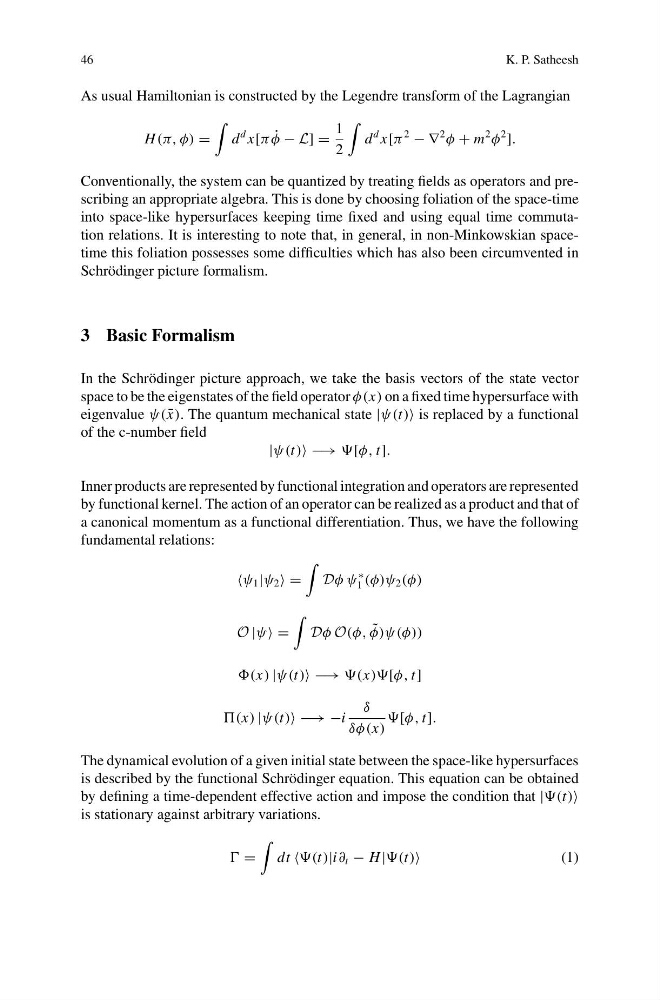
Inner products are represented by functional integration and operators are represented
by functional kernel. The action of an operator can be realized as a product and that of
a canonical momentum as a functional differentiation. Thus, we have the following
fundamental relations:
ψ 1 |ψ 2 =
Dφ ψ
∗
1 (φ)ψ 2 (φ)
O |ψ =
Dφ O(φ, ˜
φ)ψ(φ))
(x) |ψ(t) −→ (x))[φ, t]
(x) |ψ(t) −→ −i
δ
δφ(x)
[φ, t].
The dynamical evolution of a given initial state between the space-like hypersurfaces
is described by the functional Schrödinger equation. This equation can be obtained
by defining a time-dependent effective action and impose the condition that |(t)
is stationary against arbitrary variations.
=
dt (t)|i∂ t − H |(t)
(1)
K. P. Satheesh
As usual Hamiltonian is constructed by the Legendre transform of the Lagrangian
H (π, φ) =
d
d x[π ˙
φ − L] =
1
2
d
d x[π
2
− ∇
2
φ + m
2
φ
2
].
Conventionally, the system can be quantized by treating fields as operators and prescribing an appropriate algebra. This is done by choosing foliation of the space-time
into space-like hypersurfaces keeping time fixed and using equal time commutation relations. It is interesting to note that, in general, in non-Minkowskian spacetime this foliation possesses some difficulties which has also been circumvented in
Schrödinger picture formalism.
3 Basic Formalism
In the Schrödinger picture approach, we take the basis vectors of the state vector
space to be the eigenstates of the field operator φ(x) on a fixed time hypersurface with
eigenvalue ψ( ¯
x). The quantum mechanical state |ψ(t) is replaced by a functional
of the c-number field
|ψ(t) −→ [φ, t].
Inner products are represented by functional integration and operators are represented
by functional kernel. The action of an operator can be realized as a product and that of
a canonical momentum as a functional differentiation. Thus, we have the following
fundamental relations:
ψ 1 |ψ 2 =
Dφ ψ
∗
1 (φ)ψ 2 (φ)
O |ψ =
Dφ O(φ, ˜
φ)ψ(φ))
(x) |ψ(t) −→ (x))[φ, t]
(x) |ψ(t) −→ −i
δ
δφ(x)
[φ, t].
The dynamical evolution of a given initial state between the space-like hypersurfaces
is described by the functional Schrödinger equation. This equation can be obtained
by defining a time-dependent effective action and impose the condition that |(t)
is stationary against arbitrary variations.
=
dt (t)|i∂ t − H |(t)
(1)