

Dynamics of Nonlinear Systems: Integrable and Chaotic Solutions
179
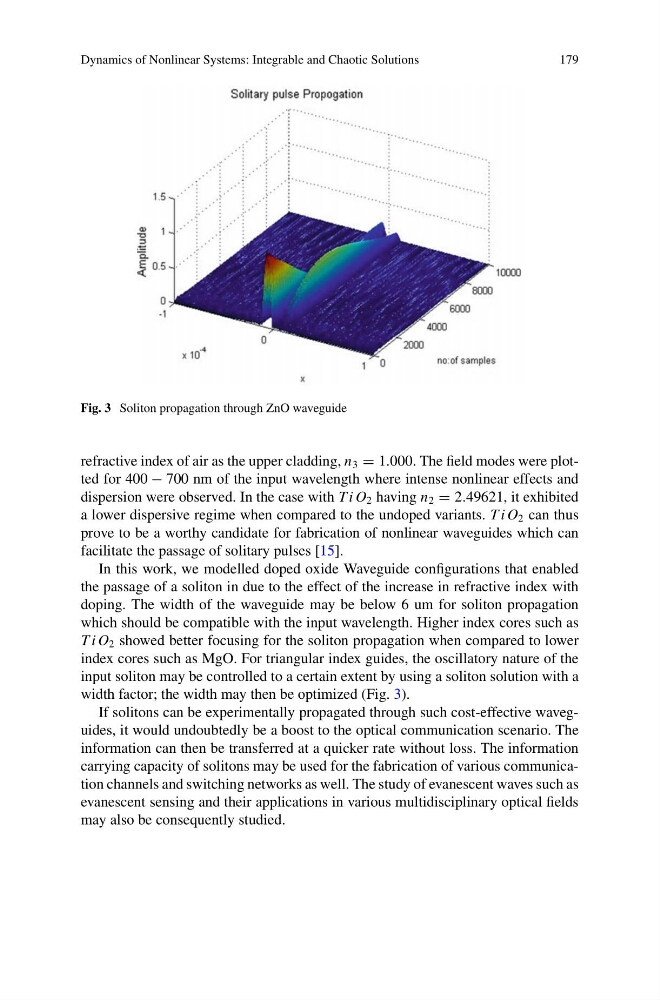
Fig. 3 Soliton propagation through ZnO waveguide
refractive index of air as the upper cladding, n 3 = 1.000. The field modes were plotted for 400 − 700 nm of the input wavelength where intense nonlinear effects and
dispersion were observed. In the case with T i O 2 having n 2 = 2.49621, it exhibited
a lower dispersive regime when compared to the undoped variants. T i O 2 can thus
prove to be a worthy candidate for fabrication of nonlinear waveguides which can
facilitate the passage of solitary pulses [15].
In this work, we modelled doped oxide Waveguide configurations that enabled
the passage of a soliton in due to the effect of the increase in refractive index with
doping. The width of the waveguide may be below 6 um for soliton propagation
which should be compatible with the input wavelength. Higher index cores such as
T i O 2 showed better focusing for the soliton propagation when compared to lower
index cores such as MgO. For triangular index guides, the oscillatory nature of the
input soliton may be controlled to a certain extent by using a soliton solution with a
width factor; the width may then be optimized (Fig. 3).
If solitons can be experimentally propagated through such cost-effective waveguides, it would undoubtedly be a boost to the optical communication scenario. The
information can then be transferred at a quicker rate without loss. The information
carrying capacity of solitons may be used for the fabrication of various communication channels and switching networks as well. The study of evanescent waves such as
evanescent sensing and their applications in various multidisciplinary optical fields
may also be consequently studied.
179
Fig. 3 Soliton propagation through ZnO waveguide
refractive index of air as the upper cladding, n 3 = 1.000. The field modes were plotted for 400 − 700 nm of the input wavelength where intense nonlinear effects and
dispersion were observed. In the case with T i O 2 having n 2 = 2.49621, it exhibited
a lower dispersive regime when compared to the undoped variants. T i O 2 can thus
prove to be a worthy candidate for fabrication of nonlinear waveguides which can
facilitate the passage of solitary pulses [15].
In this work, we modelled doped oxide Waveguide configurations that enabled
the passage of a soliton in due to the effect of the increase in refractive index with
doping. The width of the waveguide may be below 6 um for soliton propagation
which should be compatible with the input wavelength. Higher index cores such as
T i O 2 showed better focusing for the soliton propagation when compared to lower
index cores such as MgO. For triangular index guides, the oscillatory nature of the
input soliton may be controlled to a certain extent by using a soliton solution with a
width factor; the width may then be optimized (Fig. 3).
If solitons can be experimentally propagated through such cost-effective waveguides, it would undoubtedly be a boost to the optical communication scenario. The
information can then be transferred at a quicker rate without loss. The information
carrying capacity of solitons may be used for the fabrication of various communication channels and switching networks as well. The study of evanescent waves such as
evanescent sensing and their applications in various multidisciplinary optical fields
may also be consequently studied.