

178
K. S. Sreelatha
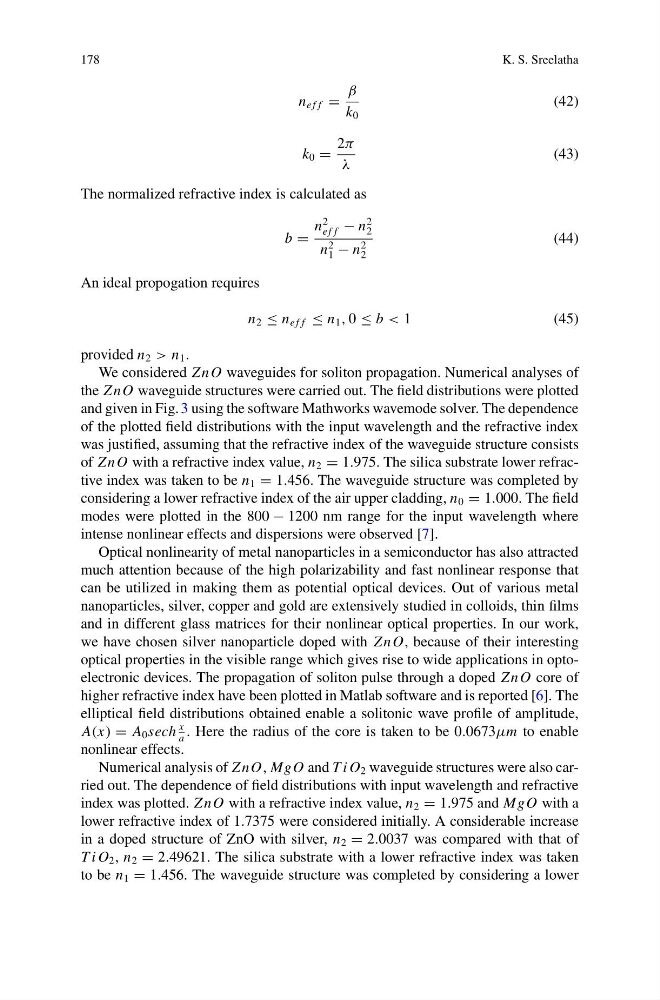
n e f f =
β
k 0
(42)
k 0 =
2π
λ
(43)
The normalized refractive index is calculated as
b =
n
2
e f f − n
2
2
n
2
1 − n
2
2
(44)
An ideal propogation requires
n 2 ≤ n e f f ≤ n 1 , 0 ≤ b < 1
(45)
provided n 2 > n 1 .
We considered ZnO waveguides for soliton propagation. Numerical analyses of
the ZnO waveguide structures were carried out. The field distributions were plotted
and given in Fig. 3 using the software Mathworks wavemode solver. The dependence
of the plotted field distributions with the input wavelength and the refractive index
was justified, assuming that the refractive index of the waveguide structure consists
of ZnO with a refractive index value, n 2 = 1.975. The silica substrate lower refractive index was taken to be n 1 = 1.456. The waveguide structure was completed by
considering a lower refractive index of the air upper cladding, n 0 = 1.000. The field
modes were plotted in the 800 − 1200 nm range for the input wavelength where
intense nonlinear effects and dispersions were observed [7].
Optical nonlinearity of metal nanoparticles in a semiconductor has also attracted
much attention because of the high polarizability and fast nonlinear response that
can be utilized in making them as potential optical devices. Out of various metal
nanoparticles, silver, copper and gold are extensively studied in colloids, thin films
and in different glass matrices for their nonlinear optical properties. In our work,
we have chosen silver nanoparticle doped with ZnO, because of their interesting
optical properties in the visible range which gives rise to wide applications in optoelectronic devices. The propagation of soliton pulse through a doped ZnO core of
higher refractive index have been plotted in Matlab software and is reported [6]. The
elliptical field distributions obtained enable a solitonic wave profile of amplitude,
A(x) = A 0 sech
x
a
. Here the radius of the core is taken to be 0.0673μm to enable
nonlinear effects.
Numerical analysis of ZnO, MgO and T i O 2 waveguide structures were also carried out. The dependence of field distributions with input wavelength and refractive
index was plotted. ZnO with a refractive index value, n 2 = 1.975 and MgO with a
lower refractive index of 1.7375 were considered initially. A considerable increase
in a doped structure of ZnO with silver, n 2 = 2.0037 was compared with that of
T i O 2 , n 2 = 2.49621. The silica substrate with a lower refractive index was taken
to be n 1 = 1.456. The waveguide structure was completed by considering a lower
K. S. Sreelatha
n e f f =
β
k 0
(42)
k 0 =
2π
λ
(43)
The normalized refractive index is calculated as
b =
n
2
e f f − n
2
2
n
2
1 − n
2
2
(44)
An ideal propogation requires
n 2 ≤ n e f f ≤ n 1 , 0 ≤ b < 1
(45)
provided n 2 > n 1 .
We considered ZnO waveguides for soliton propagation. Numerical analyses of
the ZnO waveguide structures were carried out. The field distributions were plotted
and given in Fig. 3 using the software Mathworks wavemode solver. The dependence
of the plotted field distributions with the input wavelength and the refractive index
was justified, assuming that the refractive index of the waveguide structure consists
of ZnO with a refractive index value, n 2 = 1.975. The silica substrate lower refractive index was taken to be n 1 = 1.456. The waveguide structure was completed by
considering a lower refractive index of the air upper cladding, n 0 = 1.000. The field
modes were plotted in the 800 − 1200 nm range for the input wavelength where
intense nonlinear effects and dispersions were observed [7].
Optical nonlinearity of metal nanoparticles in a semiconductor has also attracted
much attention because of the high polarizability and fast nonlinear response that
can be utilized in making them as potential optical devices. Out of various metal
nanoparticles, silver, copper and gold are extensively studied in colloids, thin films
and in different glass matrices for their nonlinear optical properties. In our work,
we have chosen silver nanoparticle doped with ZnO, because of their interesting
optical properties in the visible range which gives rise to wide applications in optoelectronic devices. The propagation of soliton pulse through a doped ZnO core of
higher refractive index have been plotted in Matlab software and is reported [6]. The
elliptical field distributions obtained enable a solitonic wave profile of amplitude,
A(x) = A 0 sech
x
a
. Here the radius of the core is taken to be 0.0673μm to enable
nonlinear effects.
Numerical analysis of ZnO, MgO and T i O 2 waveguide structures were also carried out. The dependence of field distributions with input wavelength and refractive
index was plotted. ZnO with a refractive index value, n 2 = 1.975 and MgO with a
lower refractive index of 1.7375 were considered initially. A considerable increase
in a doped structure of ZnO with silver, n 2 = 2.0037 was compared with that of
T i O 2 , n 2 = 2.49621. The silica substrate with a lower refractive index was taken
to be n 1 = 1.456. The waveguide structure was completed by considering a lower