

Machine Learning and the Bigdata Paradigm
159
time exposures are required to obtain reliable spectra. These are major limitations of
spectroscopic surveys.
When spectroscopic surveys were done, it was noted that there were a few objects
that looked like stars but had a spectra that was completely different from any known
spectra of stars. Since they looked like stars in the imaging surveys, they were named
quasi-stellar objects or Quasars in short. Later studies revealed that quasars are not
stars but are the active nucleus of distant galaxies. Because the nucleus is so bright
compared to the rest of the galaxy, they could outshine the galaxy and appear as point
sources. The Sloan Digital Sky Survey (SDSS) took the theme of doing spectroscopic
confirmation of quasars for furthering the scientific understanding of the process.
They could spectroscopically confirm about 120 thousand quasars, 930 thousand
galaxies and 460 thousand stars in their data release DR7. Sheelu Abraham and
Ninan [8] used DBNN to apply the spectral information on the five band imaging
servery conducted by SDSS to identify candidates for spectroscopic confirmation.
They used nine different image magnitudes and i band image magnitude to construct
a ten-dimensional feature space for all the spectroscopically confirmed objects. Since
the goal of the study was to accurately identify quasar candidates, a small region of
the feature space where most quasars are found was selected for the study. A subset
of about 14 thousand objects from the region was used for training the DBNN and the
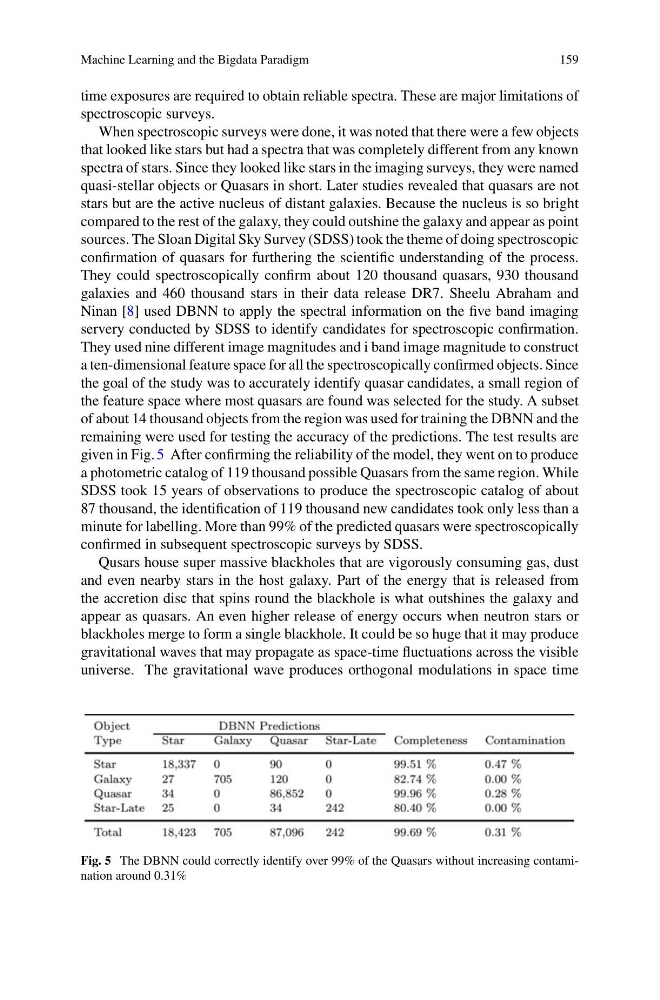
remaining were used for testing the accuracy of the predictions. The test results are
given in Fig. 5 After confirming the reliability of the model, they went on to produce
a photometric catalog of 119 thousand possible Quasars from the same region. While
SDSS took 15 years of observations to produce the spectroscopic catalog of about
87 thousand, the identification of 119 thousand new candidates took only less than a
minute for labelling. More than 99% of the predicted quasars were spectroscopically
confirmed in subsequent spectroscopic surveys by SDSS.
Qusars house super massive blackholes that are vigorously consuming gas, dust
and even nearby stars in the host galaxy. Part of the energy that is released from
the accretion disc that spins round the blackhole is what outshines the galaxy and
appear as quasars. An even higher release of energy occurs when neutron stars or
blackholes merge to form a single blackhole. It could be so huge that it may produce
gravitational waves that may propagate as space-time fluctuations across the visible
universe. The gravitational wave produces orthogonal modulations in space time
Fig. 5 The DBNN could correctly identify over 99% of the Quasars without increasing contamination around 0.31%
159
time exposures are required to obtain reliable spectra. These are major limitations of
spectroscopic surveys.
When spectroscopic surveys were done, it was noted that there were a few objects
that looked like stars but had a spectra that was completely different from any known
spectra of stars. Since they looked like stars in the imaging surveys, they were named
quasi-stellar objects or Quasars in short. Later studies revealed that quasars are not
stars but are the active nucleus of distant galaxies. Because the nucleus is so bright
compared to the rest of the galaxy, they could outshine the galaxy and appear as point
sources. The Sloan Digital Sky Survey (SDSS) took the theme of doing spectroscopic
confirmation of quasars for furthering the scientific understanding of the process.
They could spectroscopically confirm about 120 thousand quasars, 930 thousand
galaxies and 460 thousand stars in their data release DR7. Sheelu Abraham and
Ninan [8] used DBNN to apply the spectral information on the five band imaging
servery conducted by SDSS to identify candidates for spectroscopic confirmation.
They used nine different image magnitudes and i band image magnitude to construct
a ten-dimensional feature space for all the spectroscopically confirmed objects. Since
the goal of the study was to accurately identify quasar candidates, a small region of
the feature space where most quasars are found was selected for the study. A subset
of about 14 thousand objects from the region was used for training the DBNN and the
remaining were used for testing the accuracy of the predictions. The test results are
given in Fig. 5 After confirming the reliability of the model, they went on to produce
a photometric catalog of 119 thousand possible Quasars from the same region. While
SDSS took 15 years of observations to produce the spectroscopic catalog of about
87 thousand, the identification of 119 thousand new candidates took only less than a
minute for labelling. More than 99% of the predicted quasars were spectroscopically
confirmed in subsequent spectroscopic surveys by SDSS.
Qusars house super massive blackholes that are vigorously consuming gas, dust
and even nearby stars in the host galaxy. Part of the energy that is released from
the accretion disc that spins round the blackhole is what outshines the galaxy and
appear as quasars. An even higher release of energy occurs when neutron stars or
blackholes merge to form a single blackhole. It could be so huge that it may produce
gravitational waves that may propagate as space-time fluctuations across the visible
universe. The gravitational wave produces orthogonal modulations in space time
Fig. 5 The DBNN could correctly identify over 99% of the Quasars without increasing contamination around 0.31%