

158
N. S. Philip
example, if it is monsoon, there is a higher probability clouds to cause rain. Or if
the weather department has predicted that it may rain, there is a higher chance for it
to rain. The prior is not related to the likelihood, though it can be used to weigh the
likelihood to favour a particular outcome.
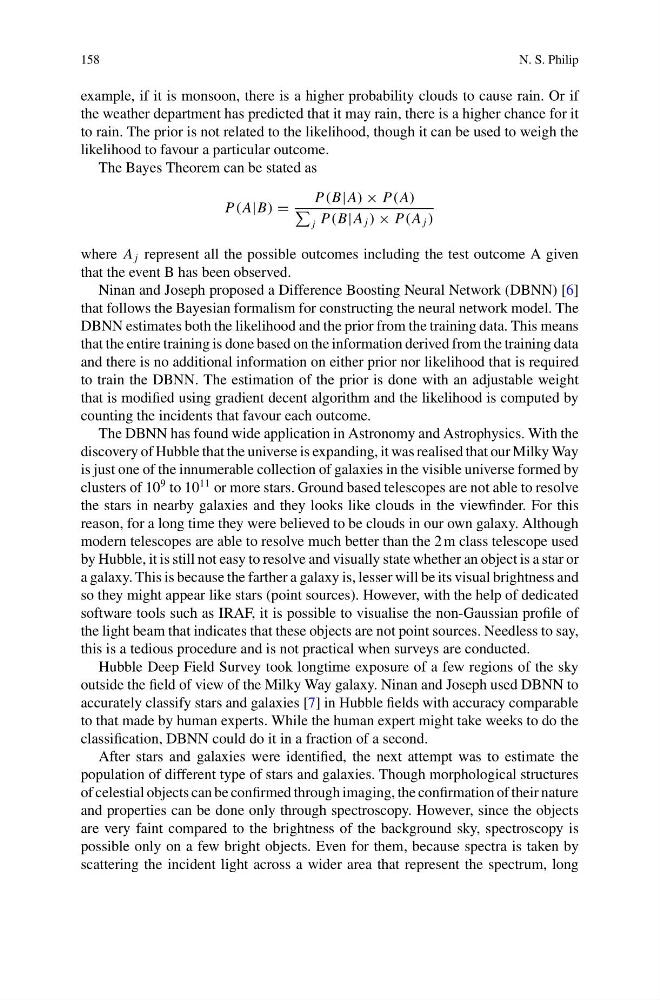
The Bayes Theorem can be stated as
P(A|B) =
P(B|A) × P(A)
j P(B|A j ) × P(A j )
where A j represent all the possible outcomes including the test outcome A given
that the event B has been observed.
Ninan and Joseph proposed a Difference Boosting Neural Network (DBNN) [6]
that follows the Bayesian formalism for constructing the neural network model. The
DBNN estimates both the likelihood and the prior from the training data. This means
that the entire training is done based on the information derived from the training data
and there is no additional information on either prior nor likelihood that is required
to train the DBNN. The estimation of the prior is done with an adjustable weight
that is modified using gradient decent algorithm and the likelihood is computed by
counting the incidents that favour each outcome.
The DBNN has found wide application in Astronomy and Astrophysics. With the
discovery of Hubble that the universe is expanding, it was realised that our Milky Way
is just one of the innumerable collection of galaxies in the visible universe formed by
clusters of 10
9 to 10
11 or more stars. Ground based telescopes are not able to resolve
the stars in nearby galaxies and they looks like clouds in the viewfinder. For this
reason, for a long time they were believed to be clouds in our own galaxy. Although
modern telescopes are able to resolve much better than the 2 m class telescope used
by Hubble, it is still not easy to resolve and visually state whether an object is a star or
a galaxy. This is because the farther a galaxy is, lesser will be its visual brightness and
so they might appear like stars (point sources). However, with the help of dedicated
software tools such as IRAF, it is possible to visualise the non-Gaussian profile of
the light beam that indicates that these objects are not point sources. Needless to say,
this is a tedious procedure and is not practical when surveys are conducted.
Hubble Deep Field Survey took longtime exposure of a few regions of the sky
outside the field of view of the Milky Way galaxy. Ninan and Joseph used DBNN to
accurately classify stars and galaxies [7] in Hubble fields with accuracy comparable
to that made by human experts. While the human expert might take weeks to do the
classification, DBNN could do it in a fraction of a second.
After stars and galaxies were identified, the next attempt was to estimate the
population of different type of stars and galaxies. Though morphological structures
of celestial objects can be confirmed through imaging, the confirmation of their nature
and properties can be done only through spectroscopy. However, since the objects
are very faint compared to the brightness of the background sky, spectroscopy is
possible only on a few bright objects. Even for them, because spectra is taken by
scattering the incident light across a wider area that represent the spectrum, long
N. S. Philip
example, if it is monsoon, there is a higher probability clouds to cause rain. Or if
the weather department has predicted that it may rain, there is a higher chance for it
to rain. The prior is not related to the likelihood, though it can be used to weigh the
likelihood to favour a particular outcome.
The Bayes Theorem can be stated as
P(A|B) =
P(B|A) × P(A)
j P(B|A j ) × P(A j )
where A j represent all the possible outcomes including the test outcome A given
that the event B has been observed.
Ninan and Joseph proposed a Difference Boosting Neural Network (DBNN) [6]
that follows the Bayesian formalism for constructing the neural network model. The
DBNN estimates both the likelihood and the prior from the training data. This means
that the entire training is done based on the information derived from the training data
and there is no additional information on either prior nor likelihood that is required
to train the DBNN. The estimation of the prior is done with an adjustable weight
that is modified using gradient decent algorithm and the likelihood is computed by
counting the incidents that favour each outcome.
The DBNN has found wide application in Astronomy and Astrophysics. With the
discovery of Hubble that the universe is expanding, it was realised that our Milky Way
is just one of the innumerable collection of galaxies in the visible universe formed by
clusters of 10
9 to 10
11 or more stars. Ground based telescopes are not able to resolve
the stars in nearby galaxies and they looks like clouds in the viewfinder. For this
reason, for a long time they were believed to be clouds in our own galaxy. Although
modern telescopes are able to resolve much better than the 2 m class telescope used
by Hubble, it is still not easy to resolve and visually state whether an object is a star or
a galaxy. This is because the farther a galaxy is, lesser will be its visual brightness and
so they might appear like stars (point sources). However, with the help of dedicated
software tools such as IRAF, it is possible to visualise the non-Gaussian profile of
the light beam that indicates that these objects are not point sources. Needless to say,
this is a tedious procedure and is not practical when surveys are conducted.
Hubble Deep Field Survey took longtime exposure of a few regions of the sky
outside the field of view of the Milky Way galaxy. Ninan and Joseph used DBNN to
accurately classify stars and galaxies [7] in Hubble fields with accuracy comparable
to that made by human experts. While the human expert might take weeks to do the
classification, DBNN could do it in a fraction of a second.
After stars and galaxies were identified, the next attempt was to estimate the
population of different type of stars and galaxies. Though morphological structures
of celestial objects can be confirmed through imaging, the confirmation of their nature
and properties can be done only through spectroscopy. However, since the objects
are very faint compared to the brightness of the background sky, spectroscopy is
possible only on a few bright objects. Even for them, because spectra is taken by
scattering the incident light across a wider area that represent the spectrum, long