

Neurons and Near-Death Spikes
145
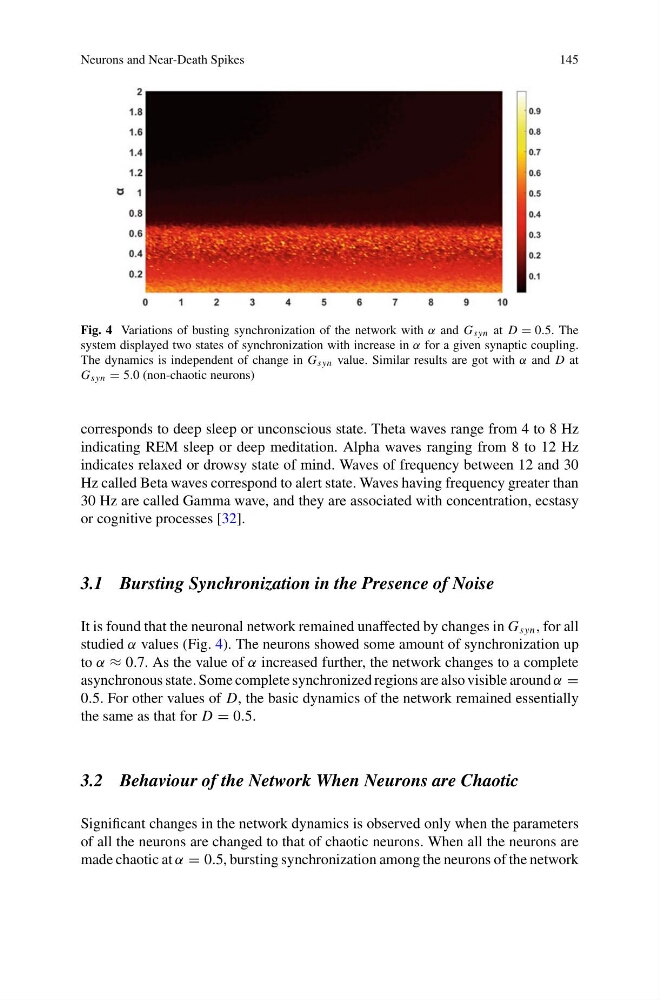
Fig. 4 Variations of busting synchronization of the network with α and G syn at D = 0.5. The
system displayed two states of synchronization with increase in α for a given synaptic coupling.
The dynamics is independent of change in G syn value. Similar results are got with α and D at
G syn = 5.0 (non-chaotic neurons)
corresponds to deep sleep or unconscious state. Theta waves range from 4 to 8 Hz
indicating REM sleep or deep meditation. Alpha waves ranging from 8 to 12 Hz
indicates relaxed or drowsy state of mind. Waves of frequency between 12 and 30
Hz called Beta waves correspond to alert state. Waves having frequency greater than
30 Hz are called Gamma wave, and they are associated with concentration, ecstasy
or cognitive processes [32].
3.1 Bursting Synchronization in the Presence of Noise
It is found that the neuronal network remained unaffected by changes in G syn , for all
studied α values (Fig. 4). The neurons showed some amount of synchronization up
to α ≈ 0.7. As the value of α increased further, the network changes to a complete
asynchronous state. Some complete synchronized regions are also visible around α =
0.5. For other values of D, the basic dynamics of the network remained essentially
the same as that for D = 0.5.
3.2 Behaviour of the Network When Neurons are Chaotic
Significant changes in the network dynamics is observed only when the parameters
of all the neurons are changed to that of chaotic neurons. When all the neurons are
made chaotic at α = 0.5, bursting synchronization among the neurons of the network
145
Fig. 4 Variations of busting synchronization of the network with α and G syn at D = 0.5. The
system displayed two states of synchronization with increase in α for a given synaptic coupling.
The dynamics is independent of change in G syn value. Similar results are got with α and D at
G syn = 5.0 (non-chaotic neurons)
corresponds to deep sleep or unconscious state. Theta waves range from 4 to 8 Hz
indicating REM sleep or deep meditation. Alpha waves ranging from 8 to 12 Hz
indicates relaxed or drowsy state of mind. Waves of frequency between 12 and 30
Hz called Beta waves correspond to alert state. Waves having frequency greater than
30 Hz are called Gamma wave, and they are associated with concentration, ecstasy
or cognitive processes [32].
3.1 Bursting Synchronization in the Presence of Noise
It is found that the neuronal network remained unaffected by changes in G syn , for all
studied α values (Fig. 4). The neurons showed some amount of synchronization up
to α ≈ 0.7. As the value of α increased further, the network changes to a complete
asynchronous state. Some complete synchronized regions are also visible around α =
0.5. For other values of D, the basic dynamics of the network remained essentially
the same as that for D = 0.5.
3.2 Behaviour of the Network When Neurons are Chaotic
Significant changes in the network dynamics is observed only when the parameters
of all the neurons are changed to that of chaotic neurons. When all the neurons are
made chaotic at α = 0.5, bursting synchronization among the neurons of the network