

144
R. P. Ignatius
transition period between asynchronous and synchronous firing states, network is
more susceptible to changes in firing pattern of individual neurons. So, the result
will help to control the dynamics of the neural networks in general.
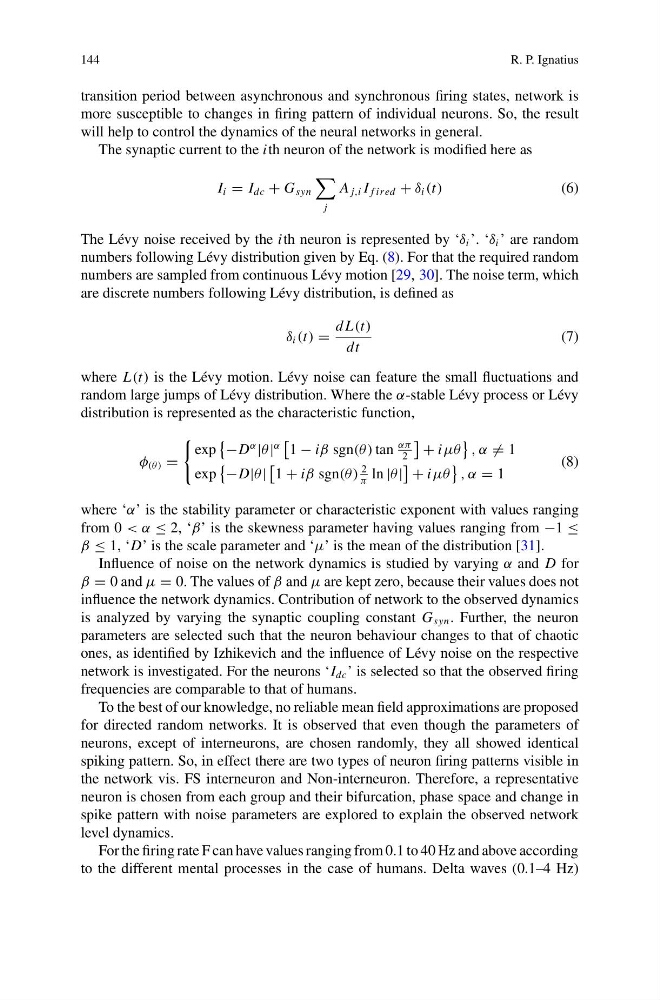
The synaptic current to the ith neuron of the network is modified here as
I i = I dc + G syn
j
A j,i I f ired + δ i (t)
(6)
The Lévy noise received by the ith neuron is represented by ‘δ i ’. ‘δ i ’ are random
numbers following Lévy distribution given by Eq. (8). For that the required random
numbers are sampled from continuous Lévy motion [29, 30]. The noise term, which
are discrete numbers following Lévy distribution, is defined as
δ i (t) =
d L(t)
dt
(7)
where L(t) is the Lévy motion. Lévy noise can feature the small fluctuations and
random large jumps of Lévy distribution. Where the α-stable Lévy process or Lévy
distribution is represented as the characteristic function,
φ (θ) =
exp
−D
α
|θ |
α
1 − iβ sgn(θ ) tan
απ
2
+ iμθ
, α = 1
exp
−D|θ |
1 + iβ sgn(θ )
2
π
ln |θ |
+ iμθ
, α = 1
(8)
where ‘α’ is the stability parameter or characteristic exponent with values ranging
from 0 < α ≤ 2, ‘β’ is the skewness parameter having values ranging from −1 ≤
β ≤ 1, ‘D’ is the scale parameter and ‘μ’ is the mean of the distribution [31].
Influence of noise on the network dynamics is studied by varying α and D for
β = 0 and μ = 0. The values of β and μ are kept zero, because their values does not
influence the network dynamics. Contribution of network to the observed dynamics
is analyzed by varying the synaptic coupling constant G syn . Further, the neuron
parameters are selected such that the neuron behaviour changes to that of chaotic
ones, as identified by Izhikevich and the influence of Lévy noise on the respective
network is investigated. For the neurons ‘I dc ’ is selected so that the observed firing
frequencies are comparable to that of humans.
To the best of our knowledge, no reliable mean field approximations are proposed
for directed random networks. It is observed that even though the parameters of
neurons, except of interneurons, are chosen randomly, they all showed identical
spiking pattern. So, in effect there are two types of neuron firing patterns visible in
the network vis. FS interneuron and Non-interneuron. Therefore, a representative
neuron is chosen from each group and their bifurcation, phase space and change in
spike pattern with noise parameters are explored to explain the observed network
level dynamics.
For the firing rate F can have values ranging from 0.1 to 40 Hz and above according
to the different mental processes in the case of humans. Delta waves (0.1–4 Hz)
R. P. Ignatius
transition period between asynchronous and synchronous firing states, network is
more susceptible to changes in firing pattern of individual neurons. So, the result
will help to control the dynamics of the neural networks in general.
The synaptic current to the ith neuron of the network is modified here as
I i = I dc + G syn
j
A j,i I f ired + δ i (t)
(6)
The Lévy noise received by the ith neuron is represented by ‘δ i ’. ‘δ i ’ are random
numbers following Lévy distribution given by Eq. (8). For that the required random
numbers are sampled from continuous Lévy motion [29, 30]. The noise term, which
are discrete numbers following Lévy distribution, is defined as
δ i (t) =
d L(t)
dt
(7)
where L(t) is the Lévy motion. Lévy noise can feature the small fluctuations and
random large jumps of Lévy distribution. Where the α-stable Lévy process or Lévy
distribution is represented as the characteristic function,
φ (θ) =
exp
−D
α
|θ |
α
1 − iβ sgn(θ ) tan
απ
2
+ iμθ
, α = 1
exp
−D|θ |
1 + iβ sgn(θ )
2
π
ln |θ |
+ iμθ
, α = 1
(8)
where ‘α’ is the stability parameter or characteristic exponent with values ranging
from 0 < α ≤ 2, ‘β’ is the skewness parameter having values ranging from −1 ≤
β ≤ 1, ‘D’ is the scale parameter and ‘μ’ is the mean of the distribution [31].
Influence of noise on the network dynamics is studied by varying α and D for
β = 0 and μ = 0. The values of β and μ are kept zero, because their values does not
influence the network dynamics. Contribution of network to the observed dynamics
is analyzed by varying the synaptic coupling constant G syn . Further, the neuron
parameters are selected such that the neuron behaviour changes to that of chaotic
ones, as identified by Izhikevich and the influence of Lévy noise on the respective
network is investigated. For the neurons ‘I dc ’ is selected so that the observed firing
frequencies are comparable to that of humans.
To the best of our knowledge, no reliable mean field approximations are proposed
for directed random networks. It is observed that even though the parameters of
neurons, except of interneurons, are chosen randomly, they all showed identical
spiking pattern. So, in effect there are two types of neuron firing patterns visible in
the network vis. FS interneuron and Non-interneuron. Therefore, a representative
neuron is chosen from each group and their bifurcation, phase space and change in
spike pattern with noise parameters are explored to explain the observed network
level dynamics.
For the firing rate F can have values ranging from 0.1 to 40 Hz and above according
to the different mental processes in the case of humans. Delta waves (0.1–4 Hz)