

Quantum Groups, q-Oscillators and q-Deformed Quantum Mechanics
105
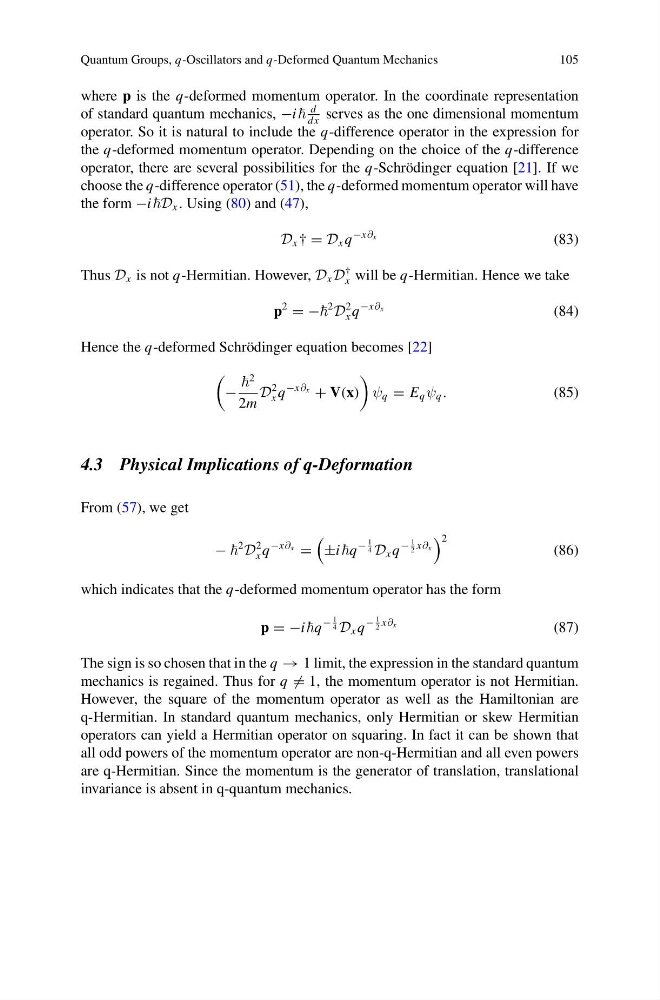
where p is the q-deformed momentum operator. In the coordinate representation
of standard quantum mechanics, −i
d
dx
serves as the one dimensional momentum
operator. So it is natural to include the q-difference operator in the expression for
the q-deformed momentum operator. Depending on the choice of the q-difference
operator, there are several possibilities for the q-Schrödinger equation [21]. If we
choose the q-difference operator (51), the q-deformed momentum operator will have
the form −iD x . Using (80) and (47),
D x † = D x q
−x∂ x
(83)
Thus D x is not q-Hermitian. However, D x D
†
x will be q-Hermitian. Hence we take
p
2
= −
2
D
2
x q
−x∂ x
(84)
Hence the q-deformed Schrödinger equation becomes [22]
−
2
2m
D
2
x q
−x∂ x + V(x)
ψ q = E q ψ q .
(85)
4.3 Physical Implications of q-Deformation
From (57), we get
−
2
D
2
x q
−x∂ x =
±iq
−
1
4 D x q
−
1
2 x∂ x
2
(86)
which indicates that the q-deformed momentum operator has the form
p = −iq
−
1
4 D x q
−
1
2 x∂ x
(87)
The sign is so chosen that in the q → 1 limit, the expression in the standard quantum
mechanics is regained. Thus for q = 1, the momentum operator is not Hermitian.
However, the square of the momentum operator as well as the Hamiltonian are
q-Hermitian. In standard quantum mechanics, only Hermitian or skew Hermitian
operators can yield a Hermitian operator on squaring. In fact it can be shown that
all odd powers of the momentum operator are non-q-Hermitian and all even powers
are q-Hermitian. Since the momentum is the generator of translation, translational
invariance is absent in q-quantum mechanics.
105
where p is the q-deformed momentum operator. In the coordinate representation
of standard quantum mechanics, −i
d
dx
serves as the one dimensional momentum
operator. So it is natural to include the q-difference operator in the expression for
the q-deformed momentum operator. Depending on the choice of the q-difference
operator, there are several possibilities for the q-Schrödinger equation [21]. If we
choose the q-difference operator (51), the q-deformed momentum operator will have
the form −iD x . Using (80) and (47),
D x † = D x q
−x∂ x
(83)
Thus D x is not q-Hermitian. However, D x D
†
x will be q-Hermitian. Hence we take
p
2
= −
2
D
2
x q
−x∂ x
(84)
Hence the q-deformed Schrödinger equation becomes [22]
−
2
2m
D
2
x q
−x∂ x + V(x)
ψ q = E q ψ q .
(85)
4.3 Physical Implications of q-Deformation
From (57), we get
−
2
D
2
x q
−x∂ x =
±iq
−
1
4 D x q
−
1
2 x∂ x
2
(86)
which indicates that the q-deformed momentum operator has the form
p = −iq
−
1
4 D x q
−
1
2 x∂ x
(87)
The sign is so chosen that in the q → 1 limit, the expression in the standard quantum
mechanics is regained. Thus for q = 1, the momentum operator is not Hermitian.
However, the square of the momentum operator as well as the Hamiltonian are
q-Hermitian. In standard quantum mechanics, only Hermitian or skew Hermitian
operators can yield a Hermitian operator on squaring. In fact it can be shown that
all odd powers of the momentum operator are non-q-Hermitian and all even powers
are q-Hermitian. Since the momentum is the generator of translation, translational
invariance is absent in q-quantum mechanics.