

104
G. Vinod
v|v = =v
2
; v|u = u|v
∗
v|αu = α v|u αv|u = α
∗
v|u
u|v + w = u|v + u|w ; u + v|w = u|w + v|w
v|v = 0 i f f v = 0 (77)
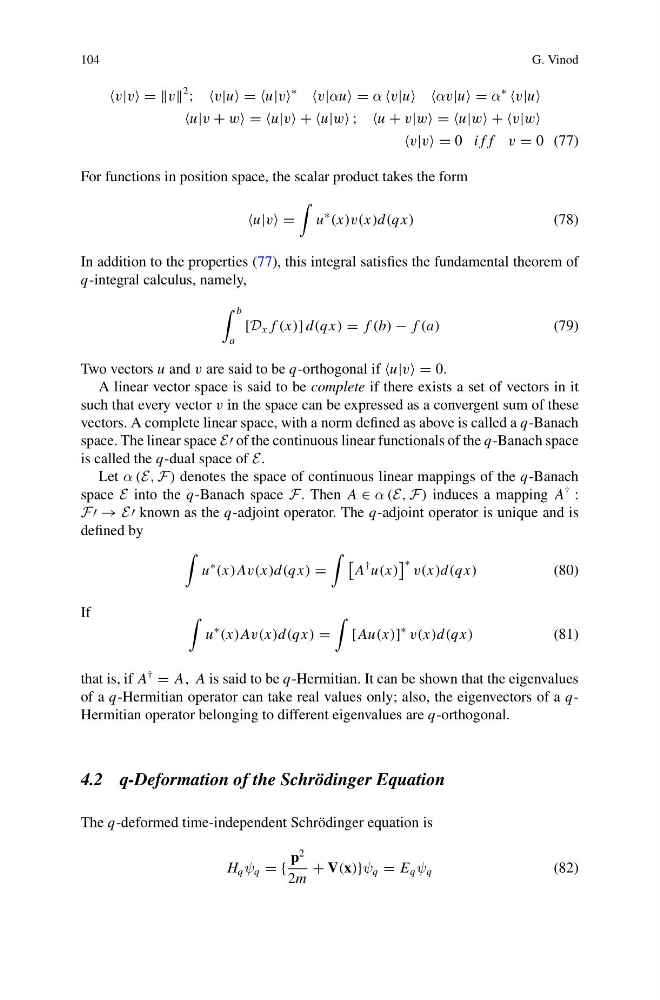
For functions in position space, the scalar product takes the form
u|v =
u
∗
(x)v(x)d(qx)
(78)
In addition to the properties (77), this integral satisfies the fundamental theorem of
q-integral calculus, namely,
b
a
[D x f (x)] d(qx) = f (b) − f (a)
(79)
Two vectors u and v are said to be q-orthogonal if u|v = 0.
A linear vector space is said to be complete if there exists a set of vectors in it
such that every vector v in the space can be expressed as a convergent sum of these
vectors. A complete linear space, with a norm defined as above is called a q-Banach
space. The linear space E of the continuous linear functionals of the q-Banach space
is called the q-dual space of E.
Let α (E, F ) denotes the space of continuous linear mappings of the q-Banach
space E into the q-Banach space F. Then A ∈ α (E, F ) induces a mapping A
†
:
F → E known as the q-adjoint operator. The q-adjoint operator is unique and is
defined by
u
∗
(x)Av(x)d(qx) =
A
† u(x)
∗ v(x)d(qx)
(80)
If
u
∗
(x)Av(x)d(qx) =
[Au(x)]
∗
v(x)d(qx)
(81)
that is, if A
†
= A, A is said to be q-Hermitian. It can be shown that the eigenvalues
of a q-Hermitian operator can take real values only; also, the eigenvectors of a qHermitian operator belonging to different eigenvalues are q-orthogonal.
4.2 q-Deformation of the Schrödinger Equation
The q-deformed time-independent Schrödinger equation is
H q ψ q = {
p
2
2m
+ V(x)}ψ q = E q ψ q
(82)
G. Vinod
v|v = =v
2
; v|u = u|v
∗
v|αu = α v|u αv|u = α
∗
v|u
u|v + w = u|v + u|w ; u + v|w = u|w + v|w
v|v = 0 i f f v = 0 (77)
For functions in position space, the scalar product takes the form
u|v =
u
∗
(x)v(x)d(qx)
(78)
In addition to the properties (77), this integral satisfies the fundamental theorem of
q-integral calculus, namely,
b
a
[D x f (x)] d(qx) = f (b) − f (a)
(79)
Two vectors u and v are said to be q-orthogonal if u|v = 0.
A linear vector space is said to be complete if there exists a set of vectors in it
such that every vector v in the space can be expressed as a convergent sum of these
vectors. A complete linear space, with a norm defined as above is called a q-Banach
space. The linear space E of the continuous linear functionals of the q-Banach space
is called the q-dual space of E.
Let α (E, F ) denotes the space of continuous linear mappings of the q-Banach
space E into the q-Banach space F. Then A ∈ α (E, F ) induces a mapping A
†
:
F → E known as the q-adjoint operator. The q-adjoint operator is unique and is
defined by
u
∗
(x)Av(x)d(qx) =
A
† u(x)
∗ v(x)d(qx)
(80)
If
u
∗
(x)Av(x)d(qx) =
[Au(x)]
∗
v(x)d(qx)
(81)
that is, if A
†
= A, A is said to be q-Hermitian. It can be shown that the eigenvalues
of a q-Hermitian operator can take real values only; also, the eigenvectors of a qHermitian operator belonging to different eigenvalues are q-orthogonal.
4.2 q-Deformation of the Schrödinger Equation
The q-deformed time-independent Schrödinger equation is
H q ψ q = {
p
2
2m
+ V(x)}ψ q = E q ψ q
(82)