

72
2 Holographic Microscopy of Phase and Diffuse Objects …
I ( x i ) = (V 1 + V 2 )(V 1 + V 2 )
∗
= |V 1 |
2
+ |V 2 |
2
+ 2Re
V 1 V
∗
2
.
(2.3)
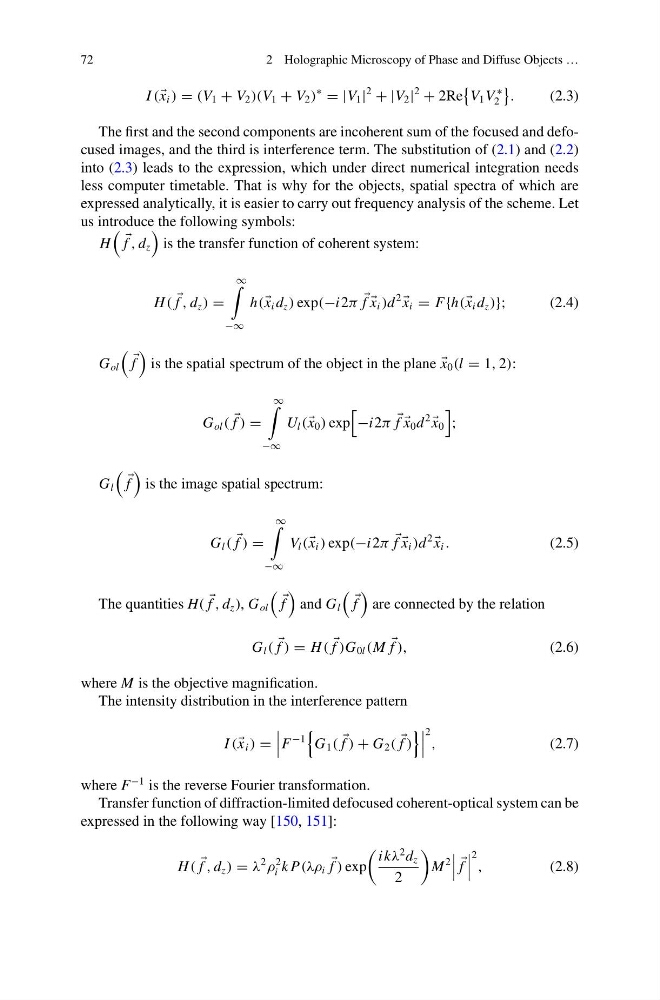
The first and the second components are incoherent sum of the focused and defocused images, and the third is interference term. The substitution of (2.1) and (2.2)
into (2.3) leads to the expression, which under direct numerical integration needs
less computer timetable. That is why for the objects, spatial spectra of which are
expressed analytically, it is easier to carry out frequency analysis of the scheme. Let
us introduce the following symbols:
H
f , d z
is the transfer function of coherent system:
H (
f , d z ) =
∞
−∞
h( x i d z ) exp(−i2π
f
x i )d
2
x i = F{h( x i d z )};
(2.4)
G ol
f
is the spatial spectrum of the object in the plane
x 0 (l = 1, 2):
G ol (
f ) =
∞
−∞
U l ( x 0 ) exp
−i2π
f
x 0 d
2
x 0
;
G l
f
is the image spatial spectrum:
G l (
f ) =
∞
−∞
V l ( x i ) exp(−i2π
f
x i )d
2
x i .
(2.5)
The quantities H(
f , d z ), G ol
f
and G l
f
are connected by the relation
G l (
f ) = H (
f )G 0l (M
f ),
(2.6)
where M is the objective magnification.
The intensity distribution in the interference pattern
I ( x i ) =
F
−1
G 1 (
f ) + G 2 (
f )
2 ,
(2.7)
where F
−1 is the reverse Fourier transformation.
Transfer function of diffraction-limited defocused coherent-optical system can be
expressed in the following way [150, 151]:
H (
f , d z ) = λ
2
ρ
2
i k P(λρ i
f ) exp
ikλ
2 d z
2
M
2
f
2 ,
(2.8)
2 Holographic Microscopy of Phase and Diffuse Objects …
I ( x i ) = (V 1 + V 2 )(V 1 + V 2 )
∗
= |V 1 |
2
+ |V 2 |
2
+ 2Re
V 1 V
∗
2
.
(2.3)
The first and the second components are incoherent sum of the focused and defocused images, and the third is interference term. The substitution of (2.1) and (2.2)
into (2.3) leads to the expression, which under direct numerical integration needs
less computer timetable. That is why for the objects, spatial spectra of which are
expressed analytically, it is easier to carry out frequency analysis of the scheme. Let
us introduce the following symbols:
H
f , d z
is the transfer function of coherent system:
H (
f , d z ) =
∞
−∞
h( x i d z ) exp(−i2π
f
x i )d
2
x i = F{h( x i d z )};
(2.4)
G ol
f
is the spatial spectrum of the object in the plane
x 0 (l = 1, 2):
G ol (
f ) =
∞
−∞
U l ( x 0 ) exp
−i2π
f
x 0 d
2
x 0
;
G l
f
is the image spatial spectrum:
G l (
f ) =
∞
−∞
V l ( x i ) exp(−i2π
f
x i )d
2
x i .
(2.5)
The quantities H(
f , d z ), G ol
f
and G l
f
are connected by the relation
G l (
f ) = H (
f )G 0l (M
f ),
(2.6)
where M is the objective magnification.
The intensity distribution in the interference pattern
I ( x i ) =
F
−1
G 1 (
f ) + G 2 (
f )
2 ,
(2.7)
where F
−1 is the reverse Fourier transformation.
Transfer function of diffraction-limited defocused coherent-optical system can be
expressed in the following way [150, 151]:
H (
f , d z ) = λ
2
ρ
2
i k P(λρ i
f ) exp
ikλ
2 d z
2
M
2
f
2 ,
(2.8)