

452
5 Laser Specklometer, Speckle-Optical Diagnostics and Laser …
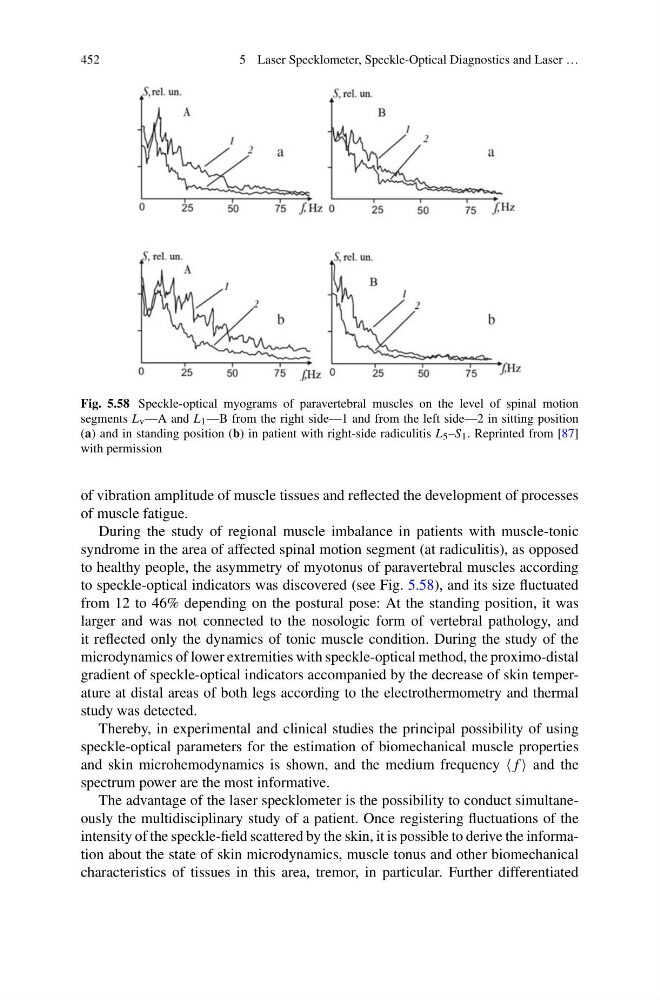
Fig. 5.58 Speckle-optical myograms of paravertebral muscles on the level of spinal motion
segments L v —A and L 1 —B from the right side—1 and from the left side—2 in sitting position
(a) and in standing position (b) in patient with right-side radiculitis L 5 –S 1 . Reprinted from [87]
with permission
of vibration amplitude of muscle tissues and reflected the development of processes
of muscle fatigue.
During the study of regional muscle imbalance in patients with muscle-tonic
syndrome in the area of affected spinal motion segment (at radiculitis), as opposed
to healthy people, the asymmetry of myotonus of paravertebral muscles according
to speckle-optical indicators was discovered (see Fig. 5.58), and its size fluctuated
from 12 to 46% depending on the postural pose: At the standing position, it was
larger and was not connected to the nosologic form of vertebral pathology, and
it reflected only the dynamics of tonic muscle condition. During the study of the
microdynamics of lower extremities with speckle-optical method, the proximo-distal
gradient of speckle-optical indicators accompanied by the decrease of skin temperature at distal areas of both legs according to the electrothermometry and thermal
study was detected.
Thereby, in experimental and clinical studies the principal possibility of using
speckle-optical parameters for the estimation of biomechanical muscle properties
and skin microhemodynamics is shown, and the medium frequency f and the
spectrum power are the most informative.
The advantage of the laser specklometer is the possibility to conduct simultaneously the multidisciplinary study of a patient. Once registering fluctuations of the
intensity of the speckle-field scattered by the skin, it is possible to derive the information about the state of skin microdynamics, muscle tonus and other biomechanical
characteristics of tissues in this area, tremor, in particular. Further differentiated
5 Laser Specklometer, Speckle-Optical Diagnostics and Laser …
Fig. 5.58 Speckle-optical myograms of paravertebral muscles on the level of spinal motion
segments L v —A and L 1 —B from the right side—1 and from the left side—2 in sitting position
(a) and in standing position (b) in patient with right-side radiculitis L 5 –S 1 . Reprinted from [87]
with permission
of vibration amplitude of muscle tissues and reflected the development of processes
of muscle fatigue.
During the study of regional muscle imbalance in patients with muscle-tonic
syndrome in the area of affected spinal motion segment (at radiculitis), as opposed
to healthy people, the asymmetry of myotonus of paravertebral muscles according
to speckle-optical indicators was discovered (see Fig. 5.58), and its size fluctuated
from 12 to 46% depending on the postural pose: At the standing position, it was
larger and was not connected to the nosologic form of vertebral pathology, and
it reflected only the dynamics of tonic muscle condition. During the study of the
microdynamics of lower extremities with speckle-optical method, the proximo-distal
gradient of speckle-optical indicators accompanied by the decrease of skin temperature at distal areas of both legs according to the electrothermometry and thermal
study was detected.
Thereby, in experimental and clinical studies the principal possibility of using
speckle-optical parameters for the estimation of biomechanical muscle properties
and skin microhemodynamics is shown, and the medium frequency f and the
spectrum power are the most informative.
The advantage of the laser specklometer is the possibility to conduct simultaneously the multidisciplinary study of a patient. Once registering fluctuations of the
intensity of the speckle-field scattered by the skin, it is possible to derive the information about the state of skin microdynamics, muscle tonus and other biomechanical
characteristics of tissues in this area, tremor, in particular. Further differentiated