

5.12 Speckle-Optical Diagnostics of Muscle Activity and …
447
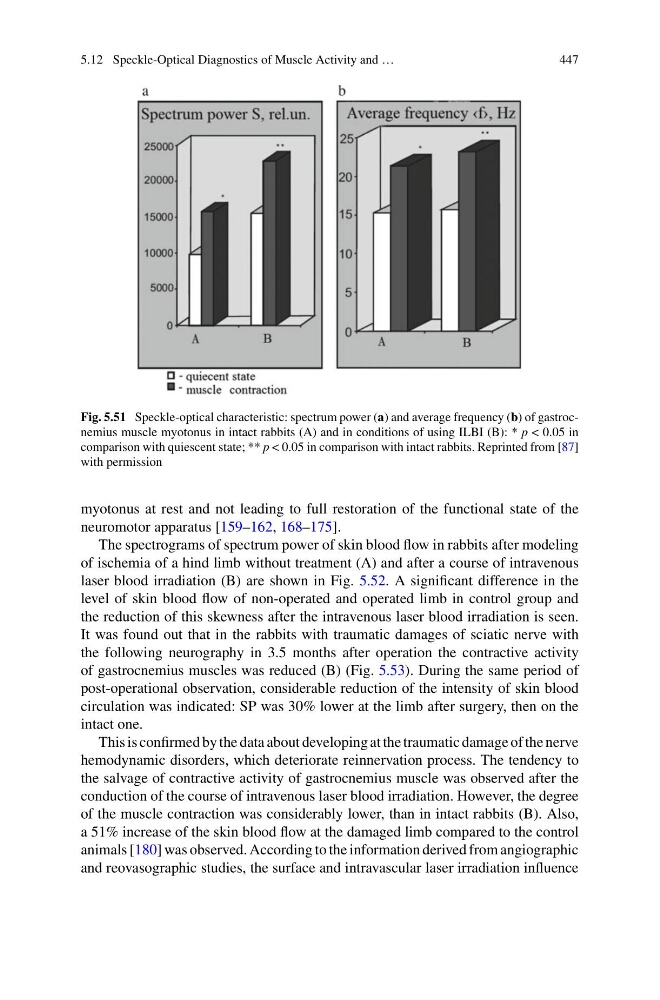
Fig. 5.51 Speckle-optical characteristic: spectrum power (a) and average frequency (b) of gastrocnemius muscle myotonus in intact rabbits (A) and in conditions of using ILBI (B): * p < 0.05 in
comparison with quiescent state; ** p < 0.05 in comparison with intact rabbits. Reprinted from [87]
with permission
myotonus at rest and not leading to full restoration of the functional state of the
neuromotor apparatus [159–162, 168–175].
The spectrograms of spectrum power of skin blood flow in rabbits after modeling
of ischemia of a hind limb without treatment (A) and after a course of intravenous
laser blood irradiation (B) are shown in Fig. 5.52. A significant difference in the
level of skin blood flow of non-operated and operated limb in control group and
the reduction of this skewness after the intravenous laser blood irradiation is seen.
It was found out that in the rabbits with traumatic damages of sciatic nerve with
the following neurography in 3.5 months after operation the contractive activity
of gastrocnemius muscles was reduced (B) (Fig. 5.53). During the same period of
post-operational observation, considerable reduction of the intensity of skin blood
circulation was indicated: SP was 30% lower at the limb after surgery, then on the
intact one.
This is confirmed by the data about developing at the traumatic damage of the nerve
hemodynamic disorders, which deteriorate reinnervation process. The tendency to
the salvage of contractive activity of gastrocnemius muscle was observed after the
conduction of the course of intravenous laser blood irradiation. However, the degree
of the muscle contraction was considerably lower, than in intact rabbits (B). Also,
a 51% increase of the skin blood flow at the damaged limb compared to the control
animals [180] was observed. According to the information derived from angiographic
and reovasographic studies, the surface and intravascular laser irradiation influence
447
Fig. 5.51 Speckle-optical characteristic: spectrum power (a) and average frequency (b) of gastrocnemius muscle myotonus in intact rabbits (A) and in conditions of using ILBI (B): * p < 0.05 in
comparison with quiescent state; ** p < 0.05 in comparison with intact rabbits. Reprinted from [87]
with permission
myotonus at rest and not leading to full restoration of the functional state of the
neuromotor apparatus [159–162, 168–175].
The spectrograms of spectrum power of skin blood flow in rabbits after modeling
of ischemia of a hind limb without treatment (A) and after a course of intravenous
laser blood irradiation (B) are shown in Fig. 5.52. A significant difference in the
level of skin blood flow of non-operated and operated limb in control group and
the reduction of this skewness after the intravenous laser blood irradiation is seen.
It was found out that in the rabbits with traumatic damages of sciatic nerve with
the following neurography in 3.5 months after operation the contractive activity
of gastrocnemius muscles was reduced (B) (Fig. 5.53). During the same period of
post-operational observation, considerable reduction of the intensity of skin blood
circulation was indicated: SP was 30% lower at the limb after surgery, then on the
intact one.
This is confirmed by the data about developing at the traumatic damage of the nerve
hemodynamic disorders, which deteriorate reinnervation process. The tendency to
the salvage of contractive activity of gastrocnemius muscle was observed after the
conduction of the course of intravenous laser blood irradiation. However, the degree
of the muscle contraction was considerably lower, than in intact rabbits (B). Also,
a 51% increase of the skin blood flow at the damaged limb compared to the control
animals [180] was observed. According to the information derived from angiographic
and reovasographic studies, the surface and intravascular laser irradiation influence