

5.7 Study of Intensity Fluctuation Spectra of Dynamic …
421
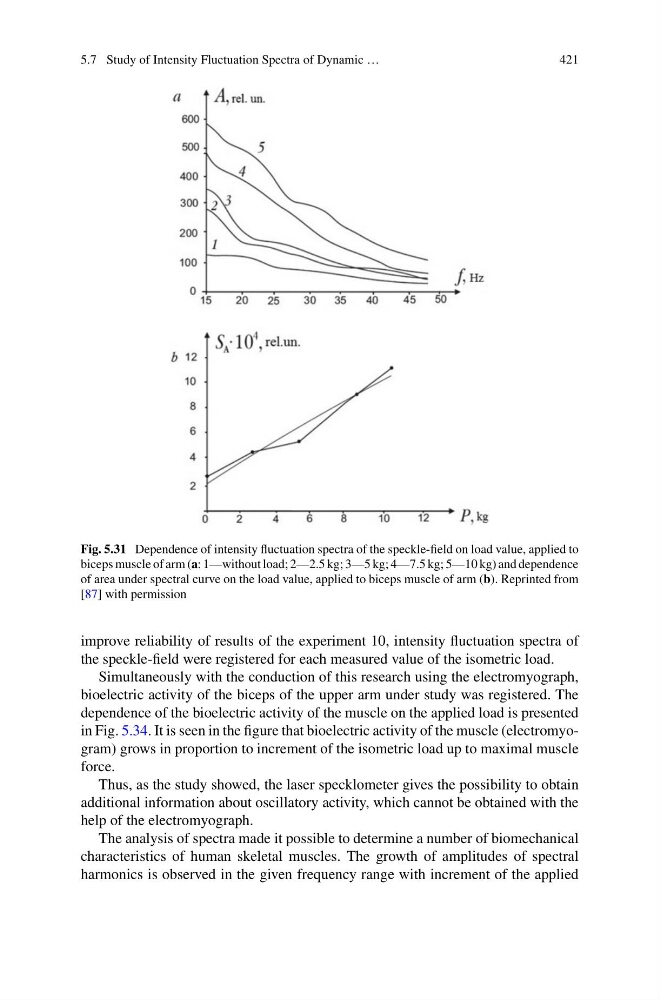
Fig. 5.31 Dependence of intensity fluctuation spectra of the speckle-field on load value, applied to
biceps muscle of arm (a: 1—without load; 2—2.5 kg; 3—5 kg; 4—7.5 kg; 5—10 kg) and dependence
of area under spectral curve on the load value, applied to biceps muscle of arm (b). Reprinted from
[87] with permission
improve reliability of results of the experiment 10, intensity fluctuation spectra of
the speckle-field were registered for each measured value of the isometric load.
Simultaneously with the conduction of this research using the electromyograph,
bioelectric activity of the biceps of the upper arm under study was registered. The
dependence of the bioelectric activity of the muscle on the applied load is presented
in Fig. 5.34. It is seen in the figure that bioelectric activity of the muscle (electromyogram) grows in proportion to increment of the isometric load up to maximal muscle
force.
Thus, as the study showed, the laser specklometer gives the possibility to obtain
additional information about oscillatory activity, which cannot be obtained with the
help of the electromyograph.
The analysis of spectra made it possible to determine a number of biomechanical
characteristics of human skeletal muscles. The growth of amplitudes of spectral
harmonics is observed in the given frequency range with increment of the applied
421
Fig. 5.31 Dependence of intensity fluctuation spectra of the speckle-field on load value, applied to
biceps muscle of arm (a: 1—without load; 2—2.5 kg; 3—5 kg; 4—7.5 kg; 5—10 kg) and dependence
of area under spectral curve on the load value, applied to biceps muscle of arm (b). Reprinted from
[87] with permission
improve reliability of results of the experiment 10, intensity fluctuation spectra of
the speckle-field were registered for each measured value of the isometric load.
Simultaneously with the conduction of this research using the electromyograph,
bioelectric activity of the biceps of the upper arm under study was registered. The
dependence of the bioelectric activity of the muscle on the applied load is presented
in Fig. 5.34. It is seen in the figure that bioelectric activity of the muscle (electromyogram) grows in proportion to increment of the isometric load up to maximal muscle
force.
Thus, as the study showed, the laser specklometer gives the possibility to obtain
additional information about oscillatory activity, which cannot be obtained with the
help of the electromyograph.
The analysis of spectra made it possible to determine a number of biomechanical
characteristics of human skeletal muscles. The growth of amplitudes of spectral
harmonics is observed in the given frequency range with increment of the applied