

1.2 Spatial Coherence of Rhodamine 6G Laser Radiation …
17
To avoid the influence of instability of reconstructing source and photomultiplier
tube, along with the measurement of point intensity of the reconstructed image (2)
by the same photomultiplier tube, the light beam (3) incident upon a hologram which
preliminary was weakened by the filter (4), was periodically under control.
From the measured intensity values of the reconstructed image, illumination
constant signal, which was provided by hologram noise, was subtracted. Measuring
systematic errors are substantially conditioned by a hologram and photomultiplier
tube nonlinearity. In general, accidental errors are provided by inaccuracy of the
points coordinates overlapping laser end in the hologram plane and in the plane of
the reconstructed image. Scatter of results of our experiments was 10% at determination of |γ |
2 just by holographic method and 15% at microphotometry of the intensity
distribution on laser end.
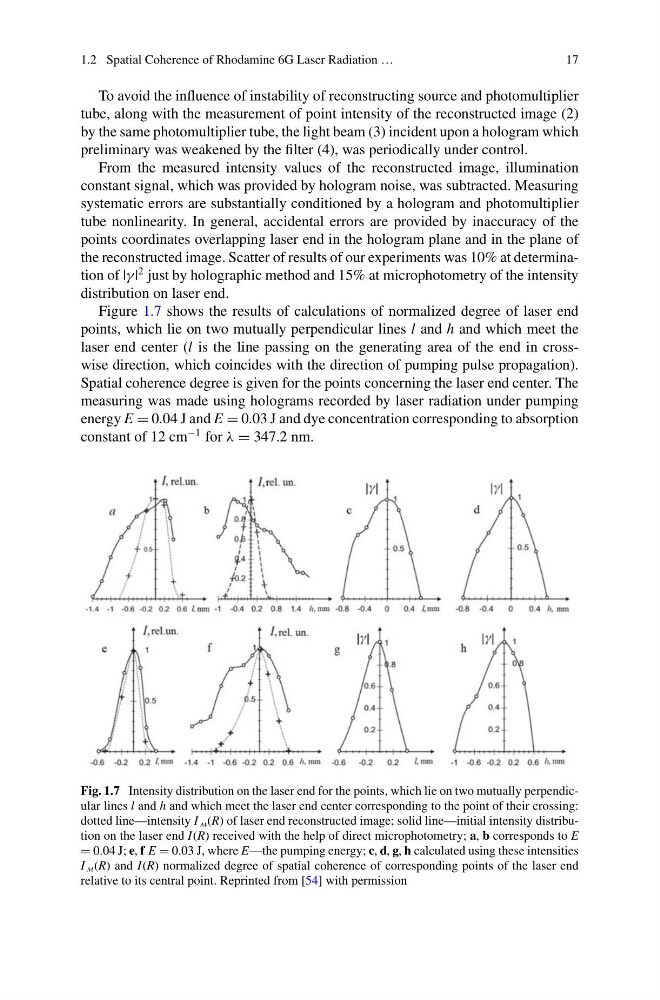
Figure 1.7 shows the results of calculations of normalized degree of laser end
points, which lie on two mutually perpendicular lines l and h and which meet the
laser end center (l is the line passing on the generating area of the end in crosswise direction, which coincides with the direction of pumping pulse propagation).
Spatial coherence degree is given for the points concerning the laser end center. The
measuring was made using holograms recorded by laser radiation under pumping
energy E = 0.04 J and E = 0.03 J and dye concentration corresponding to absorption
constant of 12 cm
−1 for λ = 347.2 nm.
Fig. 1.7 Intensity distribution on the laser end for the points, which lie on two mutually perpendicular lines l and h and which meet the laser end center corresponding to the point of their crossing:
dotted line—intensity I m (R) of laser end reconstructed image; solid line—initial intensity distribution on the laser end I(R) received with the help of direct microphotometry; a, b corresponds to E
= 0.04 J; e, f E = 0.03 J, where E—the pumping energy; c, d, g, h calculated using these intensities
I m (R) and I(R) normalized degree of spatial coherence of corresponding points of the laser end
relative to its central point. Reprinted from [54] with permission
17
To avoid the influence of instability of reconstructing source and photomultiplier
tube, along with the measurement of point intensity of the reconstructed image (2)
by the same photomultiplier tube, the light beam (3) incident upon a hologram which
preliminary was weakened by the filter (4), was periodically under control.
From the measured intensity values of the reconstructed image, illumination
constant signal, which was provided by hologram noise, was subtracted. Measuring
systematic errors are substantially conditioned by a hologram and photomultiplier
tube nonlinearity. In general, accidental errors are provided by inaccuracy of the
points coordinates overlapping laser end in the hologram plane and in the plane of
the reconstructed image. Scatter of results of our experiments was 10% at determination of |γ |
2 just by holographic method and 15% at microphotometry of the intensity
distribution on laser end.
Figure 1.7 shows the results of calculations of normalized degree of laser end
points, which lie on two mutually perpendicular lines l and h and which meet the
laser end center (l is the line passing on the generating area of the end in crosswise direction, which coincides with the direction of pumping pulse propagation).
Spatial coherence degree is given for the points concerning the laser end center. The
measuring was made using holograms recorded by laser radiation under pumping
energy E = 0.04 J and E = 0.03 J and dye concentration corresponding to absorption
constant of 12 cm
−1 for λ = 347.2 nm.
Fig. 1.7 Intensity distribution on the laser end for the points, which lie on two mutually perpendicular lines l and h and which meet the laser end center corresponding to the point of their crossing:
dotted line—intensity I m (R) of laser end reconstructed image; solid line—initial intensity distribution on the laser end I(R) received with the help of direct microphotometry; a, b corresponds to E
= 0.04 J; e, f E = 0.03 J, where E—the pumping energy; c, d, g, h calculated using these intensities
I m (R) and I(R) normalized degree of spatial coherence of corresponding points of the laser end
relative to its central point. Reprinted from [54] with permission