

5.4 Theoretical Study of Biomechanical Characteristics of Skeletal …
395
S(u, v) =
sin
1
2
u
1
2
u
u
v
J 1 (v) −
u
v
3
J 3 (v) + · · ·
−
cos[(1/2)u]
(1/2)u
u
v
2
J 2 (v) −
u
v
4
J 4 (v) + · · ·
=
sin
1
2
u
1
2
u
U 1 (u, v)
+
cos
1
2
u
1
2
u
U 2 (u, v)
(5.15)
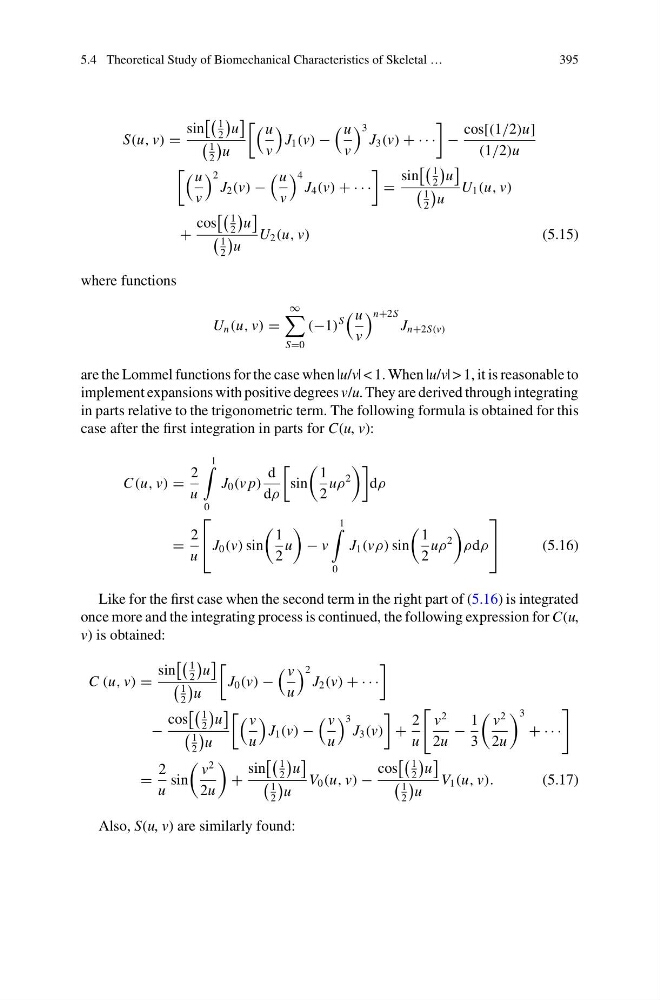
where functions
U n (u, v) =
∞
S=0
(−1)
S
u
v
n+2S
J n+2S(v)
are the Lommel functions for the case when |u/v| < 1. When |u/v| > 1, it is reasonable to
implement expansions with positive degrees v/u. They are derived through integrating
in parts relative to the trigonometric term. The following formula is obtained for this
case after the first integration in parts for C(u, v):
C(u, v) =
2
u
1
0
J 0 (v p)
d
dρ
sin
1
2
uρ
2
dρ
=
2
u
⎡
⎣ J 0 (v) sin
1
2
u
− v
1
0
J 1 (vρ) sin
1
2
uρ
2
ρdρ
⎤
⎦
(5.16)
Like for the first case when the second term in the right part of (5.16) is integrated
once more and the integrating process is continued, the following expression for C(u,
v) is obtained:
C (u, v) =
sin
1
2
u
1
2
u
J 0 (v) −
v
u
2
J 2 (v) + · · ·
−
cos
1
2
u
1
2
u
v
u
J 1 (v) −
v
u
3
J 3 (v)
+
2
u
v
2
2u
−
1
3
v
2
2u
3
+ · · ·
=
2
u
sin
v
2
2u
+
sin
1
2
u
1
2
u
V 0 (u, v) −
cos
1
2
u
1
2
u
V 1 (u, v).
(5.17)
Also, S(u, v) are similarly found:
395
S(u, v) =
sin
1
2
u
1
2
u
u
v
J 1 (v) −
u
v
3
J 3 (v) + · · ·
−
cos[(1/2)u]
(1/2)u
u
v
2
J 2 (v) −
u
v
4
J 4 (v) + · · ·
=
sin
1
2
u
1
2
u
U 1 (u, v)
+
cos
1
2
u
1
2
u
U 2 (u, v)
(5.15)
where functions
U n (u, v) =
∞
S=0
(−1)
S
u
v
n+2S
J n+2S(v)
are the Lommel functions for the case when |u/v| < 1. When |u/v| > 1, it is reasonable to
implement expansions with positive degrees v/u. They are derived through integrating
in parts relative to the trigonometric term. The following formula is obtained for this
case after the first integration in parts for C(u, v):
C(u, v) =
2
u
1
0
J 0 (v p)
d
dρ
sin
1
2
uρ
2
dρ
=
2
u
⎡
⎣ J 0 (v) sin
1
2
u
− v
1
0
J 1 (vρ) sin
1
2
uρ
2
ρdρ
⎤
⎦
(5.16)
Like for the first case when the second term in the right part of (5.16) is integrated
once more and the integrating process is continued, the following expression for C(u,
v) is obtained:
C (u, v) =
sin
1
2
u
1
2
u
J 0 (v) −
v
u
2
J 2 (v) + · · ·
−
cos
1
2
u
1
2
u
v
u
J 1 (v) −
v
u
3
J 3 (v)
+
2
u
v
2
2u
−
1
3
v
2
2u
3
+ · · ·
=
2
u
sin
v
2
2u
+
sin
1
2
u
1
2
u
V 0 (u, v) −
cos
1
2
u
1
2
u
V 1 (u, v).
(5.17)
Also, S(u, v) are similarly found: