

394
5 Laser Specklometer, Speckle-Optical Diagnostics and Laser …
≡ −
2πi
λ
S
d
2
A exp
i
d
S
2
u
1
0
J 0 (vρ) exp
−i
1
2
up 2
ρdρ,
(5.10)
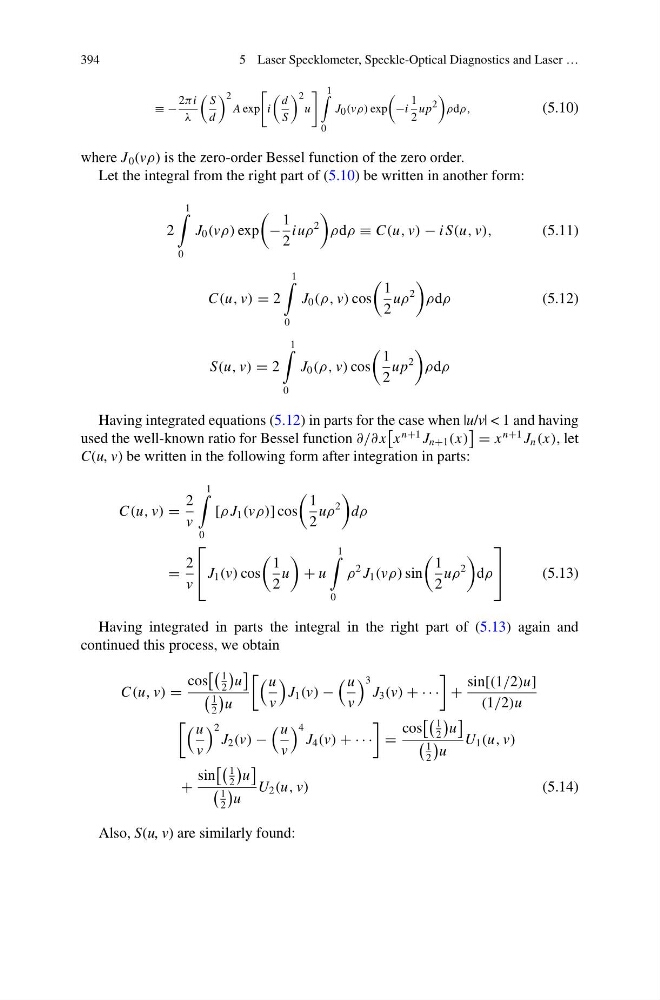
where J 0 (vρ) is the zero-order Bessel function of the zero order.
Let the integral from the right part of (5.10) be written in another form:
2
1
0
J 0 (vρ) exp
−
1
2
iuρ
2
ρdρ ≡ C(u, v) − i S(u, v),
(5.11)
C(u, v) = 2
1
0
J 0 (ρ, v) cos
1
2
uρ
2
ρdρ
(5.12)
S(u, v) = 2
1
0
J 0 (ρ, v) cos
1
2
up
2
ρdρ
Having integrated equations (5.12) in parts for the case when |u/v| < 1 and having
used the well-known ratio for Bessel function ∂/∂ x
x
n+1 J n+1 (x)
= x
n+1 J n (x), let
C(u, v) be written in the following form after integration in parts:
C(u, v) =
2
v
1
0
[ρ J 1 (vρ)] cos
1
2
uρ
2
dρ
=
2
v
⎡
⎣ J 1 (v) cos
1
2
u
+ u
1
0
ρ
2 J 1 (vρ) sin
1
2
uρ
2
dρ
⎤
⎦
(5.13)
Having integrated in parts the integral in the right part of (5.13) again and
continued this process, we obtain
C(u, v) =
cos
1
2
u
1
2
u
u
v
J 1 (v) −
u
v
3
J 3 (v) + · · ·
+
sin[(1/2)u]
(1/2)u
u
v
2
J 2 (v) −
u
v
4
J 4 (v) + · · ·
=
cos
1
2
u
1
2
u
U 1 (u, v)
+
sin
1
2
u
1
2
u
U 2 (u, v)
(5.14)
Also, S(u, v) are similarly found:
5 Laser Specklometer, Speckle-Optical Diagnostics and Laser …
≡ −
2πi
λ
S
d
2
A exp
i
d
S
2
u
1
0
J 0 (vρ) exp
−i
1
2
up 2
ρdρ,
(5.10)
where J 0 (vρ) is the zero-order Bessel function of the zero order.
Let the integral from the right part of (5.10) be written in another form:
2
1
0
J 0 (vρ) exp
−
1
2
iuρ
2
ρdρ ≡ C(u, v) − i S(u, v),
(5.11)
C(u, v) = 2
1
0
J 0 (ρ, v) cos
1
2
uρ
2
ρdρ
(5.12)
S(u, v) = 2
1
0
J 0 (ρ, v) cos
1
2
up
2
ρdρ
Having integrated equations (5.12) in parts for the case when |u/v| < 1 and having
used the well-known ratio for Bessel function ∂/∂ x
x
n+1 J n+1 (x)
= x
n+1 J n (x), let
C(u, v) be written in the following form after integration in parts:
C(u, v) =
2
v
1
0
[ρ J 1 (vρ)] cos
1
2
uρ
2
dρ
=
2
v
⎡
⎣ J 1 (v) cos
1
2
u
+ u
1
0
ρ
2 J 1 (vρ) sin
1
2
uρ
2
dρ
⎤
⎦
(5.13)
Having integrated in parts the integral in the right part of (5.13) again and
continued this process, we obtain
C(u, v) =
cos
1
2
u
1
2
u
u
v
J 1 (v) −
u
v
3
J 3 (v) + · · ·
+
sin[(1/2)u]
(1/2)u
u
v
2
J 2 (v) −
u
v
4
J 4 (v) + · · ·
=
cos
1
2
u
1
2
u
U 1 (u, v)
+
sin
1
2
u
1
2
u
U 2 (u, v)
(5.14)
Also, S(u, v) are similarly found: