

358
4 Speckle-Optical Methods and Devices for Studying …
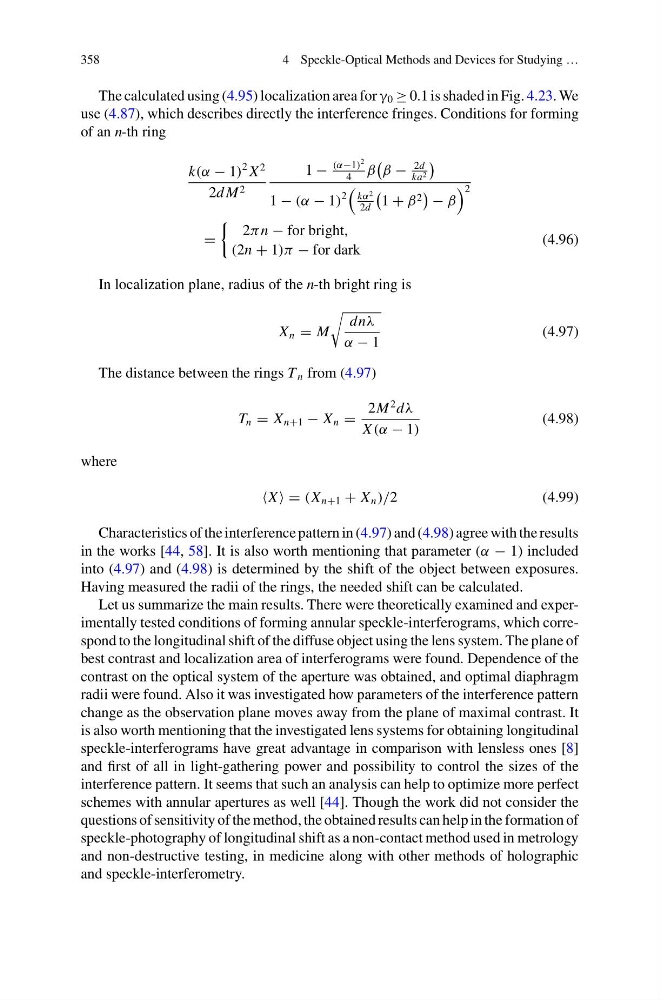
The calculated using (4.95) localization area for γ 0 ≥ 0.1 is shaded in Fig. 4.23. We
use (4.87), which describes directly the interference fringes. Conditions for forming
of an n-th ring
k(α − 1)
2 X
2
2d M 2
1 −
(α−1)
2
4
β
β −
2d
ka 2
1 − (α − 1)
2
kα 2
2d
1 + β 2
− β
2
=
2π n − for bright,
(2n + 1)π − for dark
(4.96)
In localization plane, radius of the n-th bright ring is
X n = M
dnλ
α − 1
(4.97)
The distance between the rings T n from (4.97)
T n = X n+1 − X n =
2M
2 dλ
X (α − 1)
(4.98)
where
X = (X n+1 + X n )/2
(4.99)
Characteristics of the interference pattern in (4.97) and (4.98) agree with the results
in the works [44, 58]. It is also worth mentioning that parameter (α − 1) included
into (4.97) and (4.98) is determined by the shift of the object between exposures.
Having measured the radii of the rings, the needed shift can be calculated.
Let us summarize the main results. There were theoretically examined and experimentally tested conditions of forming annular speckle-interferograms, which correspond to the longitudinal shift of the diffuse object using the lens system. The plane of
best contrast and localization area of interferograms were found. Dependence of the
contrast on the optical system of the aperture was obtained, and optimal diaphragm
radii were found. Also it was investigated how parameters of the interference pattern
change as the observation plane moves away from the plane of maximal contrast. It
is also worth mentioning that the investigated lens systems for obtaining longitudinal
speckle-interferograms have great advantage in comparison with lensless ones [8]
and first of all in light-gathering power and possibility to control the sizes of the
interference pattern. It seems that such an analysis can help to optimize more perfect
schemes with annular apertures as well [44]. Though the work did not consider the
questions of sensitivity of the method, the obtained results can help in the formation of
speckle-photography of longitudinal shift as a non-contact method used in metrology
and non-destructive testing, in medicine along with other methods of holographic
and speckle-interferometry.
4 Speckle-Optical Methods and Devices for Studying …
The calculated using (4.95) localization area for γ 0 ≥ 0.1 is shaded in Fig. 4.23. We
use (4.87), which describes directly the interference fringes. Conditions for forming
of an n-th ring
k(α − 1)
2 X
2
2d M 2
1 −
(α−1)
2
4
β
β −
2d
ka 2
1 − (α − 1)
2
kα 2
2d
1 + β 2
− β
2
=
2π n − for bright,
(2n + 1)π − for dark
(4.96)
In localization plane, radius of the n-th bright ring is
X n = M
dnλ
α − 1
(4.97)
The distance between the rings T n from (4.97)
T n = X n+1 − X n =
2M
2 dλ
X (α − 1)
(4.98)
where
X = (X n+1 + X n )/2
(4.99)
Characteristics of the interference pattern in (4.97) and (4.98) agree with the results
in the works [44, 58]. It is also worth mentioning that parameter (α − 1) included
into (4.97) and (4.98) is determined by the shift of the object between exposures.
Having measured the radii of the rings, the needed shift can be calculated.
Let us summarize the main results. There were theoretically examined and experimentally tested conditions of forming annular speckle-interferograms, which correspond to the longitudinal shift of the diffuse object using the lens system. The plane of
best contrast and localization area of interferograms were found. Dependence of the
contrast on the optical system of the aperture was obtained, and optimal diaphragm
radii were found. Also it was investigated how parameters of the interference pattern
change as the observation plane moves away from the plane of maximal contrast. It
is also worth mentioning that the investigated lens systems for obtaining longitudinal
speckle-interferograms have great advantage in comparison with lensless ones [8]
and first of all in light-gathering power and possibility to control the sizes of the
interference pattern. It seems that such an analysis can help to optimize more perfect
schemes with annular apertures as well [44]. Though the work did not consider the
questions of sensitivity of the method, the obtained results can help in the formation of
speckle-photography of longitudinal shift as a non-contact method used in metrology
and non-destructive testing, in medicine along with other methods of holographic
and speckle-interferometry.