

4.9 About Formation of Annular Speckle-Interferograms …
357
γ =
⎧
⎨
⎩
1 + (α − 1)
2
ka
2
2d
2
d
ka 2
2
− β
2
2
⎫
⎬
⎭
−
1
2
×
⎧
⎪ ⎨
⎪ ⎩
−
2(α − 1)
2 X
2
q 2 M 2
×
1 + β
2
1 + (α − 1)
2
ka 2
2d
2 d
ka 2
2 − β 2
2
⎫
⎪ ⎬
⎪ ⎭
(4.90)
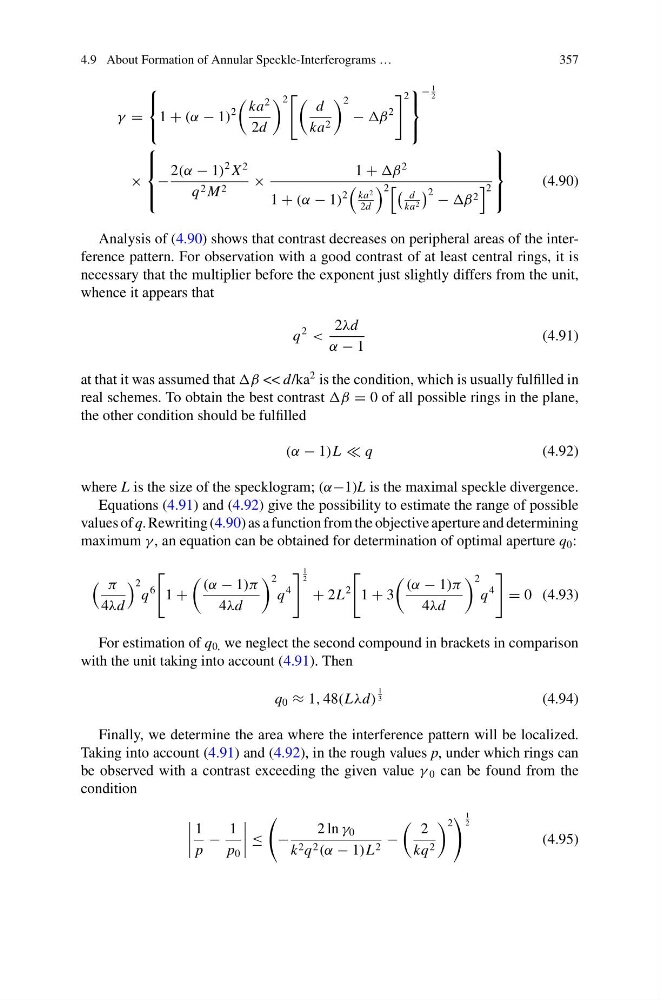
Analysis of (4.90) shows that contrast decreases on peripheral areas of the interference pattern. For observation with a good contrast of at least central rings, it is
necessary that the multiplier before the exponent just slightly differs from the unit,
whence it appears that
q
2
<
2λd
α − 1
(4.91)
at that it was assumed that β << d/ka
2 is the condition, which is usually fulfilled in
real schemes. To obtain the best contrast β = 0 of all possible rings in the plane,
the other condition should be fulfilled
(α − 1)L q
(4.92)
where L is the size of the specklogram; (α−1)L is the maximal speckle divergence.
Equations (4.91) and (4.92) give the possibility to estimate the range of possible
values of q. Rewriting (4.90) as a function from the objective aperture and determining
maximum γ , an equation can be obtained for determination of optimal aperture q 0 :
π
4λd
2
q
6
1 +
(α − 1)π
4λd
2
q
4
1
2
+ 2L
2
1 + 3
(α − 1)π
4λd
2
q
4
= 0 (4.93)
For estimation of q 0, we neglect the second compound in brackets in comparison
with the unit taking into account (4.91). Then
q 0 ≈ 1, 48(Lλd)
1
3
(4.94)
Finally, we determine the area where the interference pattern will be localized.
Taking into account (4.91) and (4.92), in the rough values p, under which rings can
be observed with a contrast exceeding the given value γ 0 can be found from the
condition
1
p
−
1
p 0
≤
−
2 ln γ 0
k 2 q 2 (α − 1)L 2 −
2
kq 2
2
1
2
(4.95)
357
γ =
⎧
⎨
⎩
1 + (α − 1)
2
ka
2
2d
2
d
ka 2
2
− β
2
2
⎫
⎬
⎭
−
1
2
×
⎧
⎪ ⎨
⎪ ⎩
−
2(α − 1)
2 X
2
q 2 M 2
×
1 + β
2
1 + (α − 1)
2
ka 2
2d
2 d
ka 2
2 − β 2
2
⎫
⎪ ⎬
⎪ ⎭
(4.90)
Analysis of (4.90) shows that contrast decreases on peripheral areas of the interference pattern. For observation with a good contrast of at least central rings, it is
necessary that the multiplier before the exponent just slightly differs from the unit,
whence it appears that
q
2
<
2λd
α − 1
(4.91)
at that it was assumed that β << d/ka
2 is the condition, which is usually fulfilled in
real schemes. To obtain the best contrast β = 0 of all possible rings in the plane,
the other condition should be fulfilled
(α − 1)L q
(4.92)
where L is the size of the specklogram; (α−1)L is the maximal speckle divergence.
Equations (4.91) and (4.92) give the possibility to estimate the range of possible
values of q. Rewriting (4.90) as a function from the objective aperture and determining
maximum γ , an equation can be obtained for determination of optimal aperture q 0 :
π
4λd
2
q
6
1 +
(α − 1)π
4λd
2
q
4
1
2
+ 2L
2
1 + 3
(α − 1)π
4λd
2
q
4
= 0 (4.93)
For estimation of q 0, we neglect the second compound in brackets in comparison
with the unit taking into account (4.91). Then
q 0 ≈ 1, 48(Lλd)
1
3
(4.94)
Finally, we determine the area where the interference pattern will be localized.
Taking into account (4.91) and (4.92), in the rough values p, under which rings can
be observed with a contrast exceeding the given value γ 0 can be found from the
condition
1
p
−
1
p 0
≤
−
2 ln γ 0
k 2 q 2 (α − 1)L 2 −
2
kq 2
2
1
2
(4.95)