

336
4 Speckle-Optical Methods and Devices for Studying …
Let us assume that time-varying amplitude of speckles obeys Gaussian statistics. In
this case for speckle intensity
I ( x, t) = |V ( x, t)|
2
autocorrelation function of speckle intensity fluctuations determined as
I ( x, t) = I ( x, t) − I ( x, t)
is expressed through
I ( x, t 1 )I ( x, t 2 ) = I ( x, z 1 )I ( x, z 2 )
= I ( x, z 1 )I ( x, z 2 )|γ ( x, z 1 , z 2 )|
2
(4.47)
The task of calculation of correlated function of speckle intensity fluctuations is
reduced to calculation of the correlated function ( x, z 1 , z 2 ) of changes of speckle
amplitude. Main parameters, which characterize dynamic speckle-field under longitudinal oscillations of the diffuse object, are the correlation function and density
of power spectrum of speckle intensity fluctuations [107, 110]. It follows from
(4.47) that for their determination it is necessary to calculate squared module of
the autocorrelation function ( x, z 1 , z 2 ) of time-varying speckles. Squared module
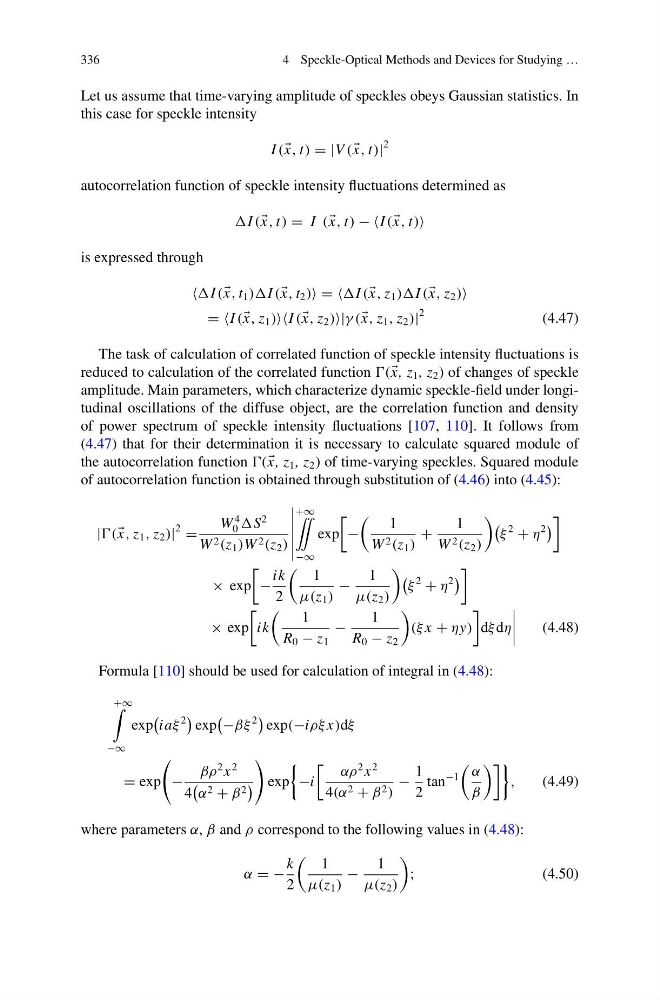
of autocorrelation function is obtained through substitution of (4.46) into (4.45):
|( x, z 1 , z 2 )|
2 =
W
4
0 S
2
W 2 (z 1 )W 2 (z 2 )
+∞
¨
−∞
exp
−
1
W 2 (z 1 )
+
1
W 2 (z 2 )
ξ
2
+ η
2
× exp
−
ik
2
1
μ(z 1 )
−
1
μ(z 2 )
ξ
2
+ η
2
× exp
ik
1
R 0 − z 1
−
1
R 0 − z 2
(ξ x + ηy)
dξ dη
(4.48)
Formula [110] should be used for calculation of integral in (4.48):
+∞
−∞
exp
iaξ
2
exp
−βξ
2
exp(−iρξ x)dξ
= exp
−
βρ
2 x
2
4
α 2 + β 2
exp
−i
αρ
2 x
2
4(α 2 + β 2 )
−
1
2
tan
−1
α
β
,
(4.49)
where parameters α, β and ρ correspond to the following values in (4.48):
α = −
k
2
1
μ(z 1 )
−
1
μ(z 2 )
;
(4.50)
4 Speckle-Optical Methods and Devices for Studying …
Let us assume that time-varying amplitude of speckles obeys Gaussian statistics. In
this case for speckle intensity
I ( x, t) = |V ( x, t)|
2
autocorrelation function of speckle intensity fluctuations determined as
I ( x, t) = I ( x, t) − I ( x, t)
is expressed through
I ( x, t 1 )I ( x, t 2 ) = I ( x, z 1 )I ( x, z 2 )
= I ( x, z 1 )I ( x, z 2 )|γ ( x, z 1 , z 2 )|
2
(4.47)
The task of calculation of correlated function of speckle intensity fluctuations is
reduced to calculation of the correlated function ( x, z 1 , z 2 ) of changes of speckle
amplitude. Main parameters, which characterize dynamic speckle-field under longitudinal oscillations of the diffuse object, are the correlation function and density
of power spectrum of speckle intensity fluctuations [107, 110]. It follows from
(4.47) that for their determination it is necessary to calculate squared module of
the autocorrelation function ( x, z 1 , z 2 ) of time-varying speckles. Squared module
of autocorrelation function is obtained through substitution of (4.46) into (4.45):
|( x, z 1 , z 2 )|
2 =
W
4
0 S
2
W 2 (z 1 )W 2 (z 2 )
+∞
¨
−∞
exp
−
1
W 2 (z 1 )
+
1
W 2 (z 2 )
ξ
2
+ η
2
× exp
−
ik
2
1
μ(z 1 )
−
1
μ(z 2 )
ξ
2
+ η
2
× exp
ik
1
R 0 − z 1
−
1
R 0 − z 2
(ξ x + ηy)
dξ dη
(4.48)
Formula [110] should be used for calculation of integral in (4.48):
+∞
−∞
exp
iaξ
2
exp
−βξ
2
exp(−iρξ x)dξ
= exp
−
βρ
2 x
2
4
α 2 + β 2
exp
−i
αρ
2 x
2
4(α 2 + β 2 )
−
1
2
tan
−1
α
β
,
(4.49)
where parameters α, β and ρ correspond to the following values in (4.48):
α = −
k
2
1
μ(z 1 )
−
1
μ(z 2 )
;
(4.50)