

334
4 Speckle-Optical Methods and Devices for Studying …
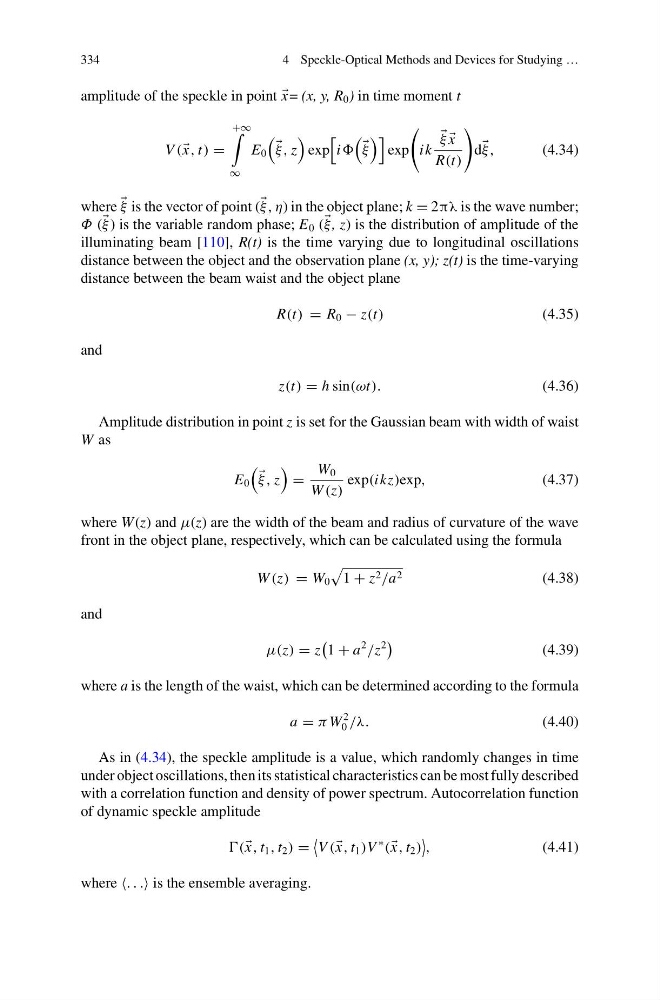
amplitude of the speckle in point
x= (x, y, R 0 ) in time moment t
V ( x, t) =
+∞
∞
E 0
ξ, z
exp
i
ξ
exp
ik
ξ
x
R(t)
d
ξ,
(4.34)
where
ξ is the vector of point (
ξ , η) in the object plane; k = 2πλ is the wave number;
Φ (
ξ ) is the variable random phase; E 0 (
ξ , z) is the distribution of amplitude of the
illuminating beam [110], R(t) is the time varying due to longitudinal oscillations
distance between the object and the observation plane (x, y); z(t) is the time-varying
distance between the beam waist and the object plane
R(t) = R 0 − z(t)
(4.35)
and
z(t) = h sin(ωt).
(4.36)
Amplitude distribution in point z is set for the Gaussian beam with width of waist
W as
E 0
ξ, z
=
W 0
W (z)
exp(ikz)exp,
(4.37)
where W (z) and μ(z) are the width of the beam and radius of curvature of the wave
front in the object plane, respectively, which can be calculated using the formula
W (z) = W 0
1 + z 2 /a 2
(4.38)
and
μ(z) = z
1 + a
2
/z
2
(4.39)
where a is the length of the waist, which can be determined according to the formula
a = π W
2
0 /λ.
(4.40)
As in (4.34), the speckle amplitude is a value, which randomly changes in time
under object oscillations, then its statistical characteristics can be most fully described
with a correlation function and density of power spectrum. Autocorrelation function
of dynamic speckle amplitude
( x, t 1 , t 2 ) =
V ( x, t 1 )V
∗
( x, t 2 )
,
(4.41)
where . . . is the ensemble averaging.
4 Speckle-Optical Methods and Devices for Studying …
amplitude of the speckle in point
x= (x, y, R 0 ) in time moment t
V ( x, t) =
+∞
∞
E 0
ξ, z
exp
i
ξ
exp
ik
ξ
x
R(t)
d
ξ,
(4.34)
where
ξ is the vector of point (
ξ , η) in the object plane; k = 2πλ is the wave number;
Φ (
ξ ) is the variable random phase; E 0 (
ξ , z) is the distribution of amplitude of the
illuminating beam [110], R(t) is the time varying due to longitudinal oscillations
distance between the object and the observation plane (x, y); z(t) is the time-varying
distance between the beam waist and the object plane
R(t) = R 0 − z(t)
(4.35)
and
z(t) = h sin(ωt).
(4.36)
Amplitude distribution in point z is set for the Gaussian beam with width of waist
W as
E 0
ξ, z
=
W 0
W (z)
exp(ikz)exp,
(4.37)
where W (z) and μ(z) are the width of the beam and radius of curvature of the wave
front in the object plane, respectively, which can be calculated using the formula
W (z) = W 0
1 + z 2 /a 2
(4.38)
and
μ(z) = z
1 + a
2
/z
2
(4.39)
where a is the length of the waist, which can be determined according to the formula
a = π W
2
0 /λ.
(4.40)
As in (4.34), the speckle amplitude is a value, which randomly changes in time
under object oscillations, then its statistical characteristics can be most fully described
with a correlation function and density of power spectrum. Autocorrelation function
of dynamic speckle amplitude
( x, t 1 , t 2 ) =
V ( x, t 1 )V
∗
( x, t 2 )
,
(4.41)
where . . . is the ensemble averaging.