

332
4 Speckle-Optical Methods and Devices for Studying …
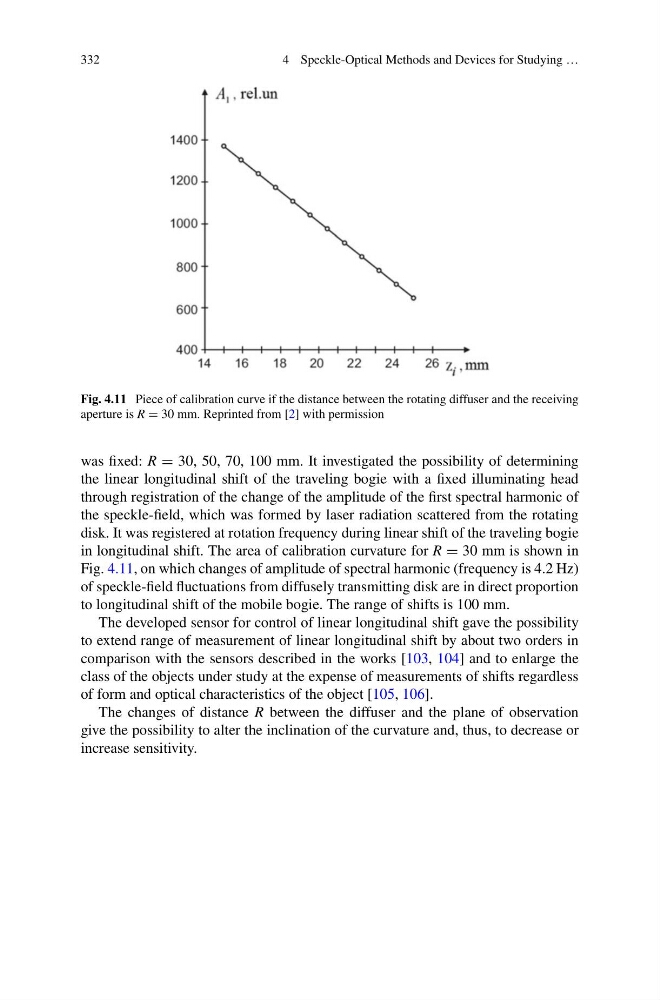
Fig. 4.11 Piece of calibration curve if the distance between the rotating diffuser and the receiving
aperture is R = 30 mm. Reprinted from [2] with permission
was fixed: R = 30, 50, 70, 100 mm. It investigated the possibility of determining
the linear longitudinal shift of the traveling bogie with a fixed illuminating head
through registration of the change of the amplitude of the first spectral harmonic of
the speckle-field, which was formed by laser radiation scattered from the rotating
disk. It was registered at rotation frequency during linear shift of the traveling bogie
in longitudinal shift. The area of calibration curvature for R = 30 mm is shown in
Fig. 4.11, on which changes of amplitude of spectral harmonic (frequency is 4.2 Hz)
of speckle-field fluctuations from diffusely transmitting disk are in direct proportion
to longitudinal shift of the mobile bogie. The range of shifts is 100 mm.
The developed sensor for control of linear longitudinal shift gave the possibility
to extend range of measurement of linear longitudinal shift by about two orders in
comparison with the sensors described in the works [103, 104] and to enlarge the
class of the objects under study at the expense of measurements of shifts regardless
of form and optical characteristics of the object [105, 106].
The changes of distance R between the diffuser and the plane of observation
give the possibility to alter the inclination of the curvature and, thus, to decrease or
increase sensitivity.
4 Speckle-Optical Methods and Devices for Studying …
Fig. 4.11 Piece of calibration curve if the distance between the rotating diffuser and the receiving
aperture is R = 30 mm. Reprinted from [2] with permission
was fixed: R = 30, 50, 70, 100 mm. It investigated the possibility of determining
the linear longitudinal shift of the traveling bogie with a fixed illuminating head
through registration of the change of the amplitude of the first spectral harmonic of
the speckle-field, which was formed by laser radiation scattered from the rotating
disk. It was registered at rotation frequency during linear shift of the traveling bogie
in longitudinal shift. The area of calibration curvature for R = 30 mm is shown in
Fig. 4.11, on which changes of amplitude of spectral harmonic (frequency is 4.2 Hz)
of speckle-field fluctuations from diffusely transmitting disk are in direct proportion
to longitudinal shift of the mobile bogie. The range of shifts is 100 mm.
The developed sensor for control of linear longitudinal shift gave the possibility
to extend range of measurement of linear longitudinal shift by about two orders in
comparison with the sensors described in the works [103, 104] and to enlarge the
class of the objects under study at the expense of measurements of shifts regardless
of form and optical characteristics of the object [105, 106].
The changes of distance R between the diffuser and the plane of observation
give the possibility to alter the inclination of the curvature and, thus, to decrease or
increase sensitivity.