

4.2 Application of Spectral Characteristics of Dynamic Speckle-Field …
325
amplitude of spectral harmonic on this frequency:
A I (ν) =
1
√
2π
exp
−π
2
ν
2
υ
2
1
λRa
2
2 +
π W
2
0
z
2
+ a
2
+ Rz
2
(λRW 0 a)
2
+
z 2 + a 2
.
(4.31)
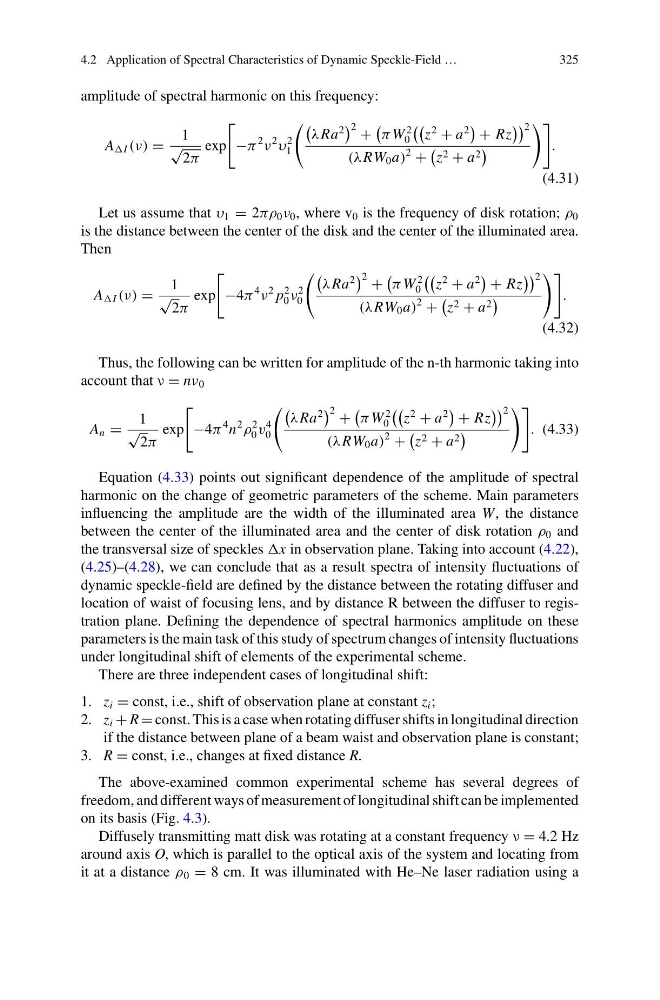
Let us assume that υ 1 = 2πρ 0 ν 0 , where v 0 is the frequency of disk rotation; ρ 0
is the distance between the center of the disk and the center of the illuminated area.
Then
A I (ν) =
1
√
2π
exp
−4π
4
ν
2 p
2
0 ν
2
0
λRa
2
2 +
π W
2
0
z
2
+ a
2
+ Rz
2
(λRW 0 a)
2
+
z 2 + a 2
.
(4.32)
Thus, the following can be written for amplitude of the n-th harmonic taking into
account that ν = nν 0
A n =
1
√
2π
exp
−4π
4 n
2
ρ
2
0 v
4
0
λRa
2
2 +
π W
2
0
z
2
+ a
2
+ Rz
2
(λRW 0 a)
2
+
z 2 + a 2
. (4.33)
Equation (4.33) points out significant dependence of the amplitude of spectral
harmonic on the change of geometric parameters of the scheme. Main parameters
influencing the amplitude are the width of the illuminated area W, the distance
between the center of the illuminated area and the center of disk rotation ρ 0 and
the transversal size of speckles x in observation plane. Taking into account (4.22),
(4.25)–(4.28), we can conclude that as a result spectra of intensity fluctuations of
dynamic speckle-field are defined by the distance between the rotating diffuser and
location of waist of focusing lens, and by distance R between the diffuser to registration plane. Defining the dependence of spectral harmonics amplitude on these
parameters is the main task of this study of spectrum changes of intensity fluctuations
under longitudinal shift of elements of the experimental scheme.
There are three independent cases of longitudinal shift:
1. z i = const, i.e., shift of observation plane at constant z i ;
2. z i + R = const. This is a case when rotating diffuser shifts in longitudinal direction
if the distance between plane of a beam waist and observation plane is constant;
3. R = const, i.e., changes at fixed distance R.
The above-examined common experimental scheme has several degrees of
freedom, and different ways of measurement of longitudinal shift can be implemented
on its basis (Fig. 4.3).
Diffusely transmitting matt disk was rotating at a constant frequency ν = 4.2 Hz
around axis O, which is parallel to the optical axis of the system and locating from
it at a distance ρ 0 = 8 cm. It was illuminated with He–Ne laser radiation using a
325
amplitude of spectral harmonic on this frequency:
A I (ν) =
1
√
2π
exp
−π
2
ν
2
υ
2
1
λRa
2
2 +
π W
2
0
z
2
+ a
2
+ Rz
2
(λRW 0 a)
2
+
z 2 + a 2
.
(4.31)
Let us assume that υ 1 = 2πρ 0 ν 0 , where v 0 is the frequency of disk rotation; ρ 0
is the distance between the center of the disk and the center of the illuminated area.
Then
A I (ν) =
1
√
2π
exp
−4π
4
ν
2 p
2
0 ν
2
0
λRa
2
2 +
π W
2
0
z
2
+ a
2
+ Rz
2
(λRW 0 a)
2
+
z 2 + a 2
.
(4.32)
Thus, the following can be written for amplitude of the n-th harmonic taking into
account that ν = nν 0
A n =
1
√
2π
exp
−4π
4 n
2
ρ
2
0 v
4
0
λRa
2
2 +
π W
2
0
z
2
+ a
2
+ Rz
2
(λRW 0 a)
2
+
z 2 + a 2
. (4.33)
Equation (4.33) points out significant dependence of the amplitude of spectral
harmonic on the change of geometric parameters of the scheme. Main parameters
influencing the amplitude are the width of the illuminated area W, the distance
between the center of the illuminated area and the center of disk rotation ρ 0 and
the transversal size of speckles x in observation plane. Taking into account (4.22),
(4.25)–(4.28), we can conclude that as a result spectra of intensity fluctuations of
dynamic speckle-field are defined by the distance between the rotating diffuser and
location of waist of focusing lens, and by distance R between the diffuser to registration plane. Defining the dependence of spectral harmonics amplitude on these
parameters is the main task of this study of spectrum changes of intensity fluctuations
under longitudinal shift of elements of the experimental scheme.
There are three independent cases of longitudinal shift:
1. z i = const, i.e., shift of observation plane at constant z i ;
2. z i + R = const. This is a case when rotating diffuser shifts in longitudinal direction
if the distance between plane of a beam waist and observation plane is constant;
3. R = const, i.e., changes at fixed distance R.
The above-examined common experimental scheme has several degrees of
freedom, and different ways of measurement of longitudinal shift can be implemented
on its basis (Fig. 4.3).
Diffusely transmitting matt disk was rotating at a constant frequency ν = 4.2 Hz
around axis O, which is parallel to the optical axis of the system and locating from
it at a distance ρ 0 = 8 cm. It was illuminated with He–Ne laser radiation using a