

8
1 Resonance Methods for Increasing Sensitivity of Interferometry …
here G is the Green’s function of wave function for G;
∂
∂n
is the normal derivative to
the surface S.
Equation (1.4) is written for the private presentation of mutual-coherence function
ˇ
:
(r 1 , r 2 , τ ) =
∞
0
(r 1 , r 2 , ν)exp(−2πντ )dν
(1.5)
Supposing that different points of the radiator surface give off uncorrelated light,
i.e., on the surface:
S, S
, ν
= δ s
S −
S
(S, ν),
(1.6)
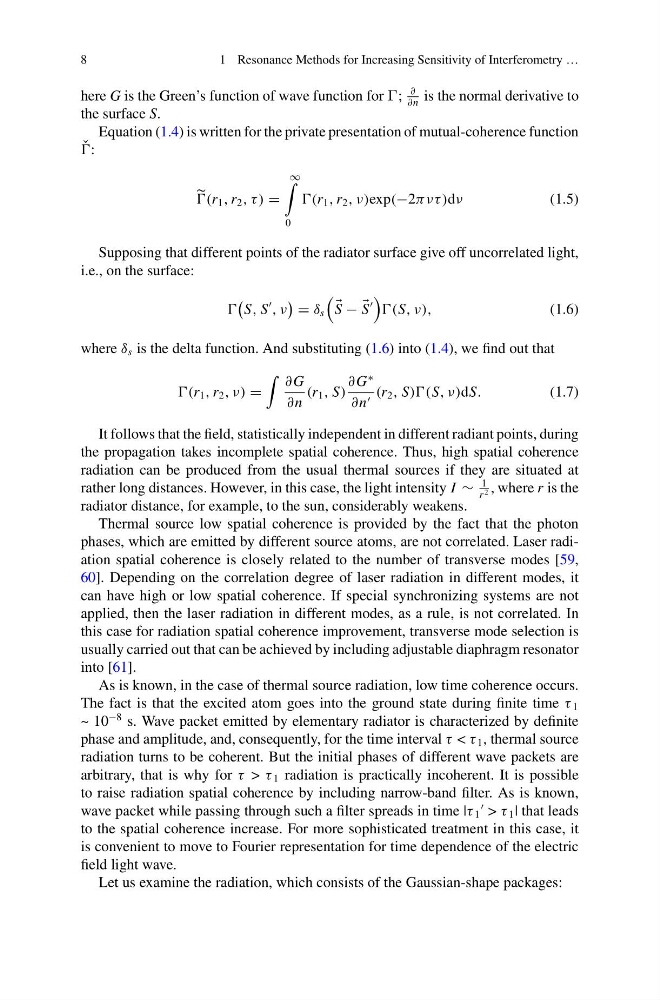
where δ s is the delta function. And substituting (1.6) into (1.4), we find out that
(r 1 , r 2 , ν) =
∂G
∂n
(r 1 , S)
∂G
∗
∂n (r 2 , S))(S, ν)dS.
(1.7)
It follows that the field, statistically independent in different radiant points, during
the propagation takes incomplete spatial coherence. Thus, high spatial coherence
radiation can be produced from the usual thermal sources if they are situated at
rather long distances. However, in this case, the light intensity I ∼
1
r 2 , where r is the
radiator distance, for example, to the sun, considerably weakens.
Thermal source low spatial coherence is provided by the fact that the photon
phases, which are emitted by different source atoms, are not correlated. Laser radiation spatial coherence is closely related to the number of transverse modes [59,
60]. Depending on the correlation degree of laser radiation in different modes, it
can have high or low spatial coherence. If special synchronizing systems are not
applied, then the laser radiation in different modes, as a rule, is not correlated. In
this case for radiation spatial coherence improvement, transverse mode selection is
usually carried out that can be achieved by including adjustable diaphragm resonator
into [61].
As is known, in the case of thermal source radiation, low time coherence occurs.
The fact is that the excited atom goes into the ground state during finite time τ 1
~ 10
−8 s. Wave packet emitted by elementary radiator is characterized by definite
phase and amplitude, and, consequently, for the time interval τ < τ 1 , thermal source
radiation turns to be coherent. But the initial phases of different wave packets are
arbitrary, that is why for τ > τ 1 radiation is practically incoherent. It is possible
to raise radiation spatial coherence by including narrow-band filter. As is known,
wave packet while passing through such a filter spreads in time |τ 1
> τ 1 | that leads
to the spatial coherence increase. For more sophisticated treatment in this case, it
is convenient to move to Fourier representation for time dependence of the electric
field light wave.
Let us examine the radiation, which consists of the Gaussian-shape packages:
1 Resonance Methods for Increasing Sensitivity of Interferometry …
here G is the Green’s function of wave function for G;
∂
∂n
is the normal derivative to
the surface S.
Equation (1.4) is written for the private presentation of mutual-coherence function
ˇ
:
(r 1 , r 2 , τ ) =
∞
0
(r 1 , r 2 , ν)exp(−2πντ )dν
(1.5)
Supposing that different points of the radiator surface give off uncorrelated light,
i.e., on the surface:
S, S
, ν
= δ s
S −
S
(S, ν),
(1.6)
where δ s is the delta function. And substituting (1.6) into (1.4), we find out that
(r 1 , r 2 , ν) =
∂G
∂n
(r 1 , S)
∂G
∗
∂n (r 2 , S))(S, ν)dS.
(1.7)
It follows that the field, statistically independent in different radiant points, during
the propagation takes incomplete spatial coherence. Thus, high spatial coherence
radiation can be produced from the usual thermal sources if they are situated at
rather long distances. However, in this case, the light intensity I ∼
1
r 2 , where r is the
radiator distance, for example, to the sun, considerably weakens.
Thermal source low spatial coherence is provided by the fact that the photon
phases, which are emitted by different source atoms, are not correlated. Laser radiation spatial coherence is closely related to the number of transverse modes [59,
60]. Depending on the correlation degree of laser radiation in different modes, it
can have high or low spatial coherence. If special synchronizing systems are not
applied, then the laser radiation in different modes, as a rule, is not correlated. In
this case for radiation spatial coherence improvement, transverse mode selection is
usually carried out that can be achieved by including adjustable diaphragm resonator
into [61].
As is known, in the case of thermal source radiation, low time coherence occurs.
The fact is that the excited atom goes into the ground state during finite time τ 1
~ 10
−8 s. Wave packet emitted by elementary radiator is characterized by definite
phase and amplitude, and, consequently, for the time interval τ < τ 1 , thermal source
radiation turns to be coherent. But the initial phases of different wave packets are
arbitrary, that is why for τ > τ 1 radiation is practically incoherent. It is possible
to raise radiation spatial coherence by including narrow-band filter. As is known,
wave packet while passing through such a filter spreads in time |τ 1
> τ 1 | that leads
to the spatial coherence increase. For more sophisticated treatment in this case, it
is convenient to move to Fourier representation for time dependence of the electric
field light wave.
Let us examine the radiation, which consists of the Gaussian-shape packages: