

1.2 Spatial Coherence of Rhodamine 6G Laser Radiation …
7
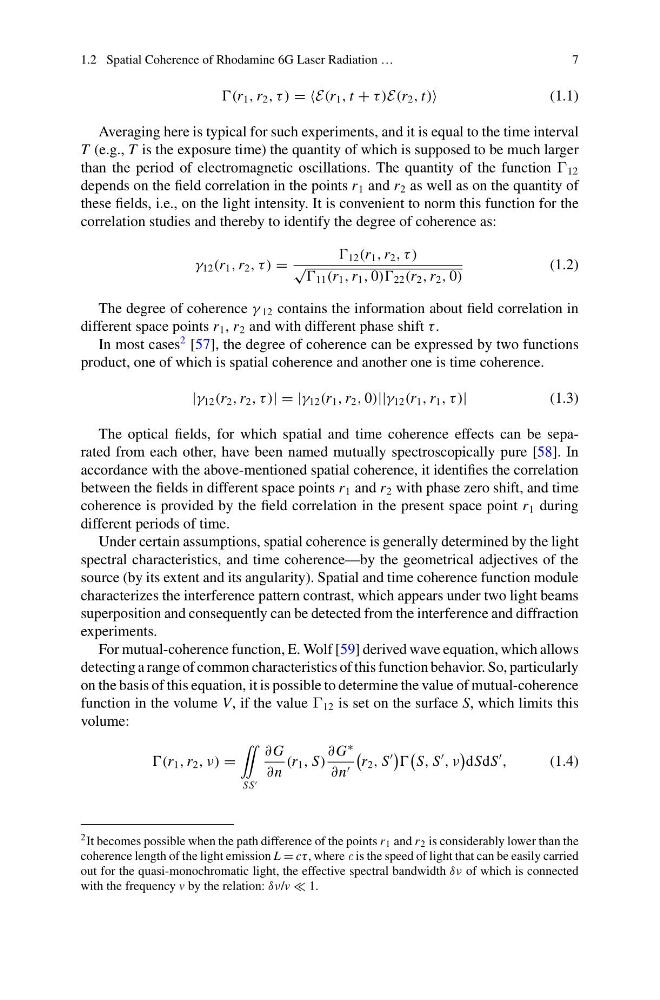
(r 1 , r 2 , τ ) = =E(r 1 , t + τ )E(r 2 , t)
(1.1)
Averaging here is typical for such experiments, and it is equal to the time interval
T (e.g., T is the exposure time) the quantity of which is supposed to be much larger
than the period of electromagnetic oscillations. The quantity of the function G 12
depends on the field correlation in the points r 1 and r 2 as well as on the quantity of
these fields, i.e., on the light intensity. It is convenient to norm this function for the
correlation studies and thereby to identify the degree of coherence as:
γ 12 (r 1 , r 2 , τ ) =
12 (r 1 , r 2 , τ )
√
11 (r 1 , r 1 , 0) 22 (r 2 , r 2 , 0)
(1.2)
The degree of coherence γ 12 contains the information about field correlation in
different space points r 1 , r 2 and with different phase shift τ.
In most cases
2 [57], the degree of coherence can be expressed by two functions
product, one of which is spatial coherence and another one is time coherence.
|γ 12 (r 2 , r 2 , τ )| = |γ 12 (r 1 , r 2 , 0)||γ 12 (r 1 , r 1 , τ )|
(1.3)
The optical fields, for which spatial and time coherence effects can be separated from each other, have been named mutually spectroscopically pure [58]. In
accordance with the above-mentioned spatial coherence, it identifies the correlation
between the fields in different space points r 1 and r 2 with phase zero shift, and time
coherence is provided by the field correlation in the present space point r 1 during
different periods of time.
Under certain assumptions, spatial coherence is generally determined by the light
spectral characteristics, and time coherence—by the geometrical adjectives of the
source (by its extent and its angularity). Spatial and time coherence function module
characterizes the interference pattern contrast, which appears under two light beams
superposition and consequently can be detected from the interference and diffraction
experiments.
For mutual-coherence function, E. Wolf [59] derived wave equation, which allows
detecting a range of common characteristics of this function behavior. So, particularly
on the basis of this equation, it is possible to determine the value of mutual-coherence
function in the volume V, if the value G 12 is set on the surface S, which limits this
volume:
(r 1 , r 2 , ν) =
¨
SS
∂G
∂n
(r 1 , S)
∂G
∗
∂n
r 2 , S
S, S
, ν
dSdS
,
(1.4)
2 It becomes possible when the path difference of the points r 1 and r 2 is considerably lower than the
coherence length of the light emission L = cτ, where s is the speed of light that can be easily carried
out for the quasi-monochromatic light, the effective spectral bandwidth δν of which is connected
with the frequency v by the relation: δν/v 1.
7
(r 1 , r 2 , τ ) = =E(r 1 , t + τ )E(r 2 , t)
(1.1)
Averaging here is typical for such experiments, and it is equal to the time interval
T (e.g., T is the exposure time) the quantity of which is supposed to be much larger
than the period of electromagnetic oscillations. The quantity of the function G 12
depends on the field correlation in the points r 1 and r 2 as well as on the quantity of
these fields, i.e., on the light intensity. It is convenient to norm this function for the
correlation studies and thereby to identify the degree of coherence as:
γ 12 (r 1 , r 2 , τ ) =
12 (r 1 , r 2 , τ )
√
11 (r 1 , r 1 , 0) 22 (r 2 , r 2 , 0)
(1.2)
The degree of coherence γ 12 contains the information about field correlation in
different space points r 1 , r 2 and with different phase shift τ.
In most cases
2 [57], the degree of coherence can be expressed by two functions
product, one of which is spatial coherence and another one is time coherence.
|γ 12 (r 2 , r 2 , τ )| = |γ 12 (r 1 , r 2 , 0)||γ 12 (r 1 , r 1 , τ )|
(1.3)
The optical fields, for which spatial and time coherence effects can be separated from each other, have been named mutually spectroscopically pure [58]. In
accordance with the above-mentioned spatial coherence, it identifies the correlation
between the fields in different space points r 1 and r 2 with phase zero shift, and time
coherence is provided by the field correlation in the present space point r 1 during
different periods of time.
Under certain assumptions, spatial coherence is generally determined by the light
spectral characteristics, and time coherence—by the geometrical adjectives of the
source (by its extent and its angularity). Spatial and time coherence function module
characterizes the interference pattern contrast, which appears under two light beams
superposition and consequently can be detected from the interference and diffraction
experiments.
For mutual-coherence function, E. Wolf [59] derived wave equation, which allows
detecting a range of common characteristics of this function behavior. So, particularly
on the basis of this equation, it is possible to determine the value of mutual-coherence
function in the volume V, if the value G 12 is set on the surface S, which limits this
volume:
(r 1 , r 2 , ν) =
¨
SS
∂G
∂n
(r 1 , S)
∂G
∗
∂n
r 2 , S
S, S
, ν
dSdS
,
(1.4)
2 It becomes possible when the path difference of the points r 1 and r 2 is considerably lower than the
coherence length of the light emission L = cτ, where s is the speed of light that can be easily carried
out for the quasi-monochromatic light, the effective spectral bandwidth δν of which is connected
with the frequency v by the relation: δν/v 1.