

322
4 Speckle-Optical Methods and Devices for Studying …
− sin(ωτ )
kW
2z
2
P −
z
μ
d
A
p
+
ik
z
1
2
(1 + cos(ωτ ))
d
p − sin(ωτ )
P
A
d −
P
p
(4.14)
where it is supposed that scalar product of vectors and p means quantity of vector
p.
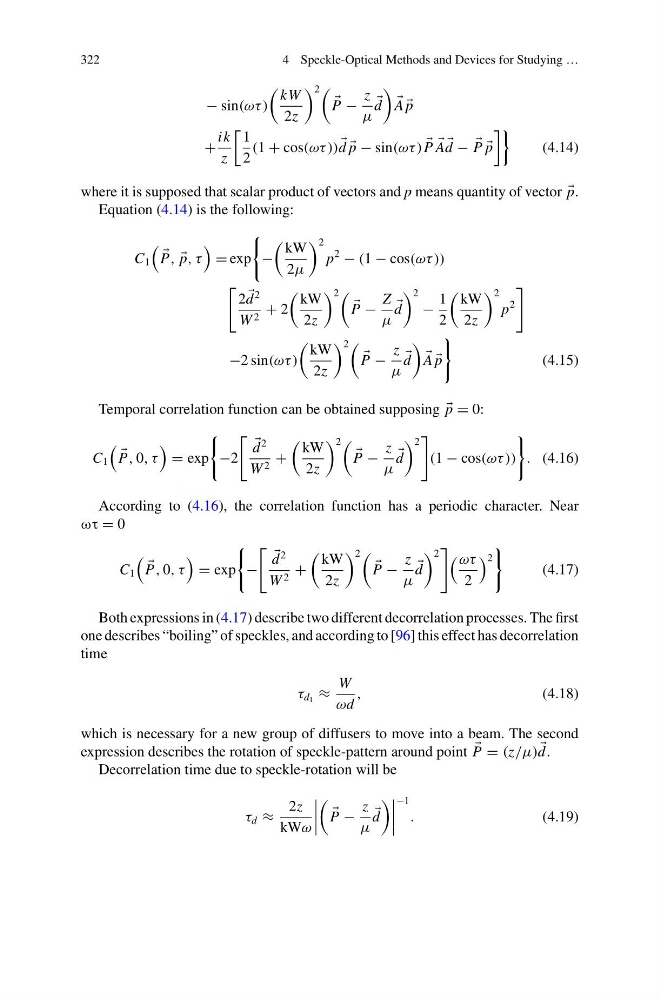
Equation (4.14) is the following:
C 1
P,
p, τ
= exp
−
kW
2μ
2
p
2
− (1 − cos(ωτ ))
2
d
2
W 2 + 2
kW
2z
2
P −
Z
μ
d
2
−
1
2
kW
2z
2
p
2
−2 sin(ωτ )
kW
2z
2
P −
z
μ
d
A
p
(4.15)
Temporal correlation function can be obtained supposing
p = 0:
C 1
P, 0, τ
= exp
−2
d
2
W 2 +
kW
2z
2
P −
z
μ
d
2
(1 − cos(ωτ ))
. (4.16)
According to (4.16), the correlation function has a periodic character. Near
ωτ = 0
C 1
P, 0, τ
= exp
−
d
2
W 2 +
kW
2z
2
P −
z
μ
d
2
ωτ
2
2
(4.17)
Both expressions in (4.17) describe two different decorrelation processes. The first
one describes “boiling” of speckles, and according to [96] this effect has decorrelation
time
τ d 1 ≈
W
ωd
,
(4.18)
which is necessary for a new group of diffusers to move into a beam. The second
expression describes the rotation of speckle-pattern around point
P = (z/μ)
d.
Decorrelation time due to speckle-rotation will be
τ d ≈
2z
kWω
P −
z
μ
d
−1
.
(4.19)
4 Speckle-Optical Methods and Devices for Studying …
− sin(ωτ )
kW
2z
2
P −
z
μ
d
A
p
+
ik
z
1
2
(1 + cos(ωτ ))
d
p − sin(ωτ )
P
A
d −
P
p
(4.14)
where it is supposed that scalar product of vectors and p means quantity of vector
p.
Equation (4.14) is the following:
C 1
P,
p, τ
= exp
−
kW
2μ
2
p
2
− (1 − cos(ωτ ))
2
d
2
W 2 + 2
kW
2z
2
P −
Z
μ
d
2
−
1
2
kW
2z
2
p
2
−2 sin(ωτ )
kW
2z
2
P −
z
μ
d
A
p
(4.15)
Temporal correlation function can be obtained supposing
p = 0:
C 1
P, 0, τ
= exp
−2
d
2
W 2 +
kW
2z
2
P −
z
μ
d
2
(1 − cos(ωτ ))
. (4.16)
According to (4.16), the correlation function has a periodic character. Near
ωτ = 0
C 1
P, 0, τ
= exp
−
d
2
W 2 +
kW
2z
2
P −
z
μ
d
2
ωτ
2
2
(4.17)
Both expressions in (4.17) describe two different decorrelation processes. The first
one describes “boiling” of speckles, and according to [96] this effect has decorrelation
time
τ d 1 ≈
W
ωd
,
(4.18)
which is necessary for a new group of diffusers to move into a beam. The second
expression describes the rotation of speckle-pattern around point
P = (z/μ)
d.
Decorrelation time due to speckle-rotation will be
τ d ≈
2z
kWω
P −
z
μ
d
−1
.
(4.19)