

4.1 Correlation and Spectral Characteristics of Dynamic Speckle-Field …
321
This operator transforms vector
ρ 1 into vector of the same quantity but directed
perpendicular to
ρ 1 and is parallel to the current velocity of the disk in point
ρ 1 .
Expressing
ρ 1 and
A
ρ 1 =
x 1
y 1
,
(4.9)
A =
0
−1
1
0
(4.10)
so that
ρ
1 =
x 1
y 1
cos(ωτ ) +
0
−1
1
0
x 1
y 1
sin(ωτ ) =
x 1 cos(ωτ ) + y 1 sin(ωτ )
y 1 cos(ωτ ) − x 1 sin(ωτ )
.
(4.11)
We suppose that the disk is illuminated by a Gaussian beam, the center of which
is situated in point
d. Thus, the illuminating field can be written in the following
form [100]:
V 1 (
ρ 1 , t) = V 0 exp
−
1
W 2 +
ik
2μ
p −
d
2
,
(4.12)
where V 0 is the field amplitude in the center of illuminated disk area; W is the radius
of 1/e
2 intensity of illuminated region; μ is the curvature radius of the wave front.
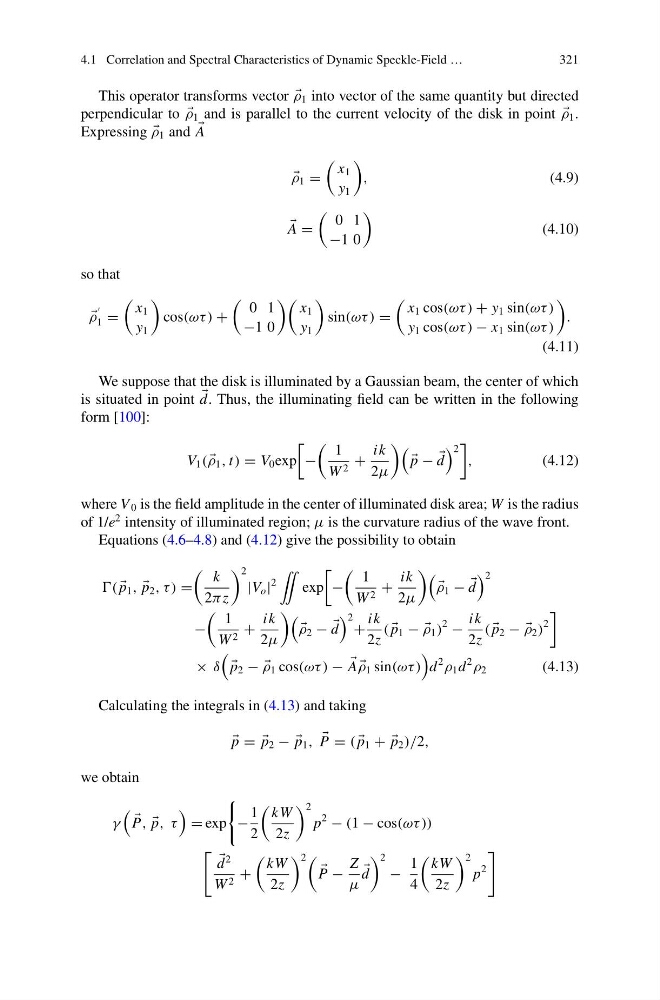
Equations (4.6–4.8) and (4.12) give the possibility to obtain
(
p 1 ,
p 2 , τ ) =
k
2π z
2
|V o |
2
¨
exp
−
1
W 2 +
ik
2μ
ρ 1 −
d
2
−
1
W 2 +
ik
2μ
ρ 2 −
d
2 +
ik
2z
(
p 1 − −
ρ 1 )
2 −
ik
2z
(
p 2 − −
ρ 2 )
2
× δ
p 2 − −
ρ 1 cos(ωτ ) −
A
ρ 1 sin(ωτ )
d
2
ρ 1 d
2
ρ 2
(4.13)
Calculating the integrals in (4.13) and taking
p = =
p 2 − −
p 1 ,
P = (
p 1 + +
p 2 )/2,
we obtain
γ
P,
p, τ
= exp
−
1
2
kW
2z
2
p
2
− (1 − cos(ωτ ))
d
2
W 2 +
kW
2z
2
P −
Z
μ
d
2
−
1
4
kW
2z
2
p
2
321
This operator transforms vector
ρ 1 into vector of the same quantity but directed
perpendicular to
ρ 1 and is parallel to the current velocity of the disk in point
ρ 1 .
Expressing
ρ 1 and
A
ρ 1 =
x 1
y 1
,
(4.9)
A =
0
−1
1
0
(4.10)
so that
ρ
1 =
x 1
y 1
cos(ωτ ) +
0
−1
1
0
x 1
y 1
sin(ωτ ) =
x 1 cos(ωτ ) + y 1 sin(ωτ )
y 1 cos(ωτ ) − x 1 sin(ωτ )
.
(4.11)
We suppose that the disk is illuminated by a Gaussian beam, the center of which
is situated in point
d. Thus, the illuminating field can be written in the following
form [100]:
V 1 (
ρ 1 , t) = V 0 exp
−
1
W 2 +
ik
2μ
p −
d
2
,
(4.12)
where V 0 is the field amplitude in the center of illuminated disk area; W is the radius
of 1/e
2 intensity of illuminated region; μ is the curvature radius of the wave front.
Equations (4.6–4.8) and (4.12) give the possibility to obtain
(
p 1 ,
p 2 , τ ) =
k
2π z
2
|V o |
2
¨
exp
−
1
W 2 +
ik
2μ
ρ 1 −
d
2
−
1
W 2 +
ik
2μ
ρ 2 −
d
2 +
ik
2z
(
p 1 − −
ρ 1 )
2 −
ik
2z
(
p 2 − −
ρ 2 )
2
× δ
p 2 − −
ρ 1 cos(ωτ ) −
A
ρ 1 sin(ωτ )
d
2
ρ 1 d
2
ρ 2
(4.13)
Calculating the integrals in (4.13) and taking
p = =
p 2 − −
p 1 ,
P = (
p 1 + +
p 2 )/2,
we obtain
γ
P,
p, τ
= exp
−
1
2
kW
2z
2
p
2
− (1 − cos(ωτ ))
d
2
W 2 +
kW
2z
2
P −
Z
μ
d
2
−
1
4
kW
2z
2
p
2