

3.4 Holographic Research Methods in Biology and Medicine
285
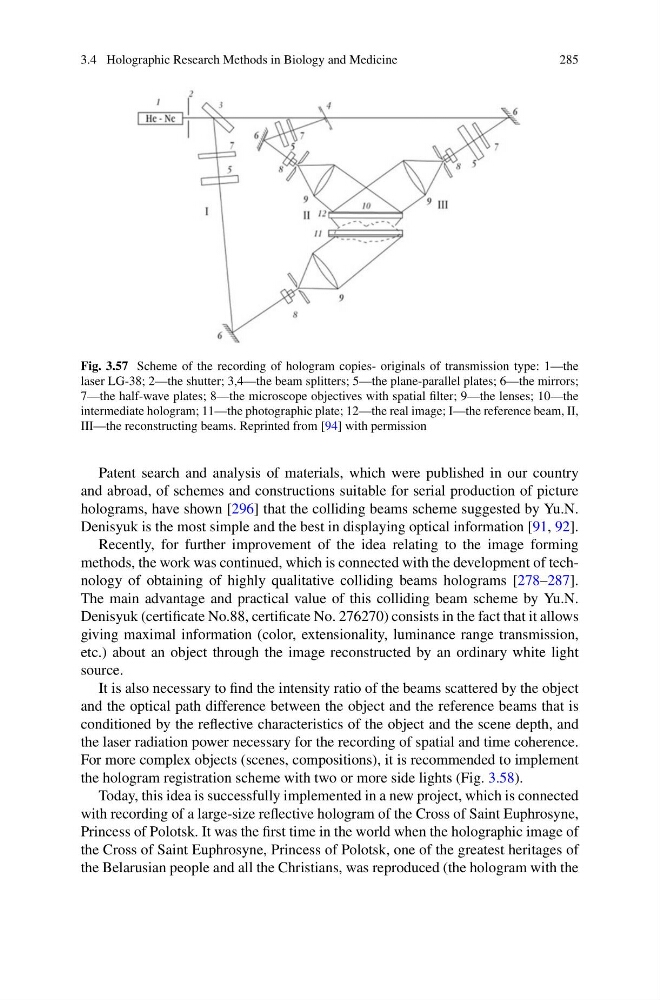
Fig. 3.57 Scheme of the recording of hologram copies- originals of transmission type: 1—the
laser LG-38; 2—the shutter; 3,4—the beam splitters; 5—the plane-parallel plates; 6—the mirrors;
7—the half-wave plates; 8—the microscope objectives with spatial filter; 9—the lenses; 10—the
intermediate hologram; 11—the photographic plate; 12—the real image; I—the reference beam, II,
III—the reconstructing beams. Reprinted from [94] with permission
Patent search and analysis of materials, which were published in our country
and abroad, of schemes and constructions suitable for serial production of picture
holograms, have shown [296] that the colliding beams scheme suggested by Yu.N.
Denisyuk is the most simple and the best in displaying optical information [91, 92].
Recently, for further improvement of the idea relating to the image forming
methods, the work was continued, which is connected with the development of technology of obtaining of highly qualitative colliding beams holograms [278–287].
The main advantage and practical value of this colliding beam scheme by Yu.N.
Denisyuk (certificate No.88, certificate No. 276270) consists in the fact that it allows
giving maximal information (color, extensionality, luminance range transmission,
etc.) about an object through the image reconstructed by an ordinary white light
source.
It is also necessary to find the intensity ratio of the beams scattered by the object
and the optical path difference between the object and the reference beams that is
conditioned by the reflective characteristics of the object and the scene depth, and
the laser radiation power necessary for the recording of spatial and time coherence.
For more complex objects (scenes, compositions), it is recommended to implement
the hologram registration scheme with two or more side lights (Fig. 3.58).
Today, this idea is successfully implemented in a new project, which is connected
with recording of a large-size reflective hologram of the Cross of Saint Euphrosyne,
Princess of Polotsk. It was the first time in the world when the holographic image of
the Cross of Saint Euphrosyne, Princess of Polotsk, one of the greatest heritages of
the Belarusian people and all the Christians, was reproduced (the hologram with the
285
Fig. 3.57 Scheme of the recording of hologram copies- originals of transmission type: 1—the
laser LG-38; 2—the shutter; 3,4—the beam splitters; 5—the plane-parallel plates; 6—the mirrors;
7—the half-wave plates; 8—the microscope objectives with spatial filter; 9—the lenses; 10—the
intermediate hologram; 11—the photographic plate; 12—the real image; I—the reference beam, II,
III—the reconstructing beams. Reprinted from [94] with permission
Patent search and analysis of materials, which were published in our country
and abroad, of schemes and constructions suitable for serial production of picture
holograms, have shown [296] that the colliding beams scheme suggested by Yu.N.
Denisyuk is the most simple and the best in displaying optical information [91, 92].
Recently, for further improvement of the idea relating to the image forming
methods, the work was continued, which is connected with the development of technology of obtaining of highly qualitative colliding beams holograms [278–287].
The main advantage and practical value of this colliding beam scheme by Yu.N.
Denisyuk (certificate No.88, certificate No. 276270) consists in the fact that it allows
giving maximal information (color, extensionality, luminance range transmission,
etc.) about an object through the image reconstructed by an ordinary white light
source.
It is also necessary to find the intensity ratio of the beams scattered by the object
and the optical path difference between the object and the reference beams that is
conditioned by the reflective characteristics of the object and the scene depth, and
the laser radiation power necessary for the recording of spatial and time coherence.
For more complex objects (scenes, compositions), it is recommended to implement
the hologram registration scheme with two or more side lights (Fig. 3.58).
Today, this idea is successfully implemented in a new project, which is connected
with recording of a large-size reflective hologram of the Cross of Saint Euphrosyne,
Princess of Polotsk. It was the first time in the world when the holographic image of
the Cross of Saint Euphrosyne, Princess of Polotsk, one of the greatest heritages of
the Belarusian people and all the Christians, was reproduced (the hologram with the