

3.3 Laser-Holographic Complex …
255
3.3.5 Methods of Direct Measurement of the Function
of Phase Difference
Spatial separation of reference beams during recording and reconstruction of holographic images is necessary to increase the accuracy of measurements directly
connected with the measurement of phase difference of the interfering waves in
the needed points of the image [202]. For this, a device responsible for frequency
shift should be inserted into one of the reference beams, for example, a spinning
diffraction grating. Then, the reconstructed waves will have the following form
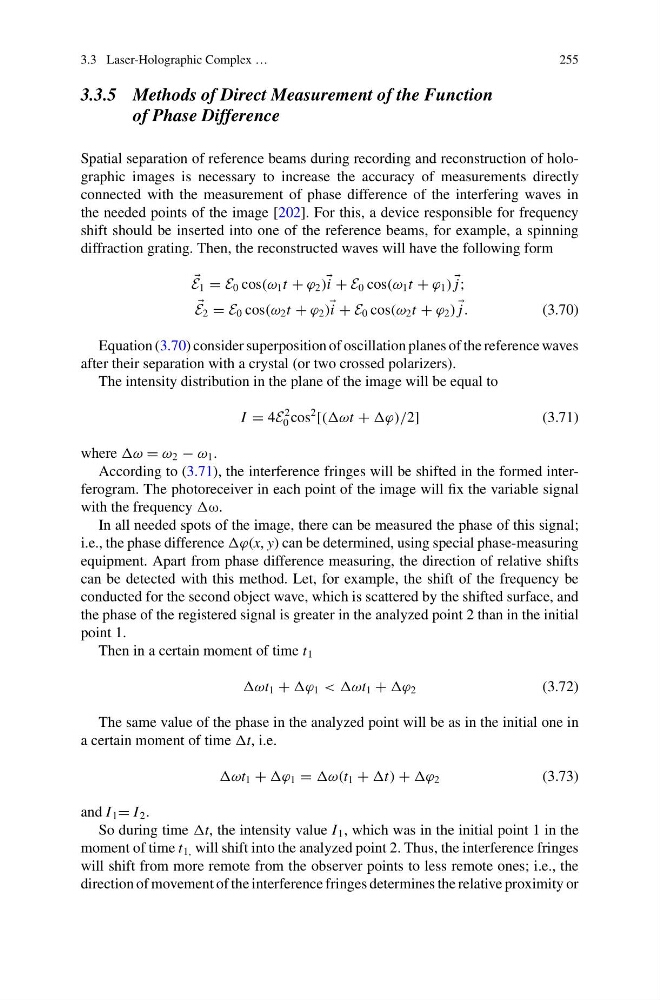
E 1 = E 0 cos(ω 1 t + ϕ 2 ) i + E 0 cos(ω 1 t + ϕ 1 ) j;
E 2 = E 0 cos(ω 2 t + ϕ 2 ) i + E 0 cos(ω 2 t + ϕ 2 ) j.
(3.70)
Equation (3.70) consider superposition of oscillation planes of the reference waves
after their separation with a crystal (or two crossed polarizers).
The intensity distribution in the plane of the image will be equal to
I = 4E
2
0 cos
2 [(ωt + ϕ)/2]
(3.71)
where ω = ω 2 − ω 1 .
According to (3.71), the interference fringes will be shifted in the formed interferogram. The photoreceiver in each point of the image will fix the variable signal
with the frequency ω.
In all needed spots of the image, there can be measured the phase of this signal;
i.e., the phase difference ϕ(x, y) can be determined, using special phase-measuring
equipment. Apart from phase difference measuring, the direction of relative shifts
can be detected with this method. Let, for example, the shift of the frequency be
conducted for the second object wave, which is scattered by the shifted surface, and
the phase of the registered signal is greater in the analyzed point 2 than in the initial
point 1.
Then in a certain moment of time t 1
ωt 1 + ϕ 1 < <ωt 1 + ϕ 2
(3.72)
The same value of the phase in the analyzed point will be as in the initial one in
a certain moment of time t, i.e.
ωt 1 + ϕ 1 = ω(t 1 + t) + ϕ 2
(3.73)
and I 1 = I 2 .
So during time t, the intensity value I 1 , which was in the initial point 1 in the
moment of time t 1, will shift into the analyzed point 2. Thus, the interference fringes
will shift from more remote from the observer points to less remote ones; i.e., the
direction of movement of the interference fringes determines the relative proximity or
255
3.3.5 Methods of Direct Measurement of the Function
of Phase Difference
Spatial separation of reference beams during recording and reconstruction of holographic images is necessary to increase the accuracy of measurements directly
connected with the measurement of phase difference of the interfering waves in
the needed points of the image [202]. For this, a device responsible for frequency
shift should be inserted into one of the reference beams, for example, a spinning
diffraction grating. Then, the reconstructed waves will have the following form
E 1 = E 0 cos(ω 1 t + ϕ 2 ) i + E 0 cos(ω 1 t + ϕ 1 ) j;
E 2 = E 0 cos(ω 2 t + ϕ 2 ) i + E 0 cos(ω 2 t + ϕ 2 ) j.
(3.70)
Equation (3.70) consider superposition of oscillation planes of the reference waves
after their separation with a crystal (or two crossed polarizers).
The intensity distribution in the plane of the image will be equal to
I = 4E
2
0 cos
2 [(ωt + ϕ)/2]
(3.71)
where ω = ω 2 − ω 1 .
According to (3.71), the interference fringes will be shifted in the formed interferogram. The photoreceiver in each point of the image will fix the variable signal
with the frequency ω.
In all needed spots of the image, there can be measured the phase of this signal;
i.e., the phase difference ϕ(x, y) can be determined, using special phase-measuring
equipment. Apart from phase difference measuring, the direction of relative shifts
can be detected with this method. Let, for example, the shift of the frequency be
conducted for the second object wave, which is scattered by the shifted surface, and
the phase of the registered signal is greater in the analyzed point 2 than in the initial
point 1.
Then in a certain moment of time t 1
ωt 1 + ϕ 1 < <ωt 1 + ϕ 2
(3.72)
The same value of the phase in the analyzed point will be as in the initial one in
a certain moment of time t, i.e.
ωt 1 + ϕ 1 = ω(t 1 + t) + ϕ 2
(3.73)
and I 1 = I 2 .
So during time t, the intensity value I 1 , which was in the initial point 1 in the
moment of time t 1, will shift into the analyzed point 2. Thus, the interference fringes
will shift from more remote from the observer points to less remote ones; i.e., the
direction of movement of the interference fringes determines the relative proximity or