

224
3 Holographic Interferometry for Studying …
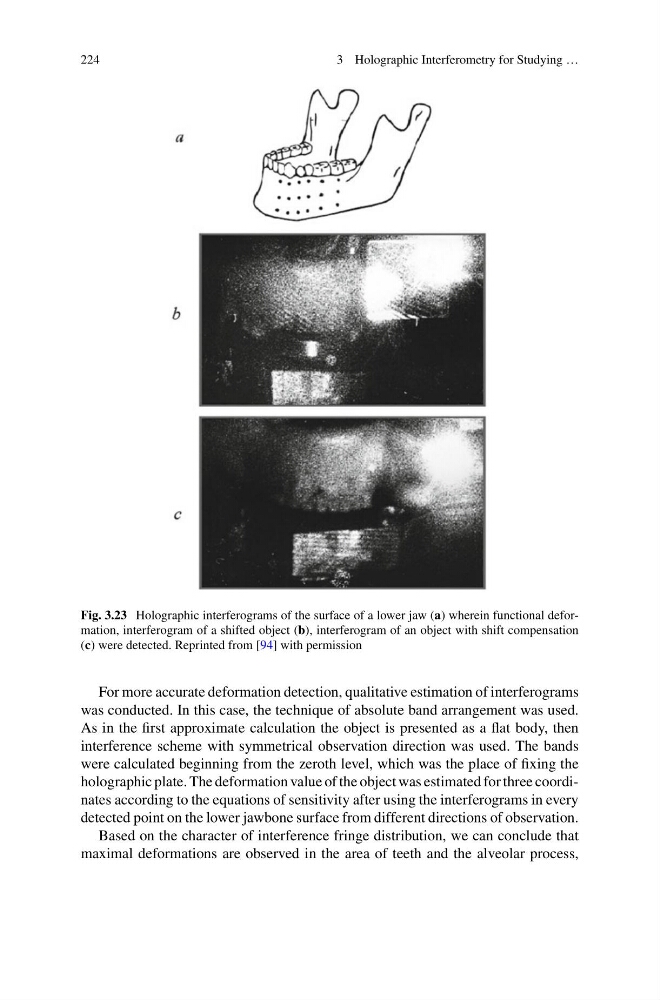
Fig. 3.23 Holographic interferograms of the surface of a lower jaw (a) wherein functional deformation, interferogram of a shifted object (b), interferogram of an object with shift compensation
(c) were detected. Reprinted from [94] with permission
For more accurate deformation detection, qualitative estimation of interferograms
was conducted. In this case, the technique of absolute band arrangement was used.
As in the first approximate calculation the object is presented as a flat body, then
interference scheme with symmetrical observation direction was used. The bands
were calculated beginning from the zeroth level, which was the place of fixing the
holographic plate. The deformation value of the object was estimated for three coordinates according to the equations of sensitivity after using the interferograms in every
detected point on the lower jawbone surface from different directions of observation.
Based on the character of interference fringe distribution, we can conclude that
maximal deformations are observed in the area of teeth and the alveolar process,
3 Holographic Interferometry for Studying …
Fig. 3.23 Holographic interferograms of the surface of a lower jaw (a) wherein functional deformation, interferogram of a shifted object (b), interferogram of an object with shift compensation
(c) were detected. Reprinted from [94] with permission
For more accurate deformation detection, qualitative estimation of interferograms
was conducted. In this case, the technique of absolute band arrangement was used.
As in the first approximate calculation the object is presented as a flat body, then
interference scheme with symmetrical observation direction was used. The bands
were calculated beginning from the zeroth level, which was the place of fixing the
holographic plate. The deformation value of the object was estimated for three coordinates according to the equations of sensitivity after using the interferograms in every
detected point on the lower jawbone surface from different directions of observation.
Based on the character of interference fringe distribution, we can conclude that
maximal deformations are observed in the area of teeth and the alveolar process,