

222
3 Holographic Interferometry for Studying …
I 1n = 2a
2
2 + 2 cos 4π z
n
λ
+ cos 8π z
n
λ
+ 2 cos 12π z
n
λ
+ cos 16π z
n
λ
.
(3.55)
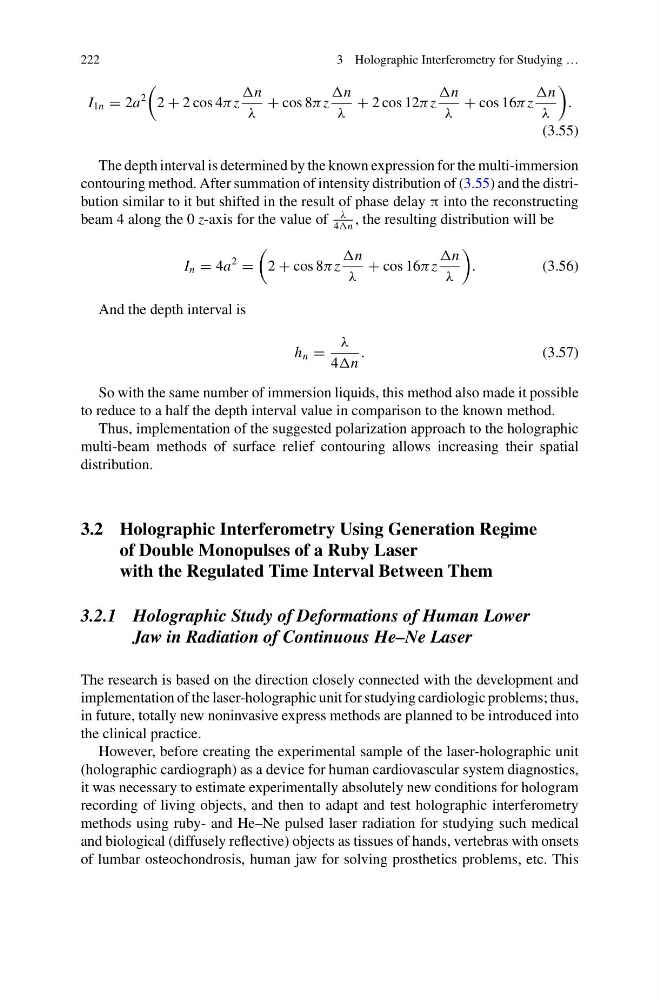
The depth interval is determined by the known expression for the multi-immersion
contouring method. After summation of intensity distribution of (3.55) and the distribution similar to it but shifted in the result of phase delay π into the reconstructing
beam 4 along the 0 z-axis for the value of
λ
4n
, the resulting distribution will be
I n = 4a
2
=
2 + cos 8π z
n
λ
+ cos 16π z
n
λ
.
(3.56)
And the depth interval is
h n =
λ
4n
.
(3.57)
So with the same number of immersion liquids, this method also made it possible
to reduce to a half the depth interval value in comparison to the known method.
Thus, implementation of the suggested polarization approach to the holographic
multi-beam methods of surface relief contouring allows increasing their spatial
distribution.
3.2 Holographic Interferometry Using Generation Regime
of Double Monopulses of a Ruby Laser
with the Regulated Time Interval Between Them
3.2.1 Holographic Study of Deformations of Human Lower
Jaw in Radiation of Continuous He–Ne Laser
The research is based on the direction closely connected with the development and
implementation of the laser-holographic unit for studying cardiologic problems; thus,
in future, totally new noninvasive express methods are planned to be introduced into
the clinical practice.
However, before creating the experimental sample of the laser-holographic unit
(holographic cardiograph) as a device for human cardiovascular system diagnostics,
it was necessary to estimate experimentally absolutely new conditions for hologram
recording of living objects, and then to adapt and test holographic interferometry
methods using ruby- and He–Ne pulsed laser radiation for studying such medical
and biological (diffusely reflective) objects as tissues of hands, vertebras with onsets
of lumbar osteochondrosis, human jaw for solving prosthetics problems, etc. This
3 Holographic Interferometry for Studying …
I 1n = 2a
2
2 + 2 cos 4π z
n
λ
+ cos 8π z
n
λ
+ 2 cos 12π z
n
λ
+ cos 16π z
n
λ
.
(3.55)
The depth interval is determined by the known expression for the multi-immersion
contouring method. After summation of intensity distribution of (3.55) and the distribution similar to it but shifted in the result of phase delay π into the reconstructing
beam 4 along the 0 z-axis for the value of
λ
4n
, the resulting distribution will be
I n = 4a
2
=
2 + cos 8π z
n
λ
+ cos 16π z
n
λ
.
(3.56)
And the depth interval is
h n =
λ
4n
.
(3.57)
So with the same number of immersion liquids, this method also made it possible
to reduce to a half the depth interval value in comparison to the known method.
Thus, implementation of the suggested polarization approach to the holographic
multi-beam methods of surface relief contouring allows increasing their spatial
distribution.
3.2 Holographic Interferometry Using Generation Regime
of Double Monopulses of a Ruby Laser
with the Regulated Time Interval Between Them
3.2.1 Holographic Study of Deformations of Human Lower
Jaw in Radiation of Continuous He–Ne Laser
The research is based on the direction closely connected with the development and
implementation of the laser-holographic unit for studying cardiologic problems; thus,
in future, totally new noninvasive express methods are planned to be introduced into
the clinical practice.
However, before creating the experimental sample of the laser-holographic unit
(holographic cardiograph) as a device for human cardiovascular system diagnostics,
it was necessary to estimate experimentally absolutely new conditions for hologram
recording of living objects, and then to adapt and test holographic interferometry
methods using ruby- and He–Ne pulsed laser radiation for studying such medical
and biological (diffusely reflective) objects as tissues of hands, vertebras with onsets
of lumbar osteochondrosis, human jaw for solving prosthetics problems, etc. This