

82
3 Coupling Model and Numerical Computation Method of Keyhole and Weld Pool
3.5 Numerical Method
3.5.1 Fast Solution of Laser Beam Energy Absorbed
by Keyhole Wall
3.5.1.1 Solution for Energy Absorption Based on Line Heat Source
If only the radial component of heat transfer in the weld pool is considered, according
to Fourier heat transfer law, the heat flow on the hole wall will be:
q v (r, φ) = −λ th ∇T ≈ −λ th
∂ T
∂r
(3.64)
Through the derivative of r on both sides of Eq. (3.6), we can obtain
∂ T
∂r
=
P
(r, φ)
2πλ th
P
e
−K 0 (P
e r ) cos ϕ + K 0 (P
e r )
e
−(P
e r ) cos ϕ
(3.65)
In which
K
0 (x) = −K 1 (x)
(3.66)
In the equation: K 1 (x)—modified second class first order Bessel function.
If only the radial component of heat transfer is considered, the computational
formula for the heat flow on keyhole wall can be expressed as:
q v (r, φ) = −λ th
∂ T
∂r
=
P
(r, φ)
2π
P
e
K 0 (P
e r ) cos ϕ + K 1 (P
e r )
e
−(P
e r ) cos ϕ (3.67)
By substituting the heat source intensity P
(r, ϕ) for each point on the inner wall
of the keyhole into the formula above, we can obtain:
q v (r, φ) = (T v − T a )λ th P
e
cos ϕ +
K 1 (P
e r )
K 0 (P
e r )
(3.68)
where:
K 1
modified second class first order Bessel function;
q v
the (radial) heat flow on keyhole wall, W m
−2 s
−1 ;
T v
evaporating temperature of metal, K.
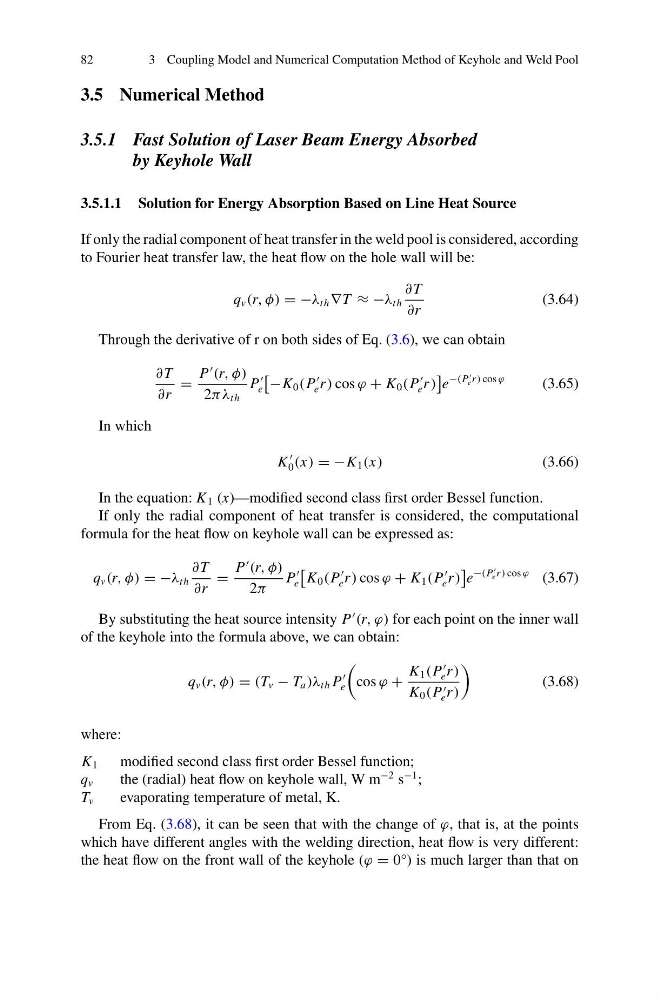
From Eq. (3.68), it can be seen that with the change of ϕ, that is, at the points
which have different angles with the welding direction, heat flow is very different:
the heat flow on the front wall of the keyhole (ϕ = 0°) is much larger than that on
3 Coupling Model and Numerical Computation Method of Keyhole and Weld Pool
3.5 Numerical Method
3.5.1 Fast Solution of Laser Beam Energy Absorbed
by Keyhole Wall
3.5.1.1 Solution for Energy Absorption Based on Line Heat Source
If only the radial component of heat transfer in the weld pool is considered, according
to Fourier heat transfer law, the heat flow on the hole wall will be:
q v (r, φ) = −λ th ∇T ≈ −λ th
∂ T
∂r
(3.64)
Through the derivative of r on both sides of Eq. (3.6), we can obtain
∂ T
∂r
=
P
(r, φ)
2πλ th
P
e
−K 0 (P
e r ) cos ϕ + K 0 (P
e r )
e
−(P
e r ) cos ϕ
(3.65)
In which
K
0 (x) = −K 1 (x)
(3.66)
In the equation: K 1 (x)—modified second class first order Bessel function.
If only the radial component of heat transfer is considered, the computational
formula for the heat flow on keyhole wall can be expressed as:
q v (r, φ) = −λ th
∂ T
∂r
=
P
(r, φ)
2π
P
e
K 0 (P
e r ) cos ϕ + K 1 (P
e r )
e
−(P
e r ) cos ϕ (3.67)
By substituting the heat source intensity P
(r, ϕ) for each point on the inner wall
of the keyhole into the formula above, we can obtain:
q v (r, φ) = (T v − T a )λ th P
e
cos ϕ +
K 1 (P
e r )
K 0 (P
e r )
(3.68)
where:
K 1
modified second class first order Bessel function;
q v
the (radial) heat flow on keyhole wall, W m
−2 s
−1 ;
T v
evaporating temperature of metal, K.
From Eq. (3.68), it can be seen that with the change of ϕ, that is, at the points
which have different angles with the welding direction, heat flow is very different:
the heat flow on the front wall of the keyhole (ϕ = 0°) is much larger than that on