

72
3 Coupling Model and Numerical Computation Method of Keyhole and Weld Pool
Large numerical dissipation is the biggest problem of the Level Set method in
tracking the free surface, meaning that it will cause serious surface quality loss. The
numerical dissipation problem can be addressed by the Particle Level Set method. Its
principles are as follows. Some virtual particles are arranged artificially on both sides
of the surface described by the Level Set to make the particles move passively with
the fluid. The position information of the particles is used to correct the numerical
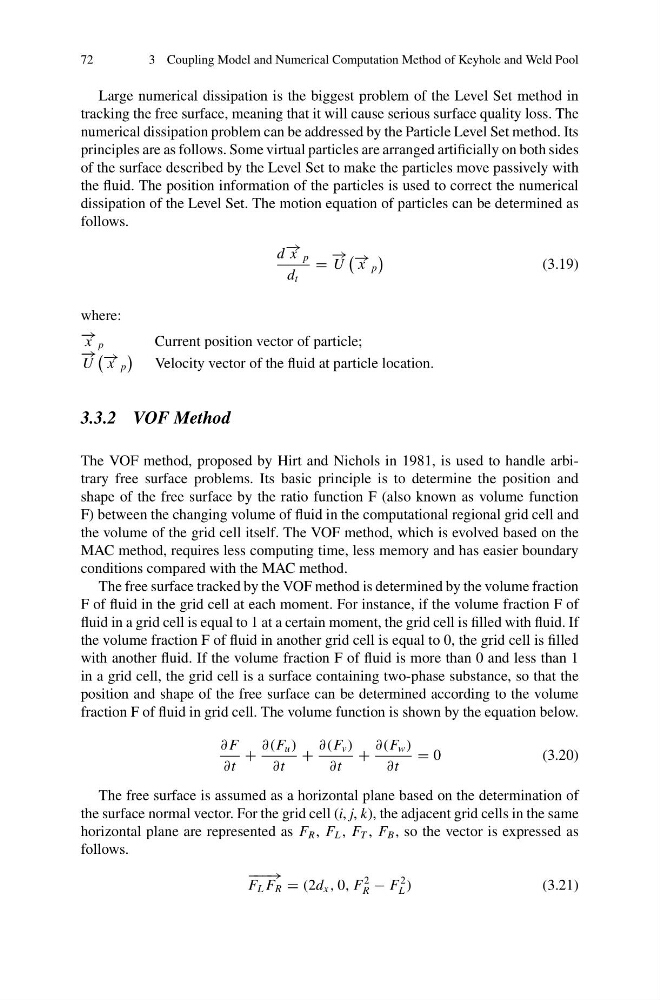
dissipation of the Level Set. The motion equation of particles can be determined as
follows.
d − → x p
d t
=
− →
U
− → x p
(3.19)
where:
− → x p
Current position vector of particle;
− →
U
− → x p
Velocity vector of the fluid at particle location.
3.3.2 VOF Method
The VOF method, proposed by Hirt and Nichols in 1981, is used to handle arbitrary free surface problems. Its basic principle is to determine the position and
shape of the free surface by the ratio function F (also known as volume function
F) between the changing volume of fluid in the computational regional grid cell and
the volume of the grid cell itself. The VOF method, which is evolved based on the
MAC method, requires less computing time, less memory and has easier boundary
conditions compared with the MAC method.
The free surface tracked by the VOF method is determined by the volume fraction
F of fluid in the grid cell at each moment. For instance, if the volume fraction F of
fluid in a grid cell is equal to 1 at a certain moment, the grid cell is filled with fluid. If
the volume fraction F of fluid in another grid cell is equal to 0, the grid cell is filled
with another fluid. If the volume fraction F of fluid is more than 0 and less than 1
in a grid cell, the grid cell is a surface containing two-phase substance, so that the
position and shape of the free surface can be determined according to the volume
fraction F of fluid in grid cell. The volume function is shown by the equation below.
∂ F
∂t
+
∂(F u )
∂t
+
∂(F v )
∂t
+
∂(F w )
∂t
= 0
(3.20)
The free surface is assumed as a horizontal plane based on the determination of
the surface normal vector. For the grid cell (i, j, k), the adjacent grid cells in the same
horizontal plane are represented as F R , F L , F T , F B , so the vector is expressed as
follows.
− −− →
F L F R = (2d x , 0, F
2
R − F
2
L )
(3.21)
3 Coupling Model and Numerical Computation Method of Keyhole and Weld Pool
Large numerical dissipation is the biggest problem of the Level Set method in
tracking the free surface, meaning that it will cause serious surface quality loss. The
numerical dissipation problem can be addressed by the Particle Level Set method. Its
principles are as follows. Some virtual particles are arranged artificially on both sides
of the surface described by the Level Set to make the particles move passively with
the fluid. The position information of the particles is used to correct the numerical
dissipation of the Level Set. The motion equation of particles can be determined as
follows.
d − → x p
d t
=
− →
U
− → x p
(3.19)
where:
− → x p
Current position vector of particle;
− →
U
− → x p
Velocity vector of the fluid at particle location.
3.3.2 VOF Method
The VOF method, proposed by Hirt and Nichols in 1981, is used to handle arbitrary free surface problems. Its basic principle is to determine the position and
shape of the free surface by the ratio function F (also known as volume function
F) between the changing volume of fluid in the computational regional grid cell and
the volume of the grid cell itself. The VOF method, which is evolved based on the
MAC method, requires less computing time, less memory and has easier boundary
conditions compared with the MAC method.
The free surface tracked by the VOF method is determined by the volume fraction
F of fluid in the grid cell at each moment. For instance, if the volume fraction F of
fluid in a grid cell is equal to 1 at a certain moment, the grid cell is filled with fluid. If
the volume fraction F of fluid in another grid cell is equal to 0, the grid cell is filled
with another fluid. If the volume fraction F of fluid is more than 0 and less than 1
in a grid cell, the grid cell is a surface containing two-phase substance, so that the
position and shape of the free surface can be determined according to the volume
fraction F of fluid in grid cell. The volume function is shown by the equation below.
∂ F
∂t
+
∂(F u )
∂t
+
∂(F v )
∂t
+
∂(F w )
∂t
= 0
(3.20)
The free surface is assumed as a horizontal plane based on the determination of
the surface normal vector. For the grid cell (i, j, k), the adjacent grid cells in the same
horizontal plane are represented as F R , F L , F T , F B , so the vector is expressed as
follows.
− −− →
F L F R = (2d x , 0, F
2
R − F
2
L )
(3.21)