

3.2 Governing Equations of Coupled Model
69
r 0 Radius of heat source, m.
Pe
is proportional to the velocity v under given diffusion coefficient and radius of
heat source. The temperature of any point in the weld pool (including any point on the
inner wall of the keyhole) can be expressed by T (r, φ) theoretically. The temperature
of the keyhole inner wall is assumed as the metal evaporation temperature T v ; If the
left side (3.6) of equation is equal to T v , the heat source intensity P
at each point
on the inner wall of the keyhole can be expressed as follows.
P
(r, ϕ) = (T v − T ∂ )
2πλ th
K 0
P
e r
e
P
e r cos ϕ
(3.9)
3.2.2.2 Heat Source Model Based on Fresnel Absorption
The approximate distribution of laser energy density is assumed to be a Gaussian distribution, and then the distribution function equation of laser energy can
be expressed as follows.
I 0 (r, z) = 3Q/
π R
2
exp
−3
r
2
/R
2
(3.10)
where:
R Light spot radius;
Q Laser power density.
In addition, let’s assume that the laser energy is not attenuated along the depth
direction. As the laser head moves, the Gaussian heat source must move with it, so
as to consider the effect of welding velocity.
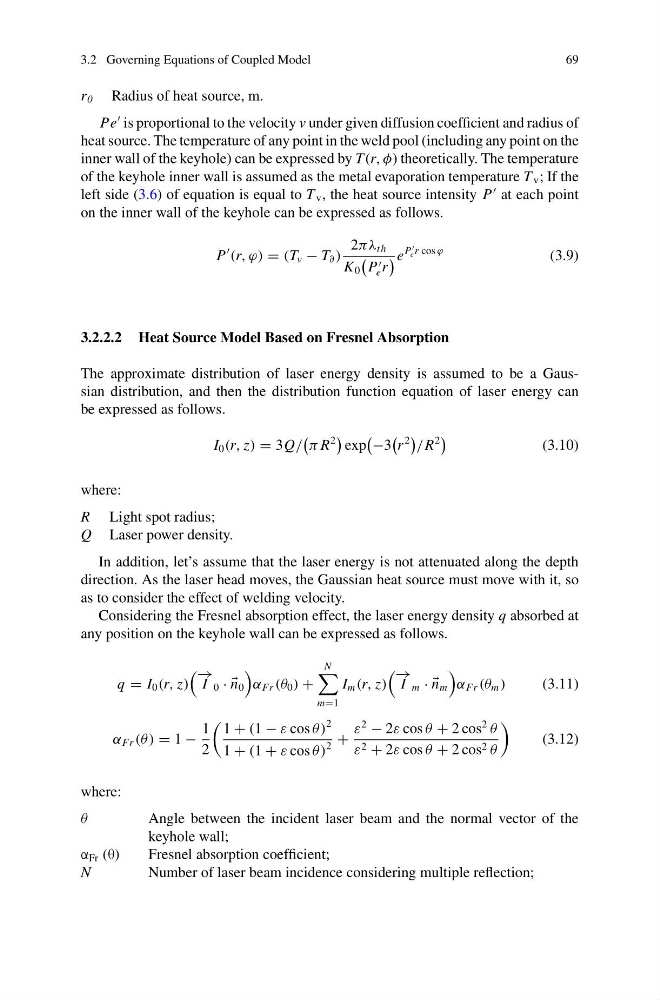
Considering the Fresnel absorption effect, the laser energy density q absorbed at
any position on the keyhole wall can be expressed as follows.
q = I 0 (r, z)
− →
I 0 · ·
n 0
α Fr (θ 0 ) +
N
m=1
I m (r, z)
− →
I m · ·
n m
α Fr (θ m )
(3.11)
α Fr (θ ) = 1 −
1
2
1 + (1 − ε cos θ)
2
1 + (1 + ε cos θ)
2
+
ε
2
− 2ε cos θ + 2 cos
2
θ
ε 2 + 2ε cos θ + 2 cos 2 θ
(3.12)
where:
θ
Angle between the incident laser beam and the normal vector of the
keyhole wall;
α Fr (θ)
Fresnel absorption coefficient;
N
Number of laser beam incidence considering multiple reflection;
69
r 0 Radius of heat source, m.
Pe
is proportional to the velocity v under given diffusion coefficient and radius of
heat source. The temperature of any point in the weld pool (including any point on the
inner wall of the keyhole) can be expressed by T (r, φ) theoretically. The temperature
of the keyhole inner wall is assumed as the metal evaporation temperature T v ; If the
left side (3.6) of equation is equal to T v , the heat source intensity P
at each point
on the inner wall of the keyhole can be expressed as follows.
P
(r, ϕ) = (T v − T ∂ )
2πλ th
K 0
P
e r
e
P
e r cos ϕ
(3.9)
3.2.2.2 Heat Source Model Based on Fresnel Absorption
The approximate distribution of laser energy density is assumed to be a Gaussian distribution, and then the distribution function equation of laser energy can
be expressed as follows.
I 0 (r, z) = 3Q/
π R
2
exp
−3
r
2
/R
2
(3.10)
where:
R Light spot radius;
Q Laser power density.
In addition, let’s assume that the laser energy is not attenuated along the depth
direction. As the laser head moves, the Gaussian heat source must move with it, so
as to consider the effect of welding velocity.
Considering the Fresnel absorption effect, the laser energy density q absorbed at
any position on the keyhole wall can be expressed as follows.
q = I 0 (r, z)
− →
I 0 · ·
n 0
α Fr (θ 0 ) +
N
m=1
I m (r, z)
− →
I m · ·
n m
α Fr (θ m )
(3.11)
α Fr (θ ) = 1 −
1
2
1 + (1 − ε cos θ)
2
1 + (1 + ε cos θ)
2
+
ε
2
− 2ε cos θ + 2 cos
2
θ
ε 2 + 2ε cos θ + 2 cos 2 θ
(3.12)
where:
θ
Angle between the incident laser beam and the normal vector of the
keyhole wall;
α Fr (θ)
Fresnel absorption coefficient;
N
Number of laser beam incidence considering multiple reflection;