

68
3 Coupling Model and Numerical Computation Method of Keyhole and Weld Pool
3.2.2 Heat Source Model
During the deep penetration welding process, the laser beam is irradiated onto the
surface of workpiece to lead to rapid melting and evaporation, thus forming keyhole
in the weld pool. For this reason, the heat source based on the change of the keyhole
morphology fits more the physical facts in the laser welding simulation calculation.
Earlier, Kaplan et al. proposed a linear heat source model based on the analytical
keyhole model in the 1990s. With the practice of keyhole surface real-time tracking
and the breakthrough of ray tracing technology in laser welding heat source application, the multiple Fresnel absorption heat source based on keyhole free surface has
been greatly concerned and widely applied in simulation applications, especially in
numerical simulation for accurate calculation of keyhole and weld pool dynamics.
3.2.2.1 Linear Heat Source Model
Kaplan proposed a calculation model for the keyhole shape of deep penetration laser
welding based on the idea of point-by-point energy balance of keyhole wall. Since
the laser welding heat source is assumed as a fast moving linear heat source, the
model is suitable for laser rapid welding and sheet welding. Since the laser heat
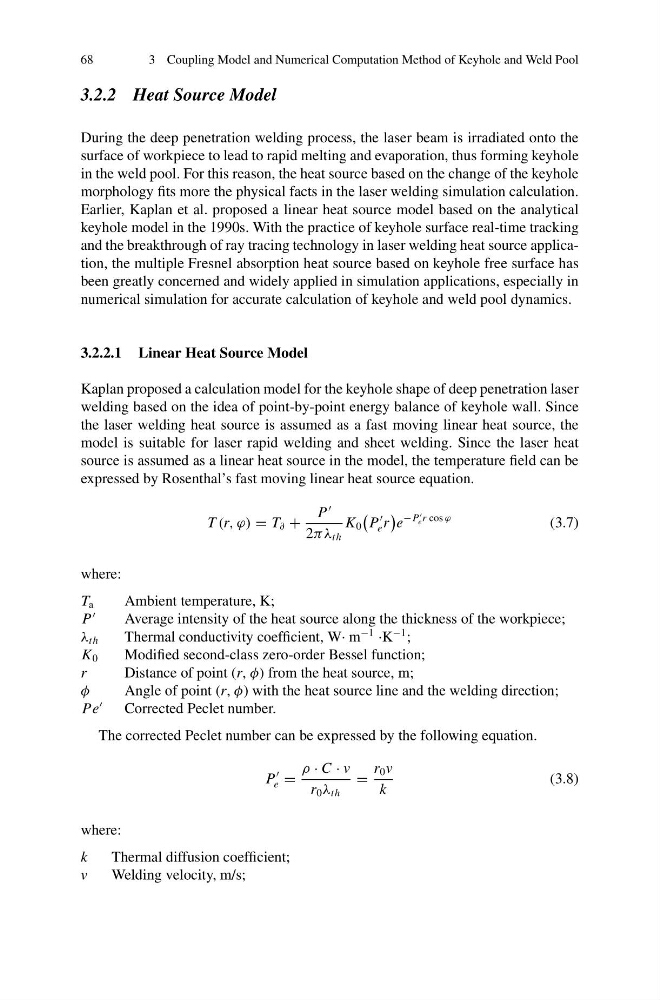
source is assumed as a linear heat source in the model, the temperature field can be
expressed by Rosenthal’s fast moving linear heat source equation.
T (r, ϕ) = T ∂ +
P
2πλ th
K 0
P
e r
e
−P
e r cos ϕ
(3.7)
where:
T a
Ambient temperature, K;
P
Average intensity of the heat source along the thickness of the workpiece;
λ th
Thermal conductivity coefficient, W· m
−1 ·K
−1 ;
K 0
Modified second-class zero-order Bessel function;
r
Distance of point (r, φ) from the heat source, m;
φ
Angle of point (r, φ) with the heat source line and the welding direction;
Pe
Corrected Peclet number.
The corrected Peclet number can be expressed by the following equation.
P
e =
ρ · C · v
r 0 λ th
=
r 0 v
k
(3.8)
where:
k
Thermal diffusion coefficient;
v
Welding velocity, m/s;
3 Coupling Model and Numerical Computation Method of Keyhole and Weld Pool
3.2.2 Heat Source Model
During the deep penetration welding process, the laser beam is irradiated onto the
surface of workpiece to lead to rapid melting and evaporation, thus forming keyhole
in the weld pool. For this reason, the heat source based on the change of the keyhole
morphology fits more the physical facts in the laser welding simulation calculation.
Earlier, Kaplan et al. proposed a linear heat source model based on the analytical
keyhole model in the 1990s. With the practice of keyhole surface real-time tracking
and the breakthrough of ray tracing technology in laser welding heat source application, the multiple Fresnel absorption heat source based on keyhole free surface has
been greatly concerned and widely applied in simulation applications, especially in
numerical simulation for accurate calculation of keyhole and weld pool dynamics.
3.2.2.1 Linear Heat Source Model
Kaplan proposed a calculation model for the keyhole shape of deep penetration laser
welding based on the idea of point-by-point energy balance of keyhole wall. Since
the laser welding heat source is assumed as a fast moving linear heat source, the
model is suitable for laser rapid welding and sheet welding. Since the laser heat
source is assumed as a linear heat source in the model, the temperature field can be
expressed by Rosenthal’s fast moving linear heat source equation.
T (r, ϕ) = T ∂ +
P
2πλ th
K 0
P
e r
e
−P
e r cos ϕ
(3.7)
where:
T a
Ambient temperature, K;
P
Average intensity of the heat source along the thickness of the workpiece;
λ th
Thermal conductivity coefficient, W· m
−1 ·K
−1 ;
K 0
Modified second-class zero-order Bessel function;
r
Distance of point (r, φ) from the heat source, m;
φ
Angle of point (r, φ) with the heat source line and the welding direction;
Pe
Corrected Peclet number.
The corrected Peclet number can be expressed by the following equation.
P
e =
ρ · C · v
r 0 λ th
=
r 0 v
k
(3.8)
where:
k
Thermal diffusion coefficient;
v
Welding velocity, m/s;