

62
2 Model of Quasi-Steady Weld Pool Dynamics and Numerical Simulation
Width/mm
Thickness/mm
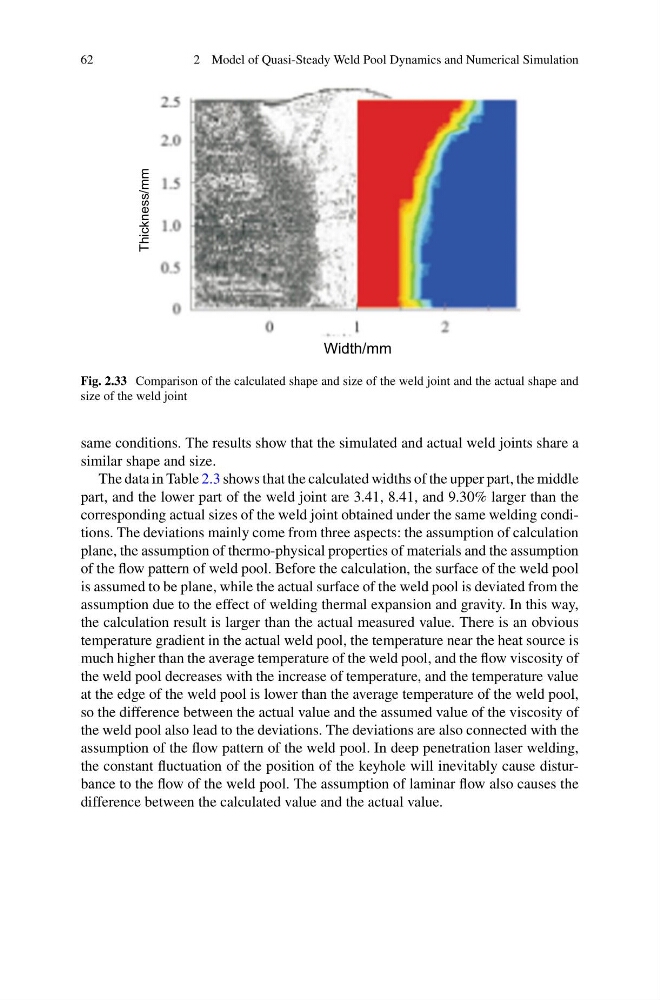
Fig. 2.33 Comparison of the calculated shape and size of the weld joint and the actual shape and
size of the weld joint
same conditions. The results show that the simulated and actual weld joints share a
similar shape and size.
The data in Table 2.3 shows that the calculated widths of the upper part, the middle
part, and the lower part of the weld joint are 3.41, 8.41, and 9.30% larger than the
corresponding actual sizes of the weld joint obtained under the same welding conditions. The deviations mainly come from three aspects: the assumption of calculation
plane, the assumption of thermo-physical properties of materials and the assumption
of the flow pattern of weld pool. Before the calculation, the surface of the weld pool
is assumed to be plane, while the actual surface of the weld pool is deviated from the
assumption due to the effect of welding thermal expansion and gravity. In this way,
the calculation result is larger than the actual measured value. There is an obvious
temperature gradient in the actual weld pool, the temperature near the heat source is
much higher than the average temperature of the weld pool, and the flow viscosity of
the weld pool decreases with the increase of temperature, and the temperature value
at the edge of the weld pool is lower than the average temperature of the weld pool,
so the difference between the actual value and the assumed value of the viscosity of
the weld pool also lead to the deviations. The deviations are also connected with the
assumption of the flow pattern of the weld pool. In deep penetration laser welding,
the constant fluctuation of the position of the keyhole will inevitably cause disturbance to the flow of the weld pool. The assumption of laminar flow also causes the
difference between the calculated value and the actual value.
2 Model of Quasi-Steady Weld Pool Dynamics and Numerical Simulation
Width/mm
Thickness/mm
Fig. 2.33 Comparison of the calculated shape and size of the weld joint and the actual shape and
size of the weld joint
same conditions. The results show that the simulated and actual weld joints share a
similar shape and size.
The data in Table 2.3 shows that the calculated widths of the upper part, the middle
part, and the lower part of the weld joint are 3.41, 8.41, and 9.30% larger than the
corresponding actual sizes of the weld joint obtained under the same welding conditions. The deviations mainly come from three aspects: the assumption of calculation
plane, the assumption of thermo-physical properties of materials and the assumption
of the flow pattern of weld pool. Before the calculation, the surface of the weld pool
is assumed to be plane, while the actual surface of the weld pool is deviated from the
assumption due to the effect of welding thermal expansion and gravity. In this way,
the calculation result is larger than the actual measured value. There is an obvious
temperature gradient in the actual weld pool, the temperature near the heat source is
much higher than the average temperature of the weld pool, and the flow viscosity of
the weld pool decreases with the increase of temperature, and the temperature value
at the edge of the weld pool is lower than the average temperature of the weld pool,
so the difference between the actual value and the assumed value of the viscosity of
the weld pool also lead to the deviations. The deviations are also connected with the
assumption of the flow pattern of the weld pool. In deep penetration laser welding,
the constant fluctuation of the position of the keyhole will inevitably cause disturbance to the flow of the weld pool. The assumption of laminar flow also causes the
difference between the calculated value and the actual value.