

44
2 Model of Quasi-Steady Weld Pool Dynamics and Numerical Simulation
It can be seen that in the front of the keyhole, the temperature changes greatly
within a small distance, and the temperature gradient is greater at the position below
2/3 of the plate thickness. We note that the temperature gradient at the front of the
keyhole is about 8334.7 K/mm on the lower surface of the workpiece. This temperature gradient is much larger than the temperature gradient on the upper surface of
the workpiece. In contrast, the temperature gradient at the back of the keyhole is
significantly lower than that at the front of the keyhole. The weld pool appears like
an inverted horseshoe, which is closely related to the heat transfer mechanism in the
laser welding.
In order to discuss the relationship between keyhole geometric parameters and
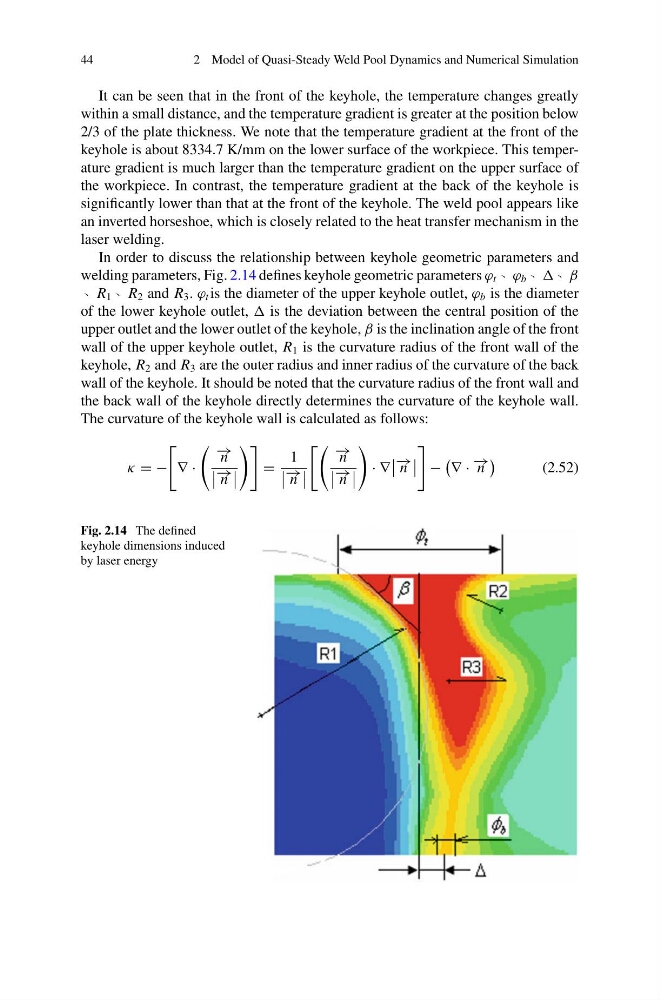
welding parameters, Fig. 2.14 defines keyhole geometric parameters ϕ t 、ϕ b 、、β
、R 1 、R 2 and R 3 . ϕ t is the diameter of the upper keyhole outlet, ϕ b is the diameter
of the lower keyhole outlet, is the deviation between the central position of the
upper outlet and the lower outlet of the keyhole, β is the inclination angle of the front
wall of the upper keyhole outlet, R 1 is the curvature radius of the front wall of the
keyhole, R 2 and R 3 are the outer radius and inner radius of the curvature of the back
wall of the keyhole. It should be noted that the curvature radius of the front wall and
the back wall of the keyhole directly determines the curvature of the keyhole wall.
The curvature of the keyhole wall is calculated as follows:
κ = −
∇ ·
− → n
− → n
=
1
− → n
− → n
− → n
· ∇
− → n
−
∇ · − → n
(2.52)
Fig. 2.14 The defined
keyhole dimensions induced
by laser energy
2 Model of Quasi-Steady Weld Pool Dynamics and Numerical Simulation
It can be seen that in the front of the keyhole, the temperature changes greatly
within a small distance, and the temperature gradient is greater at the position below
2/3 of the plate thickness. We note that the temperature gradient at the front of the
keyhole is about 8334.7 K/mm on the lower surface of the workpiece. This temperature gradient is much larger than the temperature gradient on the upper surface of
the workpiece. In contrast, the temperature gradient at the back of the keyhole is
significantly lower than that at the front of the keyhole. The weld pool appears like
an inverted horseshoe, which is closely related to the heat transfer mechanism in the
laser welding.
In order to discuss the relationship between keyhole geometric parameters and
welding parameters, Fig. 2.14 defines keyhole geometric parameters ϕ t 、ϕ b 、、β
、R 1 、R 2 and R 3 . ϕ t is the diameter of the upper keyhole outlet, ϕ b is the diameter
of the lower keyhole outlet, is the deviation between the central position of the
upper outlet and the lower outlet of the keyhole, β is the inclination angle of the front
wall of the upper keyhole outlet, R 1 is the curvature radius of the front wall of the
keyhole, R 2 and R 3 are the outer radius and inner radius of the curvature of the back
wall of the keyhole. It should be noted that the curvature radius of the front wall and
the back wall of the keyhole directly determines the curvature of the keyhole wall.
The curvature of the keyhole wall is calculated as follows:
κ = −
∇ ·
− → n
− → n
=
1
− → n
− → n
− → n
· ∇
− → n
−
∇ · − → n
(2.52)
Fig. 2.14 The defined
keyhole dimensions induced
by laser energy