

26
2 Model of Quasi-Steady Weld Pool Dynamics and Numerical Simulation
In the symmetry plane:
∂u
∂ y
=
∂w
∂ y
= 0, v = 0,
∂ T
∂ y
= 0
(2.22)
2.2.3 Heat Source Model in Deep Penetration Laser Welding
The Gauss heat source model is suitable for most finite element simulations that do not
combine the convective heat transfer of weld pool with pore simulation organically.
In these simulations, however, the model describes surface heat source and body heat
source quite differently. Surface heat source only acts on the surface element of the
workpiece, while body heat source is applied to some elements inside the workpiece.
Considering the gradual attenuation of laser beam energy in the direction of plate
thickness during deep penetration laser welding, Wu Su et al. [27] of Tsinghua
University proposed a Gauss rotating heat source model:
q rotar y (x, y, z) = q(0, 0)exp
−3c s
log10
h
z
x
2
+ y
2
(2.23)
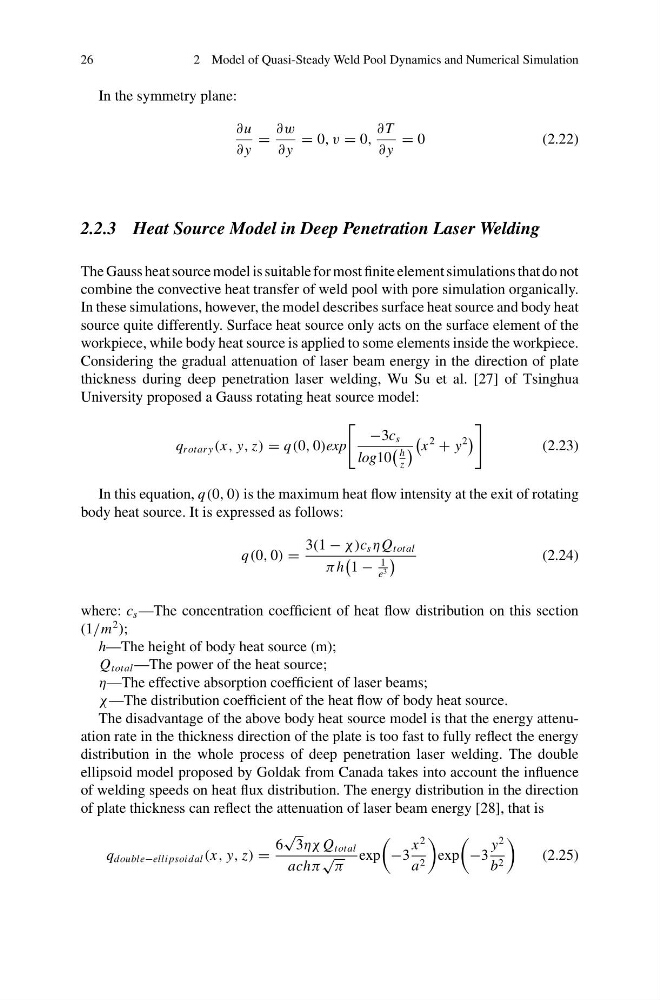
In this equation, q(0, 0) is the maximum heat flow intensity at the exit of rotating
body heat source. It is expressed as follows:
q(0, 0) =
3(1 − χ )c s ηQ total
π h
1 −
1
e 3
(2.24)
where: c s —The concentration coefficient of heat flow distribution on this section
(1/m
2 );
h—The height of body heat source (m);
Q total —The power of the heat source;
η—The effective absorption coefficient of laser beams;
χ —The distribution coefficient of the heat flow of body heat source.
The disadvantage of the above body heat source model is that the energy attenuation rate in the thickness direction of the plate is too fast to fully reflect the energy
distribution in the whole process of deep penetration laser welding. The double
ellipsoid model proposed by Goldak from Canada takes into account the influence
of welding speeds on heat flux distribution. The energy distribution in the direction
of plate thickness can reflect the attenuation of laser beam energy [28], that is
q double−elli psoidal (x, y, z) =
6
√
3ηχ Q total
achπ
√ π
exp
−3
x
2
a 2
exp
−3
y
2
b 2
(2.25)
2 Model of Quasi-Steady Weld Pool Dynamics and Numerical Simulation
In the symmetry plane:
∂u
∂ y
=
∂w
∂ y
= 0, v = 0,
∂ T
∂ y
= 0
(2.22)
2.2.3 Heat Source Model in Deep Penetration Laser Welding
The Gauss heat source model is suitable for most finite element simulations that do not
combine the convective heat transfer of weld pool with pore simulation organically.
In these simulations, however, the model describes surface heat source and body heat
source quite differently. Surface heat source only acts on the surface element of the
workpiece, while body heat source is applied to some elements inside the workpiece.
Considering the gradual attenuation of laser beam energy in the direction of plate
thickness during deep penetration laser welding, Wu Su et al. [27] of Tsinghua
University proposed a Gauss rotating heat source model:
q rotar y (x, y, z) = q(0, 0)exp
−3c s
log10
h
z
x
2
+ y
2
(2.23)
In this equation, q(0, 0) is the maximum heat flow intensity at the exit of rotating
body heat source. It is expressed as follows:
q(0, 0) =
3(1 − χ )c s ηQ total
π h
1 −
1
e 3
(2.24)
where: c s —The concentration coefficient of heat flow distribution on this section
(1/m
2 );
h—The height of body heat source (m);
Q total —The power of the heat source;
η—The effective absorption coefficient of laser beams;
χ —The distribution coefficient of the heat flow of body heat source.
The disadvantage of the above body heat source model is that the energy attenuation rate in the thickness direction of the plate is too fast to fully reflect the energy
distribution in the whole process of deep penetration laser welding. The double
ellipsoid model proposed by Goldak from Canada takes into account the influence
of welding speeds on heat flux distribution. The energy distribution in the direction
of plate thickness can reflect the attenuation of laser beam energy [28], that is
q double−elli psoidal (x, y, z) =
6
√
3ηχ Q total
achπ
√ π
exp
−3
x
2
a 2
exp
−3
y
2
b 2
(2.25)