

8.5 Dynamic Dilution Behavior of Moving Weld Pools …
239
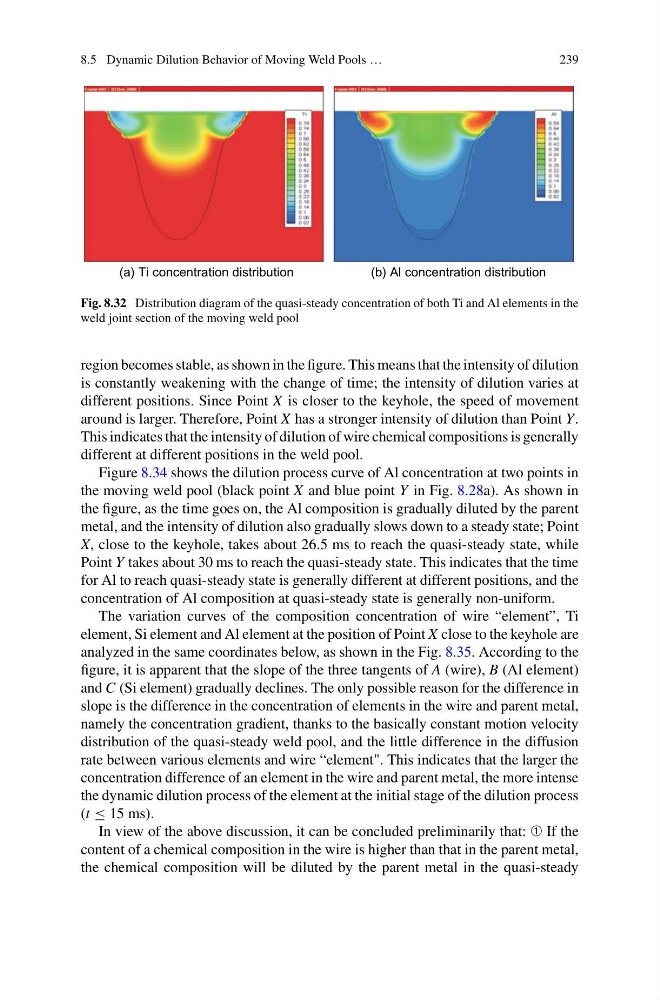
(a) Ti concentration distribution
(b) Al concentration distribution
Fig. 8.32 Distribution diagram of the quasi-steady concentration of both Ti and Al elements in the
weld joint section of the moving weld pool
region becomes stable, as shown in the figure. This means that the intensity of dilution
is constantly weakening with the change of time; the intensity of dilution varies at
different positions. Since Point X is closer to the keyhole, the speed of movement
around is larger. Therefore, Point X has a stronger intensity of dilution than Point Y.
This indicates that the intensity of dilution of wire chemical compositions is generally
different at different positions in the weld pool.
Figure 8.34 shows the dilution process curve of Al concentration at two points in
the moving weld pool (black point X and blue point Y in Fig. 8.28a). As shown in
the figure, as the time goes on, the Al composition is gradually diluted by the parent
metal, and the intensity of dilution also gradually slows down to a steady state; Point
X, close to the keyhole, takes about 26.5 ms to reach the quasi-steady state, while
Point Y takes about 30 ms to reach the quasi-steady state. This indicates that the time
for Al to reach quasi-steady state is generally different at different positions, and the
concentration of Al composition at quasi-steady state is generally non-uniform.
The variation curves of the composition concentration of wire “element”, Ti
element, Si element and Al element at the position of Point X close to the keyhole are
analyzed in the same coordinates below, as shown in the Fig. 8.35. According to the
figure, it is apparent that the slope of the three tangents of A (wire), B (Al element)
and C (Si element) gradually declines. The only possible reason for the difference in
slope is the difference in the concentration of elements in the wire and parent metal,
namely the concentration gradient, thanks to the basically constant motion velocity
distribution of the quasi-steady weld pool, and the little difference in the diffusion
rate between various elements and wire “element". This indicates that the larger the
concentration difference of an element in the wire and parent metal, the more intense
the dynamic dilution process of the element at the initial stage of the dilution process
(t ≤ 15 ms).
In view of the above discussion, it can be concluded preliminarily that: ➀ If the
content of a chemical composition in the wire is higher than that in the parent metal,
the chemical composition will be diluted by the parent metal in the quasi-steady
239
(a) Ti concentration distribution
(b) Al concentration distribution
Fig. 8.32 Distribution diagram of the quasi-steady concentration of both Ti and Al elements in the
weld joint section of the moving weld pool
region becomes stable, as shown in the figure. This means that the intensity of dilution
is constantly weakening with the change of time; the intensity of dilution varies at
different positions. Since Point X is closer to the keyhole, the speed of movement
around is larger. Therefore, Point X has a stronger intensity of dilution than Point Y.
This indicates that the intensity of dilution of wire chemical compositions is generally
different at different positions in the weld pool.
Figure 8.34 shows the dilution process curve of Al concentration at two points in
the moving weld pool (black point X and blue point Y in Fig. 8.28a). As shown in
the figure, as the time goes on, the Al composition is gradually diluted by the parent
metal, and the intensity of dilution also gradually slows down to a steady state; Point
X, close to the keyhole, takes about 26.5 ms to reach the quasi-steady state, while
Point Y takes about 30 ms to reach the quasi-steady state. This indicates that the time
for Al to reach quasi-steady state is generally different at different positions, and the
concentration of Al composition at quasi-steady state is generally non-uniform.
The variation curves of the composition concentration of wire “element”, Ti
element, Si element and Al element at the position of Point X close to the keyhole are
analyzed in the same coordinates below, as shown in the Fig. 8.35. According to the
figure, it is apparent that the slope of the three tangents of A (wire), B (Al element)
and C (Si element) gradually declines. The only possible reason for the difference in
slope is the difference in the concentration of elements in the wire and parent metal,
namely the concentration gradient, thanks to the basically constant motion velocity
distribution of the quasi-steady weld pool, and the little difference in the diffusion
rate between various elements and wire “element". This indicates that the larger the
concentration difference of an element in the wire and parent metal, the more intense
the dynamic dilution process of the element at the initial stage of the dilution process
(t ≤ 15 ms).
In view of the above discussion, it can be concluded preliminarily that: ➀ If the
content of a chemical composition in the wire is higher than that in the parent metal,
the chemical composition will be diluted by the parent metal in the quasi-steady